
The Forgotten LS1 Wagon Americans Were Never Allowed To Buy
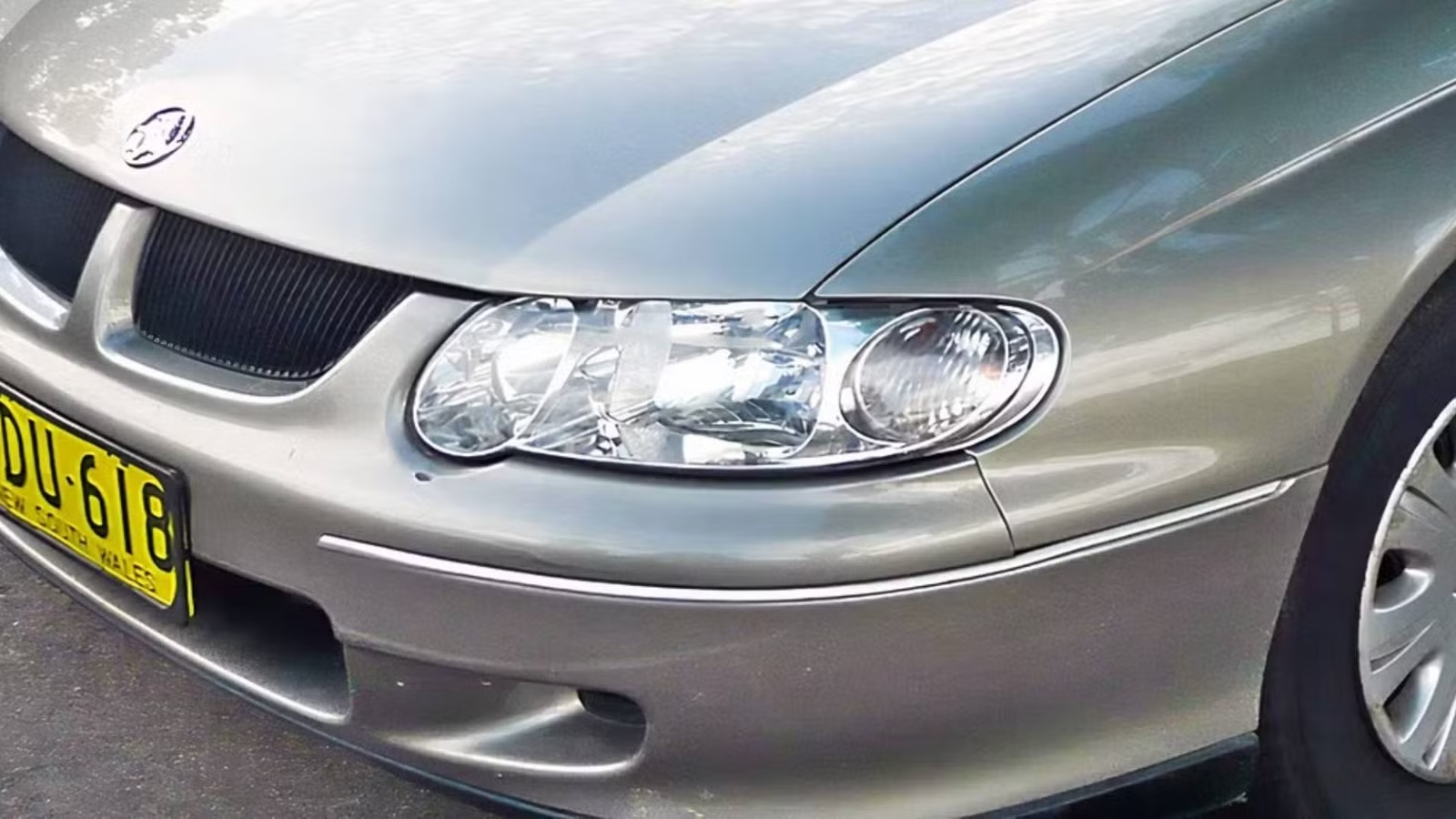
Same engine, two completely different lives. One went into the 1997 Chevrolet Corvette and became an American legend, chased by an entire generation of gearheads. The other went into a family wagon almost nobody in America has ever heard of, wrapped in velour, built for school pickup lines instead of racetracks. General Motors built both of them on purpose. Only one of them was ever sold here, and the other one is still sitting quietly on the other side of the planet, waiting for anyone to notice.
America’s Greatest V8 Hid In A Grocery Getter

General Motors dropped a genuine engineering surprise into the 1997 Chevrolet Corvette C5, an all-aluminum Gen III small-block making 345 horsepower and 350 lb-ft of torque. It paired old-school pushrod grunt with the lightweight and high-revving manners of a modern sports car engine, something no domestic V8 had really managed before. That engine was the LS1, and it replaced the LT1 and LT4 small-blocks that had powered the late C4 generation. It went on to power most of the muscle cars that followed, from the Camaro and Firebird to the Pontiac GTO.

American enthusiasts treated it like a religion, and for good reason. It was proof that a pushrod V8 could still hang with anything overseas. While American buyers were celebrating, a completely different arm of General Motors was quietly doing something beautifully unhinged on the other side of the planet. Holden had been buying Chevrolet small-blocks for its performance models for years already, so when the LS1 came online, sending it to Australia next was a natural, if very quiet, decision. They took that same Corvette-spec engine and wrapped it in a completely unassuming grocery-getter.
This wasn’t an aggressive, flared-out super wagon with massive brakes and a spoiler bolted to the tailgate. This was a totally mundane family hauler built for picking up kids from school and hauling the weekly groceries, hiding a factory-spec Corvette engine under a hood that looked like it belonged in a rental fleet. Buyers could walk into a dealership, tick a few option boxes on a standard family car, and drive away with it. No fanfare, no badge to give it away, nothing under the wagon’s skin to suggest it had anything more than a six-cylinder doing the work.

The Ultimate Fake-Woodgrain Sleeper

Picture pulling up to a school pickup line in a thoroughly uninspiring family wagon, rolling on tiny 15-inch alloy wheels that looked like they belonged on a budget-trim commuter. The interior was pure early-2000s mediocrity, plush velour seating wrapped around glossy fake woodgrain trim on the dash, the door cards, and the center console, the exact catalog-standard look every mid-tier family car of the era seemed to ship with, whether it came from Detroit, Japan, or Elizabeth, South Australia, where this one was actually built.
Nothing on the outside gave it away. No hood scoop, no dual exhaust, no badge anywhere announcing what was actually sitting under the hood. But underneath that boring shell sat a 302-horsepower secret. Dropping the Gen III small-block into this platform wasn’t just about straight-line speed, either; it changed the whole balance of the car.

The all-aluminum LS1 also shed real weight off the nose, which matters more than it sounds like it should. A big, heavy engine sitting out over the front wheels is exactly what makes most family sedans and wagons understeer and feel numb through a corner. A bare LS1 block weighed around 108 pounds, roughly 88 pounds lighter than the outgoing cast-iron V8 it replaced, and that’s engine weight alone, not the whole car.
That’s enough to turn a heavy, understeering family wagon into something more meaningfully balanced through a corner, without changing a single body panel. Cheap fake wood on the outside, a genuine aluminum sports car engine underneath, doing real work on how the car actually drove. That’s the whole paradox in one car, and it’s a better trick than anything a tuner shop could bolt on afterward.
The Grocery Runner That Hid A V8: The Holden VX Berlina Wagon

Holden, General Motors’ Australian division, finally gave this sleeper a name. Between October 2000 and September 2002, buyers could option the VX Berlina Wagon with a 5.7-liter LS1, dropping the Corvette’s engine into a car that looked like a wolf that had put on sheep’s clothing for a decade. A running update partway through that window, in August 2001, even added a proper limited-slip differential to every V8 model, so buyers who found it late still got the more capable version.
The Berlina badge sat right in the middle of Holden’s lineup, a luxury family trim above the base Executive but nowhere near the flared body kits and sport suspension of the performance-focused Commodore SS. That’s exactly what made it perfect cover. It was built to fly under the radar, not draw attention to itself, and it did that job so well that most people who saw one on the street had no idea a V8 was even an option.
Tick the V8 box on a Berlina wagon and you got the same Gen III alloy block that powered the C5 Corvette, tuned to 225 kW at 5,200 rpm and 460 Nm at 4,400 rpm, or 302 horsepower and 339 lb-ft. That’s less than the Corvette’s 345 horsepower, but more than enough to overwhelm a set of modest rear tires and thoroughly surprise anything else waiting at the same stoplight. An elongated wagon with a huge cargo hold, dressed in velour and plastic wood, putting down real Corvette-block torque. Holden kept building that combination for years, first as the VT in 1999, later through the VY and VZ, right up to 2007. Nobody in America ever got the chance to buy any of it, in any of those years.
Velour Seats, Fake Wood Trim, And A Genuine 302 Horsepower

American gearheads didn’t have an equivalent during that same 2000-to-2002 window. The LT1-powered Caprice and Roadmaster wagons had already been dead for years by then, and the modern Dodge Magnum wouldn’t show up until 2005. Right in the middle of the LS1’s prime, Detroit simply wasn’t selling a V8 wagon to anyone. The VX Berlina out-slept just about anything America was building in that window. General Motors clearly knew how to build a practical, rear-wheel-drive family car that could still light up its rear tires on demand. They just built it on the other side of the planet, and never bothered bringing it home.
What elevates the VX Berlina Wagon from footnote to legend is how it responded to tuning. The LS1 was built with real headroom, and owners in Australia figured that out fast. Modifying these wagons became a genuine rite of passage in the local scene, right alongside doing it to the sedan and the ute versions of the same car. Local performance shops built entire businesses around unlocking that reserve, years before most American enthusiasts had any idea what Holden was doing with the platform.
An over-the-radiator cold air intake and a basic tune were often enough to wake the whole thing up, unlocking Corvette-level power the factory had quietly dialed back for the luxury trim. A mundane dad-wagon became a genuine sports car killer, capable of running down modern performance sedans that had no idea what just passed them at the lights. That reputation followed the platform for years. Ask anyone who was into Commodores in Australia during the 2000s, and the Berlina wagon comes up in the same breath as the far more aggressive Holden Special Vehicles models, despite never wearing a single HSV badge.
The Forbidden Fruit We’re Still Chasing

A rear-wheel-drive, V8-powered wagon with zero aggressive styling feels like a fever dream today. Modern performance wagons are covered in massive intakes, carbon splitters, and brake calipers that scream for attention before the engine even starts. The subtle factory sleeper has mostly been lost to marketing departments who can’t resist a bigger badge and a louder exhaust note. That’s exactly why the VX Berlina Wagon remains the ultimate forbidden fruit for American enthusiasts: the kind of car gearheads still trade stories about at late-night meets and on forums, brilliant and unhinged engineering that never got a chance here.

Bringing one stateside isn’t as simple as clicking through an auction site. The VX Berlina was built exclusively in right-hand drive for the Australian market, so it falls under gray-market import rules rather than a normal dealer purchase. The golden ticket is the federal 25-year rule, administered by NHTSA, and it doesn’t care what side of the car the steering wheel is on. Cars built at the start of the VX Berlina’s run have already crossed that threshold, with the rest of the production window clearing by September 2027.
Getting one still means international shipping, a customs broker, and tracking down parts for a trim level nobody at the local dealership has ever heard of. It won’t be cheap and it won’t be fast, and that’s before anyone even finds a decent example to bring over in the first place. A quarter-century after the first one rolled off the line in Adelaide, the forbidden fruit is finally, technically, within reach. Whether anyone here actually goes and gets one is a different question entirely.
Sources: General Motors, Holden, Classic.com

Related posts


Latest Post


No Comments