
RUF’s New EHRA Is A 650-HP Grand Tourer Named After A Speed Record
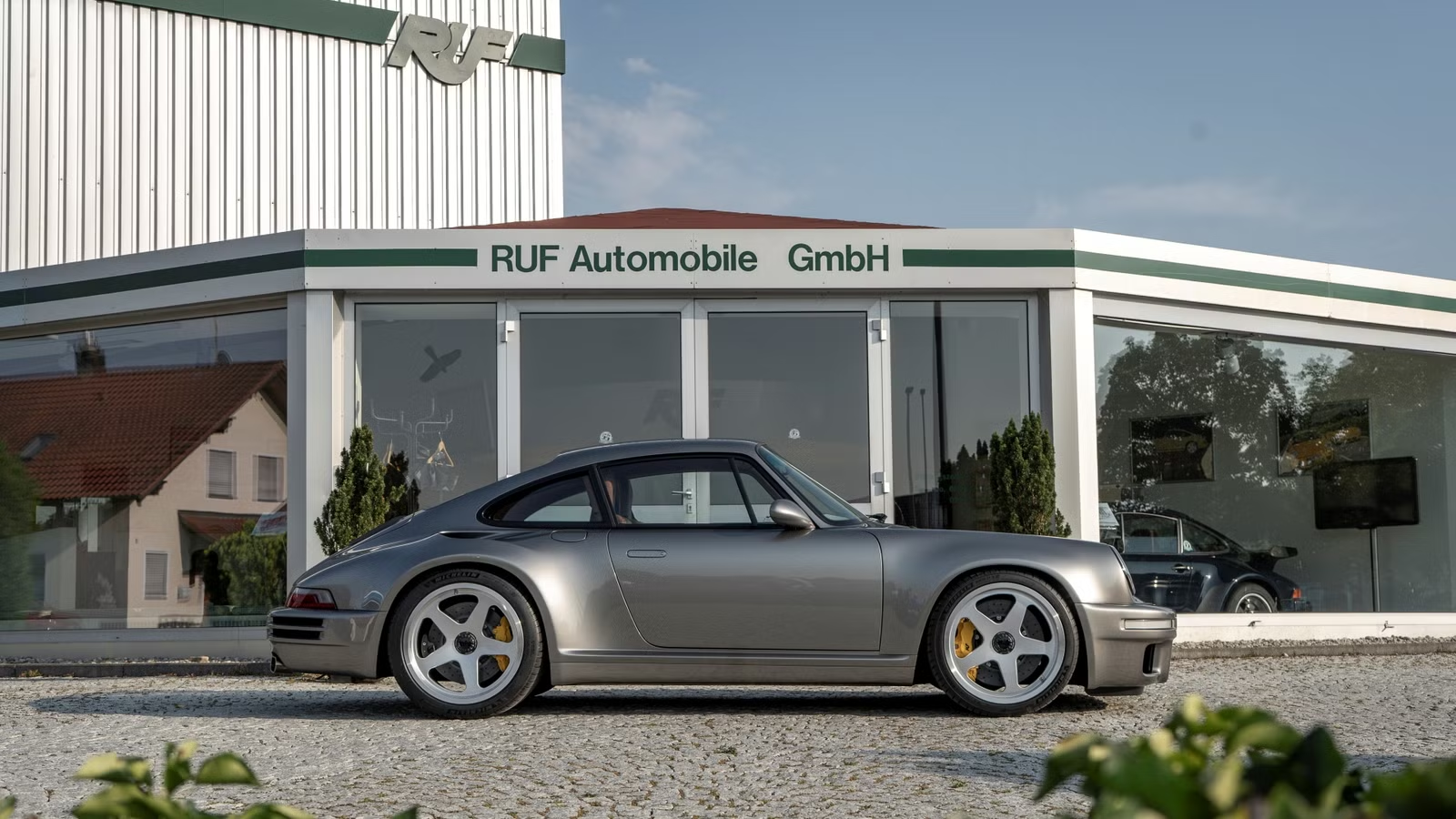
RUF Automobile debuted its most significant new model in years at The Quail during Monterey Car Week on August 14, 2026. The EHRA — named after the Ehra-Lessien proving ground where the CTR “Yellowbird” set its world speed record in 1987 — is the brand’s first grand-touring car and the latest to ride RUF’s proprietary carbon-fiber monocoque chassis.

This is not a track weapon softened for the road. RUF describes the EHRA as a deliberate balance: 650 horsepower and 664 lb-ft of torque from a 3.6-liter twin-turbo boxer-six, wrapped in a widebody fastback that skips the whale tail entirely and seats two in hand-stitched leather for the long haul. For a manufacturer whose lineage runs through some of the most uncompromising performance cars ever built, the EHRA marks a meaningful shift in ambition.
A Widebody Fastback Built Around The Boxer-Six
The EHRA’s 3.6-liter twin-turbo flat-six — a configuration RUF has developed across multiple generations — produces 650 hp and 664 lb-ft of torque, channeled through a seven-speed manual transmission and a fully variable all-wheel-drive system with a limited-slip differential. RUF says the AWD setup is tuned to preserve rear-wheel-drive dynamics when conditions allow, giving the driver genuine latitude rather than just a safety net.

Suspension is double-wishbone at all four corners, with pushrod-actuated horizontal adaptive dampers — the same layout found on the SCR and CTR Anniversary. The result, according to RUF, is precise feedback without sacrificing everyday ride quality. A variable carbon-fiber rear spoiler deploys automatically at highway speeds and can also be controlled manually by the driver, replacing the fixed whale tail that defines most cars in the RUF lineup.
Wider, Sleeker, And Aerodynamically Purposeful

Compared to the CTR Anniversary, the EHRA runs 58mm wider up front and 54mm wider at the rear. Those wider tracks aren’t purely aesthetic — RUF says the expanded bodywork improves cooling and high-speed stability, both critical for a car intended to cover ground at pace over extended distances. The fastback roofline and integrated rear deck are shaped to manage airflow cleanly without the visual drama of a fixed spoiler.
Newly designed five-spoke centerlock forged alloy wheels fill the arches, and the front and rear fascias are unique to the EHRA. Hidden electronically deployed door handles, integrated air intakes in the rear quarter windows, and RUF’s LED light clusters tie the car visually to the rest of the current lineup while giving it a distinct, more swept identity.
An Interior Built For Distance, Not Just Driver Engagement

The first production EHRA wears Liquid Silver over a cabin that leans warm rather than clinical. Hand-stitched natural brown leather in a staggered checkered-flag pattern covers the seats and surfaces, while dark matte-finished carbon trim and titanium pedals provide contrast. The foldable carbon bucket “lollipop” seats are designed to hold occupants firmly during spirited driving while remaining comfortable on longer runs — a balance that has historically been difficult to strike in cars at this performance level.
A five-pod gauge cluster with RUF Green instruments is the focal point of the driver’s view. Details like the monogram stitching and the quality of the leather finish signal that RUF is positioning the EHRA squarely at collectors and driving connoisseurs, not just outright performance buyers.
What The Debut At The Quail Means For RUF
The Quail has become RUF’s annual showcase moment, and the 2026 gathering was particularly dense. Alongside the EHRA world debut, RUF delivered four customer cars: a RODEO finished in Aventurine Green Metallic with 610 hp, a Grand Prix White CTR Anniversary with 710 hp and rear-wheel drive only, a wingless SCR in Grand Prix White with a 510-hp naturally aspirated 4.0-liter spinning to 8,750 rpm, and an Etna Blue CTR3 EVO — RUF’s 800-hp, 236-mph track flagship.
All RUF vehicles at Monterey ran on renewable e-fuels supplied by HIF Global, which produces synthetic fuels from captured CO₂ and renewable energy. RUF says e-fuels are a natural extension of its commitment to keeping high-performance combustion engines viable going forward — a position that will resonate with a customer base that has little interest in electrification.
Alois Ruf framed the EHRA’s significance plainly: “The EHRA is a very special car for us as our first grand touring car, and we can’t wait for the world to see it.”
For a brand that spent decades defining what an uncompromising driver’s car could be, building one that also works as a grand tourer is a genuine evolution — and the EHRA makes a compelling case that RUF hasn’t had to compromise much to get there.

Related posts


Latest Post


No Comments