The V6 Sports Car That Out-Accelerates A New Mustang GT
12 minutes reading
Friday, 14 Aug 2026 13:30 0 71 autotech
Every few years, a car arrives that quietly dismantles one of American performance culture’s most stubborn assumptions. Right now, that car is a compact Cadillac sedan with a twin-turbocharged V6 under the hood — and it is running to 60 mph faster than a brand-new Mustang GT on a consistent, documented basis. The data isn’t theoretical. It comes from timed, published tests conducted by some of the most respected automotive outlets in the country, including Car and Driver’s annual 10 Best evaluation and Motor Trend’s instrumented testing program. The V8 badge still sells hundreds of thousands of cars a year. Increasingly, the numbers argue it shouldn’t have the acceleration conversation all to itself.
What makes this story worth telling is the specific machine at its center: a compact American performance sedan that most buyers aren’t even browsing for, one that costs more than the Mustang GT, sits in a shrinking segment, and does something genuinely extraordinary in the process.
Why V8 Power No Longer Guarantees Acceleration Supremacy
5.0-liter Coyote engine, view of top in bayFord
For most of American automotive history, the equation was simple. More cylinders meant more displacement. More displacement meant more torque. More torque meant faster acceleration. It was an uncomplicated relationship, and for decades it held up well enough that V8 loyalty became less a performance calculation and more a cultural identity.
Forced induction changed the arithmetic. A turbocharged or twin-turbocharged six-cylinder engine can generate torque figures that a naturally aspirated V8 of equivalent or larger displacement cannot match at low RPM, and it is low-RPM torque, not peak horsepower, that determines how aggressively a car accelerates from a standing start. Turbochargers effectively multiply the work each cylinder can do by forcing additional air into the combustion chamber, allowing smaller engines to produce outsized power relative to their size and weight. The weight savings matter, too. A lighter engine mounted lower in the chassis improves the power-to-weight ratio and lowers the center of gravity simultaneously. The result is a car that is quicker on the strip and more agile in corners.
Front 3/4 action shot of 2026 Ford Mustang GT driving on roadFord
This shift has been visible at the highest levels of the performance market for some time. The turbocharged inline-six in BMW’s M3, the twin-turbo flat-six in Porsche’s 911, and the boosted six-cylinders found across Mercedes-AMG’s lineup have collectively dismantled the idea that V8s hold an inherent performance advantage. What lingered was the belief that this trend applied only to European exotics — that American performance, and specifically American muscle, operated by different rules.
How The Cadillac CT4-V Blackwing Turns A Twin-Turbo V6 Into A Super-Sedan Weapon
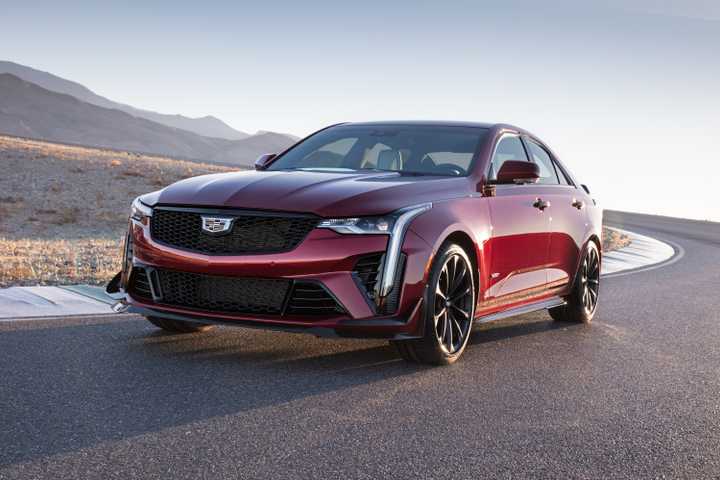
A front-facing shot of a Cadillac CT4-V Blackwing on the trackCadillac
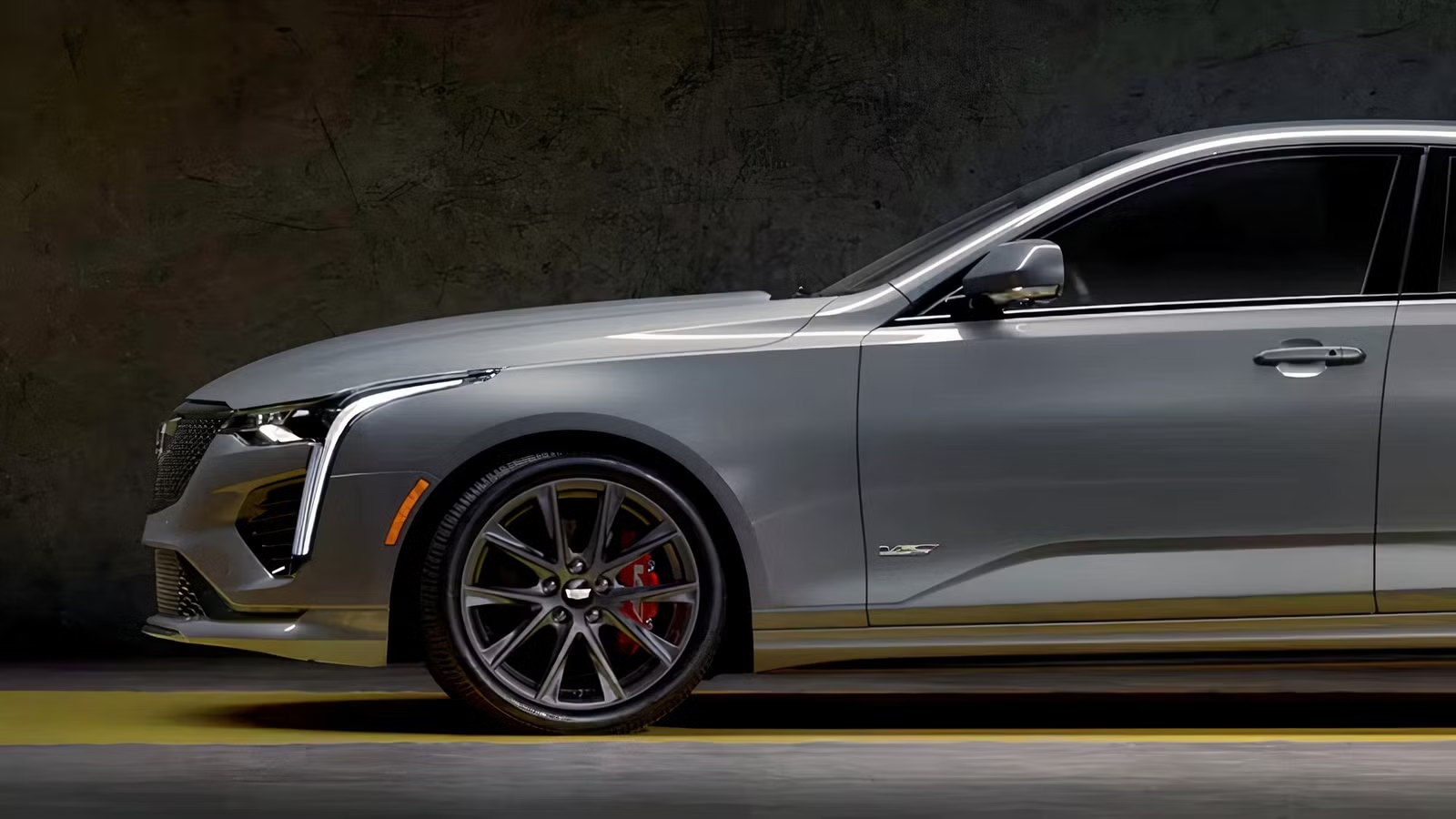
The 2026 Cadillac CT4-V Blackwing is not a car that announces itself loudly. It looks like a compact luxury sedan. Its badge says Cadillac. Its interior, while sporting and well-appointed, doesn’t scream racecar. None of that prepares you for what the 3.6-liter twin-turbocharged V6 under its hood is actually capable of doing.
That engine, GM’s LF4 unit, produces 472 horsepower and 445 pound-feet of torque. It is a genuine twin-turbocharged V6 — not an inline-six, not a turbocharged four-cylinder dressed up with marketing language. The architecture requires engineers to fit two turbochargers into a more complex packaging arrangement than a straight-six allows, and Cadillac’s powertrain team has done so without sacrificing the throttle response and power delivery that define the driving experience. Power goes exclusively to the rear wheels through either a standard six-speed manual — one of the last available in any performance sedan — or an optional 10-speed automatic.
Cadillac CT4-V Blackwing on the track rearCadillac
The platform it sits on, GM’s Alpha 2 architecture, was engineered specifically with driving dynamics as the primary priority. Magnetorheological adaptive dampers — the same fast-acting units that have earned GM’s ride-and-handling engineers consistent praise from testers across every major publication — allow the CT4-V Blackwing to cover ground with ride compliance that belies its cornering capability. The result is a car that Car and Driver has documented achieving more than 1.0 g of cornering capability while remaining genuinely comfortable on imperfect roads. Standard equipment includes Michelin Pilot Sport 4S summer tires, Brembo brakes, and a Performance Traction Management system with multiple driver-selectable modes.
The 2026 CT4-V Blackwing starts at $64,195, with the optional 10-speed automatic adding $2,275 to that figure. Fully optioned with packages like the Carbon Fiber 2 aerodynamic suite, tested cars have reached into the mid-$80,000 range — a significant premium over the entry-level Mustang GT, but one that reflects an entirely different category of engineering.
Where The Blackwing Leaves The Mustang GT Behind
Front 3/4 action shot of 2025 Ford Mustang GT drivingFord
This is where the data does the talking, and where the sleeper narrative earns its credibility. The 2026 Ford Mustang GT is powered by a 5.0-liter naturally aspirated Coyote V8 producing 480 horsepower — 486 with the optional active-valve performance exhaust — and 415 pound-feet of torque. Ford rates the GT with the 10-speed automatic at 4.2 seconds to 60 mph. That figure is consistent across multiple independent sources: CarBuzz confirms 4.2 seconds for the automatic-equipped GT with the performance exhaust, while a separate published technical breakdown notes a 4.3-second figure for the base 10-speed automatic configuration.
In independent track testing, the Mustang GT has been documented achieving the 0–60 mph sprint in as little as 4.2 seconds, with a quarter-mile of 12.5 seconds at a trap speed of 114 mph under optimal conditions. Across sources and configurations, the range sits consistently between 4.2 and 4.3 seconds.
Action shot of a 2021 Cadillac CT4-V BlackwingCadillac
The CT4-V Blackwing with the 10-speed automatic is quicker, and the independent testing record establishes this conclusively. Motor Trend’s instrumented test of the CT4-V Blackwing recorded a 4.0-second sprint to 60 mph with a quarter-mile of 12.4 seconds at 114 mph. Car and Driver’s 2026 10Best evaluation — one of the most rigorous annual testing programs in American automotive journalism — recorded a 4.0-second 60-mph time and a 12.4-second quarter-mile for the Blackwing. That is the same quarter-mile elapsed time as the Mustang GT, but dispatched with a higher peak velocity at the traps and reached a full two tenths of a second sooner from a standstill.
To be precise about the comparison: the Blackwing’s advantage at 60 mph is between 0.2 and 0.3 seconds, depending on configuration and testing conditions. That is not a rounding error. At the strip, that margin separates meaningful performance tiers. The twin-turbocharged V6 achieves its advantage through the combination of torque delivery characteristics — the twin turbos spool quickly enough to produce peak thrust earlier in the rev range — and the CT4’s relatively compact dimensions and rear-biased weight distribution, which work with the 10-speed’s rapid gear changes to put power down more efficiently from launch.
Side view of 2023 orange Cadillac CT4-V Blackwing.Garret Donahue | TopSpeed
What makes the comparison more remarkable is that the Mustang GT’s 480 horsepower exceeds the Blackwing’s 472 horsepower by eight units. On paper, the V8 should win. In practice, the twin-turbo V6’s torque delivery, the Blackwing’s weight and balance, and its launch control system combine to extract more usable acceleration from slightly less peak power.
What Our Test Drive Revealed
Center console in the CT4-V BlackwingCadillac
Rear seats in the CT4-V BlackwingCadillac
Our team had the opportunity to test drive the CT4-V Blackwing, and praised its performance before even getting to its premium cabin. Multiple versatile drive modes, a spectacular manual transmission, and a well-balanced, well-equipped performance chassis gave our team enough to draw comparisons to European rivals like the M4. Comparisons aside, this thing rips!
Whether driving in the mid-range Sport mode or dabbling in the Competitive settings this is a phenomenal driver’s car… This clutch/shifter combo is nothing short of spectacular — as easy to drive in all conditions as they come while still delivering pinpoint accuracy to gear engagement.
Of course, the cabin is drenched in classic Cadillac leather. The layout is clearly geared toward two-person trips, as the rear seat is noticeably cramped — though the trunk is actually the same size as the CT5’s, so there’s room to pack for a weekend getaway with your favorite passenger. Intuitive tech and easy-to-use performance settings strike a balance that keeps you comfortable and well-accommodated, while never letting you forget you’re in a Blackwing.
The Performance Car Enthusiasts Continue To Overlook
A Yellow 2024 Cadillac CT4-V Blackwing DrivingCadillac
The Cadillac CT4-V Blackwing has won Car and Driver’s 10Best award five consecutive years running. It has been named by MotorTrend in comparison tests as a benchmark against European competitors. It has received near-universal critical acclaim from every major automotive publication that has tested it. And it continues to fly almost entirely under the radar of the performance-car buying public.
The reasons are not hard to find. It’s a Cadillac. In the imagination of the American performance buyer, Cadillac occupies a mental category adjacent to Lincoln and Buick — comfortable, luxurious, aspirational in a grandfatherly way, but not exciting. The brand’s sporting heritage, which includes the genuinely brilliant ATS-V and the CTS-V before it, has not been sufficient to reposition Cadillac in the minds of buyers who associate serious performance with Chevrolet, Ford, and Dodge. This is a perception problem, not a performance problem — but in a market driven by cultural identity as much as specification sheets, a perception problem and a sales problem are often the same thing.
Cadillac CT4-V Blackwing interiorCadillac
The segment itself is also disappearing. The compact performance sedan — once the territory of the BMW M3, Mercedes-AMG C63, and Alfa Romeo Giulia Quadrifoglio — has contracted significantly as those rivals have moved to hybrid powertrains, higher price points, and SUV spinoffs. The CT4-V Blackwing is one of the last rear-wheel-drive compact performance sedans available with a manual gearbox. It exists in a category the market has largely abandoned, which means it receives less coverage, fewer comparison-test appearances, and less organic word-of-mouth than it would if it were competing against a larger field.
The Mustang is a cultural institution. No amount of specification-sheet superiority competes with decades of iconography, film appearances, and national mythology. Buying a Mustang GT means something to American performance buyers beyond the 0–60 time — it signals affiliation with a specific automotive tradition. The Blackwing cannot and does not offer that, and for many buyers, that intangible matters more than two tenths of a second. The result is a car that the automotive press has consistently celebrated and the broader market has largely ignored: a genuine sleeper in every sense.
Why The CT4-V Blackwing Makes A Stronger Case Than A Traditional Muscle Car
Cadillac
The argument for the CT4-V Blackwing over the Mustang GT rests on more than the acceleration gap. It rests on what you get for the price premium and what the car is capable of beyond a straight line.
On straight-line performance alone, the Blackwing wins, as established by multiple independent tests. But the CT4-V Blackwing’s case extends to circuit work, too. Car and Driver’s testing documents more than 1.0 g of lateral acceleration — a capability the Mustang GT does not match in base form without the optional Performance Package. The magnetorheological dampers, rear-wheel-drive layout, and Michelin Pilot Sport 4S tires give the Blackwing a handling balance that is genuinely exploitable on a road course. The Mustang GT is a compelling driver’s car, but it was engineered with a different brief: broader market appeal, accessible power, and an experience that rewards traditional muscle-car engagement.
Interior view in the CT4-V BlackwingCadillac
The price gap is real and should not be minimized. The 2026 Mustang GT starts at $46,885, making it more than $17,000 cheaper than the CT4-V Blackwing’s $64,195 base price. For buyers whose priority is maximum performance per dollar, the Mustang GT’s value proposition remains compelling. The question is whether buyers cross-shopping these two cars are optimizing purely for price-per-tenth-of-a-second, or whether they are looking for the most complete performance package they can find.
For buyers choosing the latter, the CT4-V Blackwing presents a case that the muscle-car conversation rarely makes room for: a car that is genuinely quicker than the American icon it is being compared to, more capable on a technical road or circuit, available with a proper manual gearbox, and backed by five consecutive years of validation from the toughest annual testing program in American automotive journalism. The fact that it carries a V6 rather than a V8 used to be a liability. In 2026, it’s barely even a footnote.
Total Cost To Own Tells An Interesting Story
2025 Cadillac CT4-V Blackwing front shot driving at nightCadillac
Luxury cars are notoriously more expensive to own than mainstream vehicles, due to factors including high MSRPs, specialized maintenance costs, and sometimes hard-to-find replacement parts. That said, the CT4-V Blackwing is among the more reasonable luxury cars to own, especially given its performance focus. According to KBB’s TCO estimate, the 2026 Cadillac CT4-V Blackwing will cost $99,887 to own over five years, with $38,258 attributed to depreciation and $61,629 going toward out-of-pocket expenses like fuel, maintenance, and insurance.
When we look at the 2026 Ford Mustang GT’s five-year TCO of $84,110, we see the effects of higher luxury ownership costs at play, with the Cadillac costing over $15,000 more over five years. However, a closer look reveals that the Mustang GT will depreciate by $25,336, while out-of-pocket expenses total $58,774 — meaning the CT4-V Blackwing costs less than $3,000 more to run day-to-day than the Mustang GT. Zooming in further, repair and maintenance costs between the two are nearly identical: the CT4-V Blackwing totals $8,035 in maintenance and $1,279 for repairs, while the Mustang GT totals $8,071 for maintenance and $1,833 for repairs — meaning it actually costs slightly more to maintain a Mustang GT than the CT4-V Blackwing.
Base Trim Engine
3.6L V-6 ICE
Base Trim Transmission
10-speed automatic
Base Trim Drivetrain
Rear-Wheel Drive
Base Trim Horsepower
472 HP @5750 RPM
Base Trim Torque
445 lb.-ft. @ 3500 RPM
Base Trim Fuel Economy (city/highway/combined)
15/23/18 MPG
Base Trim Battery Type
Lead acid battery
Make
Cadillac
Model
CT4-V Blackwing
Sources: Cadillac U.S., Ford, Car and Driver, MotorTrend









No Comments