
The Head-Turning Pre-War Harley-Davidson You’ve Never Heard Of
We’ve all heard of the most iconic Harley-Davidson cruisers ever made, even from the pre-war era. The two that come to mind first are the EL Knucklehead and the WLA Liberator, both of which have massive significance for the motor company and American motorcycling culture. Between these legends, there’s another iconic Harley that gets overshadowed. Here’s all you need to know about that pre-war Harley.
Several Pre-War Harley-Davidsons Often Make Headlines

Harley-Davidson has a long history dating back to 1903, but the ‘30s and ‘40s proved to be the most important era for the motor company. Harley had just survived the Great Depression and was about to motorize the US military in World War II, and that time marked the dawn of the modern big twin that would go on to define the company. And that time gave birth to the most iconic and important Harley-Davidson: the EL Knucklehead.

The EL Knucklehead is the bike that takes center stage when you talk about pre-war Harleys, and for good reason. The bike revolutionized big twin performance, thanks to its advanced (for the time) 61 cubic inch overhead-valve V-twin engine, nicknamed for its distinct rocker box shape. It was Harley’s first mass-produced model with overhead valves instead of side valves. It created a new standard for power and styling and helped bring Indian Motorcycles to its knees. For Harley-Davidson fans, the El Knucklehead remains the ultimate collector’s item with the Bar and Shield logo.

Then came WWII, which forced Harley-Davidson to shift its production to war efforts with the WLA Liberator. This is the next bike that made headlines from that era. It earned the Liberator nickname across Europe as Allied soldiers used these bikes as they liberated towns and territories. And post-war, this bike is attributed to the explosion of biker culture in the US. Perhaps without the Liberator, the American motorcycling culture would not have looked the same.

Meet The Unknown Yet Iconic Pre-War Harley-Davidson

Given the legends that dominate the pre-war era conversations, it’s hard for another bike to be a part of that conversation. However, the bike we have here deserves a spot. It may not be as legendary as the EL Knucklehead or the WLA, but it’s worth a second look for what it represents for the motor company. That bike is the WLD Sport Solo, a sporty bike that inspired a line of bikes that’s still on sale today.
Based On The Venerable 45ci Flathead Platform

Back then, the 45ci flathead was the backbone of Harley-Davidson’s lineup, as it was the most versatile and approachable motorcycle platform in America. While using a slightly lower technical design than the OHV EL model, the side-valved flathead earned a reputation for durability that few machines at the time could match. Today, it remains one of the longest-tenured engines in the history of internal combustion, powering an array of bikes from 1937 to 1973, including the WLA war machine, police bikes, and the flat track-dominating WLDR and WR race bikes.

In 1937, the flathead found its way into the WLD, which was based on the standard WL model but ran a higher compression ratio for better performance. It did so without sacrificing the reliability that made the flathead so popular in the first place. The result was a sporty cruiser that was renowned for its livelier character and sporty riding, which also made it suitable for everyday riding.

For a brief time, the WLD Sport Solo bridged everyday civilian utility and spirited street performance before the motor company shifted its focus to the war effort, ending the WLD’s production in 1942. According to Mecum and The Legend Begins: Harley-Davidson Motorcycles 1903-1969, only 33 WLD Sport Solo units were ever made. When Harley returned to civilian motorcycles post-war, the WLD was replaced by the side-valve K model in 1952.

Today, the WLD Sport Solo remains a milestone in Harley-Davidson’s history. It’s a rare motorcycle built during the company’s most significant transitional years, and one of the finest examples of the flathead 45s. More importantly, it set the mechanical and stylistic tone for sporty middleweight cruisers, directly inspiring the legendary Sportster line that came in 1957. Essentially, the WLD Sport Solo did for the Sportster what the EL Knucklehead did for the big twin cruisers.
There’s A Well-Maintained WLD Sport Solo Up For Grabs

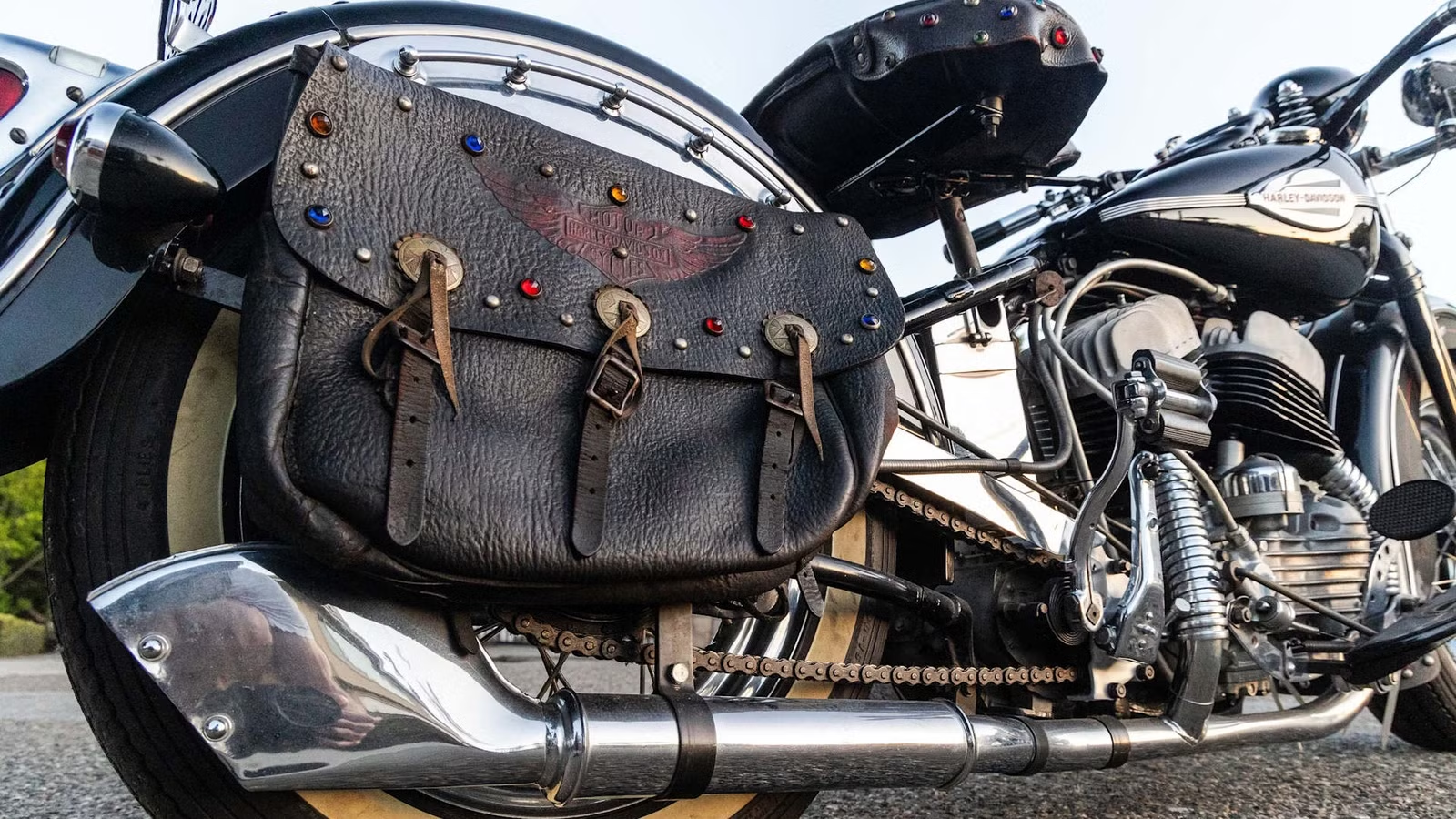
If you want to get your hands on one of the finest flatheads ever made, now’s your chance. Mecum Auctions has listed a pristine 1942 Harley-Davidson WLD Sport Solo for the Monterey 2026 auction, which is the same one pictured in this article. While Hagerty estimates the WLD’s value at $18,500, Mecum is expecting this model to fetch around $40,000 to $50,000. For a collector, that’s a sweet deal for one of the rarest Harleys of that era.

This particular model has 39,040 miles on the odometer, and the engine number is 42WLD10292. Formerly a part of the John Parham Estate Collection, the bike features a black tank with red pinstriping and matching fenders. It also features original pre-war rhino-grain black leather saddlebags coordinated with the seat, along with various pre-war accessories. Honestly, it’s a beautiful bike that is sure to elevate any motorcycle collection, especially one that also features the EL Knucklehead and the WLA Liberator.
The WLD Sport Solo: Hardware And Specifications

The WLD Sport Solo was the high-compression civilian sport version of the WL platform, and like all Harleys of the time, it was designed to be simple and serviceable. It’s powered by a high-compression version of the 45-degree side-valved flathead V-twin, displacing 750cc and fed by a Linkert carburetor. It also features larger inlet ports and cooling fins compared to the standard flathead. The flathead is mated to a 3-speed hand shift with a dry clutch.

The engine sits in a single-down-tube frame with a springer front end and a rigid tail. While wheel sizes and styling are nearly identical to the EL Knucklehead and the later FL, the bike’s shorter wheelbase of 57.5 inches and 530 pounds give it nimble handling compared to the big twin models. Speaking of styling, it features a single headlight sitting above an electric horn, and both wheels are covered with classic swept fenders. If you enjoy this period of Harley-Davidson styling and the history of Sportsters, the WLD Sport Solo is worth a look.
Source: Harley-Davidson, Mecum Auctions, National Motorcycle Museum, Hagerty

Related posts
Latest Post


No Comments