
The Fastest Quarter-Mile Time For A Ford Muscle Car In The ’60s
Few automotive benchmarks carry the raw, visceral appeal of a quarter-mile run. Strip away the lap times and skidpad numbers, and what you’re left with is the purest measure of a car’s straight-line soul: traction off the line, power through the gears, and the relentless pull of a well-tuned engine doing exactly what it was built to do. It’s no coincidence that the drag strip became the proving ground of choice for the muscle car era — and no manufacturer played that game harder than Ford. The quarter mile has long been one of the most definitive ways to measure a car’s performance, and the Blue Oval’s 1960s lineup gave it some genuinely legendary numbers to work with.

The 1960s were a golden age of factory-built speed, with manufacturers doing everything short of outright cheating to embarrass their rivals on the strip. HotCars dug into the records to find the fastest muscle car Ford produced in the quarter mile during that remarkable decade.
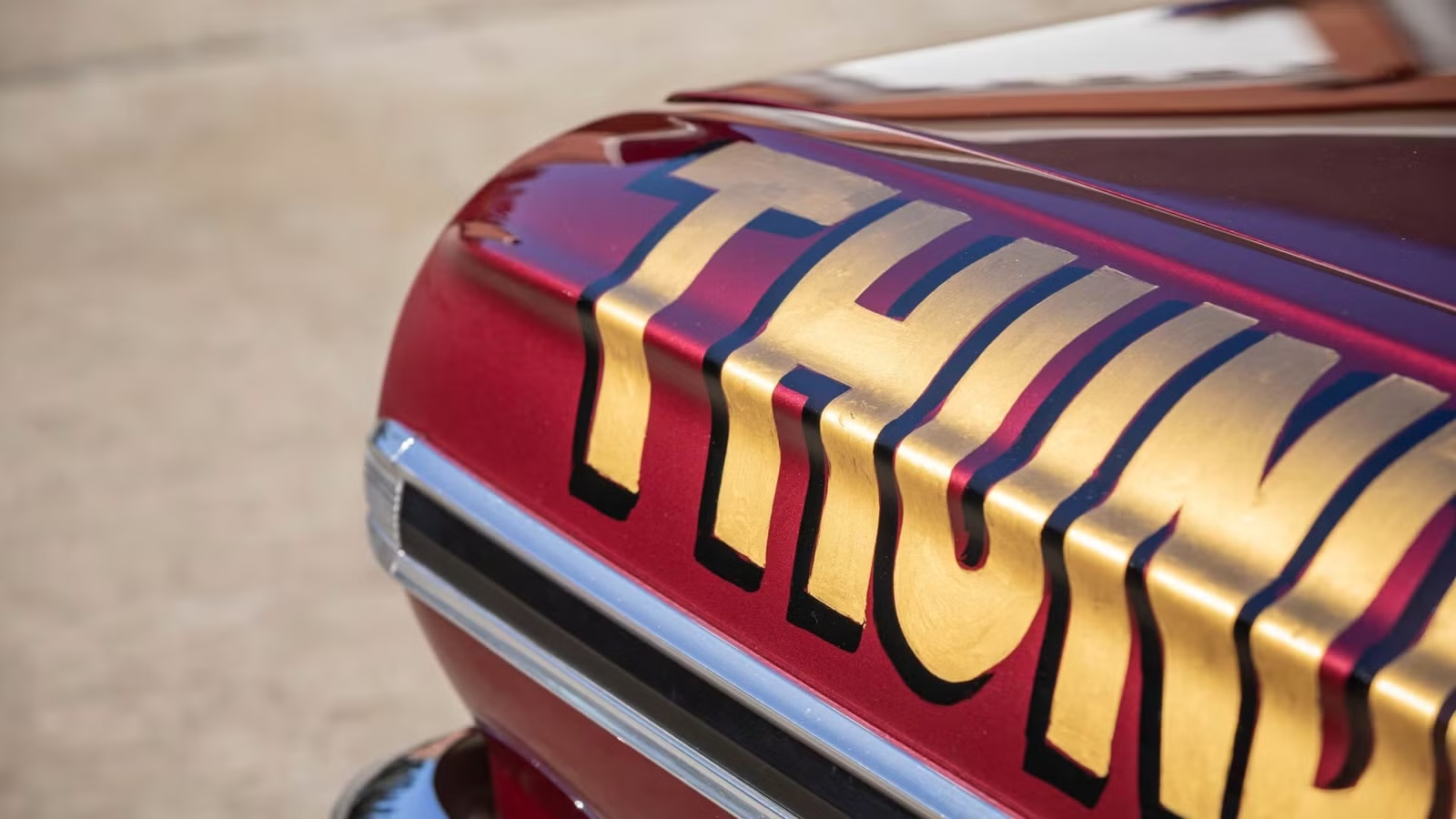
1964 Fairlane Thunderbolt Was Ford’s Quarter-Mile Champ In The ’60s
1964 Fairlane Thunderbolt Specs
|
Engine |
 49 autotech 427 ci FE V8 |
|
Power |
425 hp |
|
Torque |
480 lb-ft |
|
Quarter-Mile Time |
11.08 seconds |
(Source: Hemmings)
Throughout history, some of the most hardcore and performance-focused cars have been homologation specials. These are essentially race cars tweaked to be road-legal, with many of the tricks that make them so competitive on the track carried over to the street versions. This was exactly the scenario that gave the world the mighty 1964 Ford Fairlane Thunderbolt.
The Thunderbolt was campaigned by Ford in the NHRA Drag Racing Super Stock class, with the American manufacturer looking to put on a show for the competition. Ford had started the 1960s running uprated Galaxie models, though things got exciting for the 1964 drag season as the NHRA revised its rulebook.
For the first time, massive 427 ci V8s would be eligible to be slotted under the hoods of the SS racers, while the minimum weight was set at 3,200 pounds, according to Hemmings. Ford had developed the potent 425 hp, 427 ci FE V8 for use in the Galaxie but couldn’t get the car’s weight below 3,425 lbs — a significant handicap against lighter rivals on the strip.
Ford Looks To The Fairlane To Save Weight
The idea to switch cars came courtesy of Bob Tasca, a Ford dealer who was also an integral member of the Ford Drag Racing Team. He proposed running a much-lighter Fairlane with the Galaxie’s race engine, an idea Ford embraced immediately. The brand’s then marketing manager, Frank Zimmerman, was sold on it, and a plan was hatched to run the Fairlane in 1964.
Featuring a new high-riser version of the 427 ci FE V8, the special Fairlane racer came in at right around the 3,200 lbs limit when fully built. The weight combined with its 425 hp power output meant it could clear the quarter mile in as little as 11.08 seconds, earning the road-legal version the enviable title of the fastest Ford muscle car to ever cover the distance.
Fairlane Had To Undergo Extensive Development To Become Race-Ready
As with anything worth doing, mating the Fairlane to the commanding V8 wasn’t a simple process. The model was never designed to house a powerplant as large as the 427, so the engine bay lacked the space needed to fit the engine and all its ancillary components. The team therefore had to relocate the battery to the trunk and cut back the spring towers, the latter to make room for the rocker arm covers.
They also replaced the steel front fenders with fiberglass components to help keep weight down. The heavier glass windows were traded for lighter Plexiglass versions as well. The original plan was to build just 10 examples of the Thunderbolt, as this was what the NHRA homologation rules stipulated at the time. Ford therefore delivered ten stripped-out Fairlanes to the team for conversion.
To save time down the road, the squad focused on developing the Thunderbolt package on just one of the cars. This was to ensure they wouldn’t have to continuously go back and make alterations to the others later on.
Ford Was Forced To Build More Thunderbolts Than Initially Planned
According to Hemmings, the NHRA ultimately ordered Ford to build a total of 100 Thunderbolts, 50 equipped with manual gearboxes and the other 50 with automatics. Ford Drag Team boss Dick Brannan told Hemmings that 127 vehicles ended up being made, with all but the first ten examples painted white. The road-going cars were offered for $3,780 at the time — a remarkable value for what was essentially a licensed drag racer.
Also a driver for the program, Brannan was the one who secured the Thunderbolt’s stunning 11.08-second quarter-mile run. It wasn’t long for the world, though, as more compact cars from the competition began to arrive. This forced Ford to shift their attention to the newly released Mustang and Falcon models. In terms of street-legal racers, however, the Thunderbolt’s 11.08-second sprint is enough to give it the accolade of being the fastest production muscle car produced by Ford during the 1960s.
Shelby GT500KR Was Another Stout Quarter-Mile Challenger

1968 GT500KR Specs
|
Engine |
428 ci Cobra Jet V8 |
|
Power |
400+ hp |
|
Torque |
440 lb-ft |
|
Quarter-Mile Time |
13.9 seconds |
(Sources: 0-60 Times, Hagerty)
The Shelby Mustang GT500 was one of the most prolific muscle cars to emerge during the 1960s, the iconic machine beefing up the Mustang with a 428 ci V8. The 360 hp engine was joined by lighter fiberglass body panels to help keep weight down, while luxuries like air conditioning and power steering were also added.
To push performance even further, Shelby offered a special version of the GT500 with a 428 ci Cobra Jet V8. It differed from the standard 428 by receiving larger heads, a forced-induction air ram system, and a special intake manifold derived from Ford’s race-bred 427 V8. These modifications boosted power to over 400 hp, as per Hagerty, with the new creation being christened the GT500KR.
The result of the upgrades was profound, with the GT500KR capable of completing the quarter mile in just 13.9 seconds according to 0-60 Times. While well behind the Thunderbolt’s benchmark, the GT500KR was designed to be a true road car rather than a purpose-built racer.
Competition From Chevrolet Forced Shelby To Secure A Trademark
KR stands for King Of The Road, a nameplate Shelby founder Carroll Shelby had wanted to use on a car for some time. According to Shelby American, Mr. Shelby heard from then-Ford General Manager Lee Iacocca that Chevrolet was planning to name one of its cars the KR. Eager to secure the name for himself, Shelby quickly engaged a trademark lawyer.
Upon finding out the name was still available, he secured a trademark for it and planted it on the uprated GT500. Alongside the iconic name, the GT500KR was also given an enhanced interior that included wood trim and updated gauges. It was available in both coupe and convertible form.
The GT500KR represented a potent blend of luxury and muscle, allowing it to become one of the quickest Ford muscle cars of the ’60s. However, it could only dream of matching the insanely quick 1964 Ford Fairlane Thunderbolt for that top title.
Sources: Hemmings, Mecum Auctions, 0-60 Times, Shelby American

Related posts
Latest Post



No Comments