
This Affordable Sedan Still Uses An Engine Layout Most Automakers Abandoned
For better or for worse, the auto industry has long embraced downsizing as one of its core principles. Engines have thus been getting smaller and increasingly more reliant on turbocharging or hybrid assistance, so that whole “no replacement for displacement” philosophy has lost pretty much all its meaning. It seems harder and harder to find a conventional, naturally aspirated powertrain with each passing day, even if certain segments of the car market still hold on to them to varying degrees. Performance-focused exotics remain a stronghold for naturally aspirated non-hybrid applications, but things don’t look nearly as promising for them elsewhere.
Why Are Naturally Aspirated Engines A Dying Breed?

Hybrids and turbos took over for a number of key reasons, with increased fuel efficiency and lower emissions being a couple of obvious ones. Government regulations have tightened considerably over the years and are continuing to do so, which puts pressure on manufacturers to downsize while making bigger naturally aspirated mills less feasible. As such, pure displacement has been losing considerable ground to forced induction or electrification, engines with eight or more cylinders are getting rarer, and there seems to be little to no room for natural aspiration in the future. Interestingly enough, though, one budget-friendly Japanese sedan still champions the engine configuration that so many others have abandoned. It’s something of an oddity on today’s automotive landscape, which makes it a fascinating case study into how natural aspiration can still endure if engineered the right way.
Traditional Engineering Where You Least Expect It

We feel compelled to once again emphasize one crucial distinction here. This isn’t some expensive sports car relying on predictable throttle response, NA heritage or a convincing exhaust soundtrack to maximize driving pleasure. It is instead a compact economy sedan (or hatchback) aimed at regular buyers with a price tag of around $25,000 — not the first place you’d think to look for a non-turbo, non-hybrid powerplant displacing two and a half liters. This likely sounds strange to a lot of you out there, but the bright minds over at Mazda somehow made it make sense. And their logic does come across as sound when you look into things a little deeper, so let’s go ahead and do just that.

The Mazda3 2.5 S Hides A Cool Surprise Under The Hood

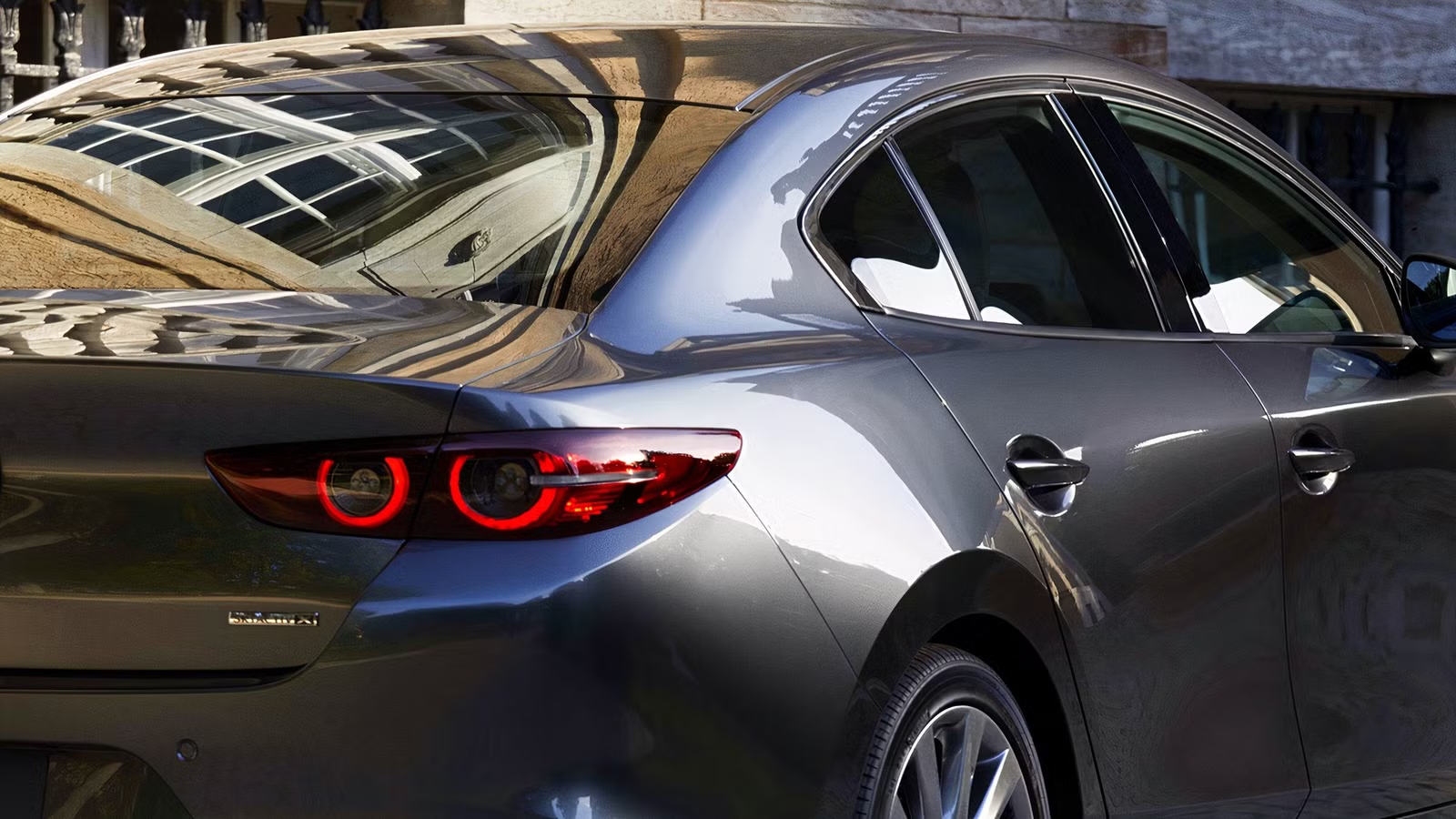
The Mazda3 first arrived back in 2004 and is currently in its fourth generation, which debuted for the model-year 2019. Our primary focus today will be on the base 2.5 S variant, priced at $24,650 for 2026. Under the hood, it comes equipped with Mazda’s Skyactiv-G powerhouse — a naturally aspirated 2.5-liter inline-four featuring dual overhead cams, variable valve timing and 13:1 compression. Now, cars like the Honda Civic and Toyota Corolla also offer NA engines, but these only displace two liters and are paired with CVTs. By contrast, the Mazda3’s bigger Skyactiv-G is linked to a six-speed automatic, and it also produces a bit more power thanks to that extra capacity. We’re talking 186 horsepower and just as many pound-feet of torque, which can feel surprisingly fun when coupled with the engine’s linear throttle response.
On the other hand, the base Civic makes just 150 ponies and 133 pound-feet, while the Corolla has 169 horsepower along with 151 pound-feet of twist. And although the 2.5 S has the larger engine and a higher output, it still ranks very close to its rivals in terms of fuel economy with 30 miles per gallon combined EPA. Things are particularly interesting for the 2026-model 2.5 S, not just because of what is there but also because of what isn’t. The Mazda3 previously had cylinder deactivation and start-stop technology, yet neither of them are in use for 2026. Despite that, the car’s gas mileage stayed pretty much the same, which is quite remarkable since Mazda is effectively doing more with less. And by simplifying the 3’s powertrain hardware, it leans a little closer toward traditional engineering than it did before.

The base Mazda3 sedan is available solely with front-wheel drive, but one can also get all-wheel drive on higher trims like the Carbon Edition or Turbo Premium Plus. But you’ll have to look at the hatchback variants if you want the 3 with a manual, which is only equipped on the 2.5 S Premium version. And, of course, there is also a turbocharged version of that Skyactiv-G mill, present in the Turbo Premium Plus version of both the hatchback and sedan. With 93-octane premium fuel, it can spawn up to 250 horsepower and 320 pound-feet of torque — considerably more than the naturally aspirated engine powering other trims. You will need a fair bit of extra cash for these force-fed 3s, though, as pricing starts at $36,940 for the sedan and $38,090 for the hatchback.
Why Mazda’s Engineering Philosophy Matters

What Mazda is essentially demonstrating here is that you don’t necessarily have to downsize aggressively, turbocharge or use hybridization to keep emissions low and fuel economy high. Simplicity plays a key role on the 2.5 S for 2026, and it comes to show that automakers can still squeeze some potential out of plain ICE technology without complex add-ons or any kind of mechanical sorcery. It also keeps development and manufacturing costs nice and low, which is part of what makes the base 3 so affordable at just 25 grand. Simpler hardware means fewer things that can go wrong, too, and this translates to lower maintenance and servicing costs in the long run.
Moreover, that 2.5-liter naturally aspirated four-cylinder is far more appealing than, say, a much smaller turbocharged inline-three or a hybrid powertrain (at least on paper). Another talking point is the six-speed automatic gearbox, consistently praised by reviewers and everyday buyers who don’t exactly hold CVTs in high regard. The overall driving experience is more engaging than you would expect from your typical economy car, and arguably more so than what the base Civic or Corolla have to offer. With all these things in mind, Mazda’s decision to remain somewhat conservative starts to make perfect sense, while also meaning the 3 is more than just another entry-level econobox.
What Else Does The 2.5 S Sedan Bring To The Table?

We spent a lot of time talking about that Skyactiv-G four-banger, but it’s worth having a look at the Mazda3’s other characteristics, as well. People often highlight its solid handling dynamics and balanced chassis, noting that it’s much more fun to drive than other vehicles in its class. The 3’s interior is yet another major strength, because it looks and feels surprisingly premium for a $25,000 compact sedan. It’s a step above that of its rivals in terms of refinement, and Mazda offers a ton of safety assists as standard features. That includes things like lane-keep assist, blind spot monitoring and driver attention alert, to name just a few. With all these snazzy features, its elegant interior and excellent noise insulation, the Mazda3 feels almost like an entry-level luxury car you’d expect to cost way more than it actually does.
Its exterior is characterized by Mazda’s Kodo design language, which relies on smooth, fluid surfaces to make it look stylish without trying too hard. So, all things considered, the car feels great to drive, is pretty yet understated, and packs a nice bit of luxury without breaking the bank. These factors combined make the 3 a very solid option for buyers on a budget, with the added benefits of a bigger-than-usual NA motor and that conventional six-speed automatic. And if you’re looking for a bit more oomph to spice things up, then you can always opt for the 250-horsepower Turbo Premium Plus so long as you’re prepared to spend 40 grand or more.
Sources: Mazda USA, Consumer Reports

Related posts


Latest Post


No Comments