
This Simple Japanese Powertrain Became One Of The Most Trusted Ever Built
Some engines can last; some cannot. In a mainstream market filled with turbocharged and highly strung mills, reliability means something completely different today than it did a decade ago. While some modern engines look set to last into the hundreds of thousands of miles, the same level of confidence that we have in more mature engines has not yet been established.

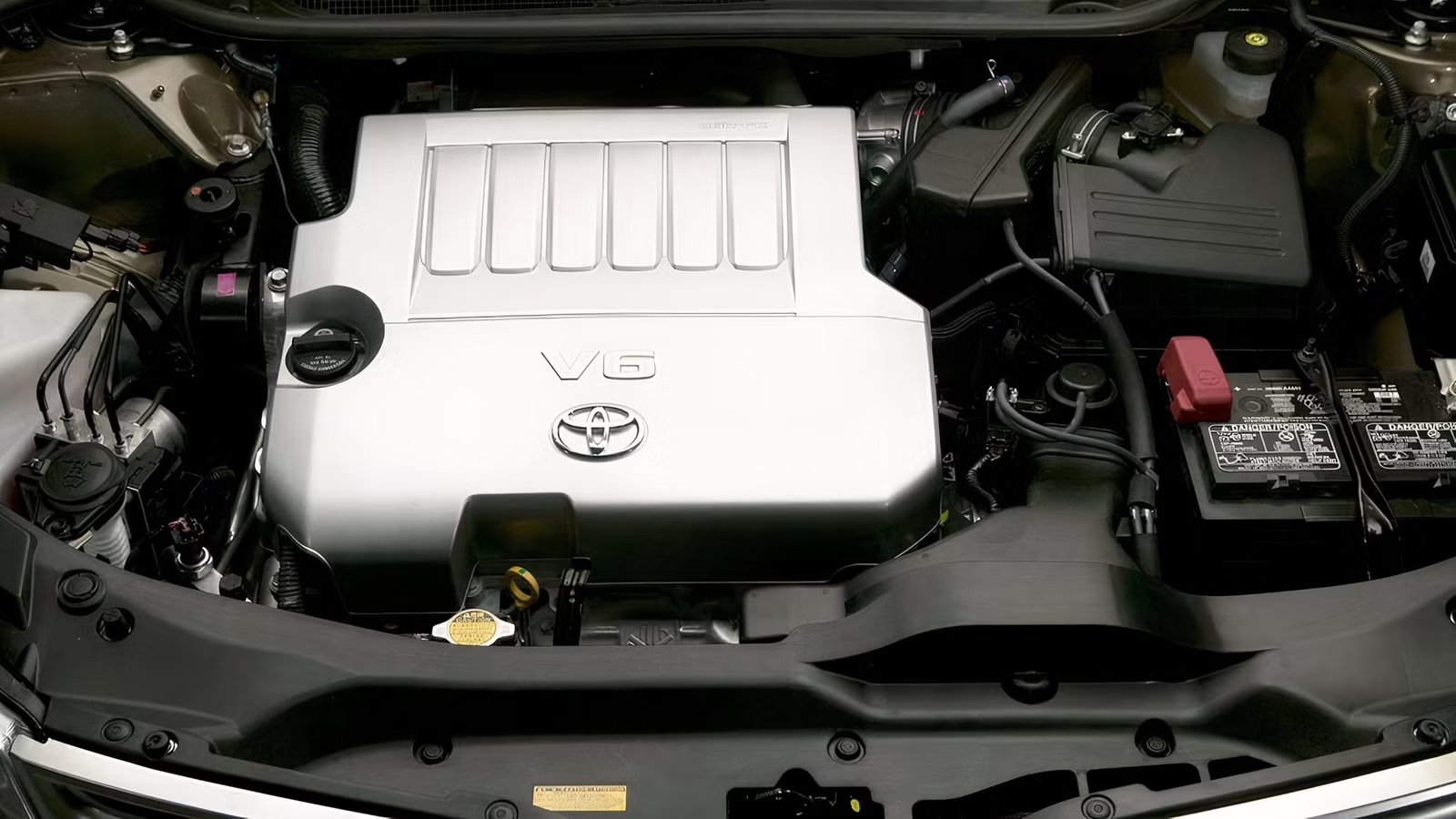
Toyota has a few engines that we could happily drive for a couple of hundred thousand miles with proper maintenance, but this legendary V-engine has to be seen as one of the most reliable and sturdy ever built.
What BMW And Mercedes Got Right — And Why Toyota Did It Better
Peak horsepower might win headlines, but it rarely determines whether an engine becomes one of the most reliable ever built. The engines that enthusiasts remember decades later are the ones that start every morning, shrug off high mileage, and keep delivering consistent performance with little more than routine maintenance. Something like BMW’s M57 turbo-diesel fits the bill here.

Despite never chasing record-breaking output, its cast-iron block, forged rotating assembly, and conservative factory tuning make it capable of covering hundreds of thousands of miles with impressive resilience. It hasn’t become a favorite because it is the fastest diesel of its era, but because it balances strong torque with durability.

Mercedes-Benz’s OM606 follows a similar philosophy. This straight-six diesel wasn’t built to dominate the spec sheets, yet its overbuilt bottom end, mechanical simplicity in earlier versions, and ability to take on huge mileage have earned it near-legendary status among people in the know.
We have all come to learn that an engine with generous safety margins and thoughtful cooling often proves a lot more valuable than something that kicks out 500 horsepower. It may be painted with the same brush as a lot of German machines, but many an OM606 engine has cruised past 500,000 miles, and it makes you think twice whether it is just the Japanese brands that know what they are doing in terms of durability.
The Benchmark Engines That Prove Simplicity Always Wins Long-Term

It does feel good when your car’s engine throws you back into your seat and can take on the best sports cars, but that is not where greatness comes from. Toyota’s UZ-series V8s show that lasting greatness comes from refinement as much as power. Whether fitted in a luxury sedan or SUV, these naturally aspirated V8s deliver effortless power, low vibrations, and have shown an ability to do 300,000 miles without a major rebuild. Conservative engineering, an understressed design, and robust materials have kept these engines going predictably for decades.
Honda’s K24 four-cylinder tells the same story, but from a different angle. Rather than relying on outright displacement or forced induction, it combines a rigid aluminum block, durable timing chain, efficient i-VTEC system, and excellent thermal management in an engine that can be driven hard or gently with equal confidence. Affordable servicing, which Edmunds estimates will cost just over $3,000 for repairs to a 2022 ILX, with some of that low cost attributable to the K24 under the hood, a wide availability of parts, and a reputation for keeping going, has made it one of the benchmark engine families for longevity.
The Toyota 3.5-Liter 2GR-FE V6 Became A Benchmark For Reliability

For 18 years, Toyota and Lexus equipped the 3.5-liter 2GR-FE V6 in their minivans, SUVs, sedans, and coupes. We unfortunately saw the last 2GR-FE grace a model in the U.S. in 2022, but in that time, it became a real icon for easy, everyday power that you can trust.
Naturally Aspirated Design Built To Handle Hundreds Of Thousands Of Miles

Toyota is known for its reliability anyway, but the naturally aspirated 2GR-FE V6 has quietly been there, chugging along and making life easy. Beyond the role of owner maintenance, the engine’s longevity comes down to the way Toyota built it.
The highest mileage claims for vehicles with a 2GR-FE range from between 440,000 and 448,000 miles, while the most documented claim was from an owner of a 2008 Sienna, who put just shy of 372,000 miles on the clock. They did change the water pump at 327,000 miles and the fuel pump at 337,000 miles, but apart from that, 20,000-mile oil changes were all that was needed.

An engine does not remain in production for nearly two decades unless it consistently delivers where it matters. The 2GR-FE earned Toyota’s trust as much as it did ours, and Toyota made the most of its reputation, fitting it in millions of vehicles here in the U.S., proving it had engineered a powertrain capable of meeting vastly different demands while remaining dependable.
Used Across Toyota And Lexus Models For Years Of Proven Performance


It is almost easier to list the Toyota and Lexus models between 2005 and 2022 that did not end up with a 2GR-FE under the hood, either as an option or as the standard engine. For Lexus, this bulletproof engine was used in the ES 350 between 2007 and 2018, the RX between 2007 and 2015, the RX 350L between 2018 and 2022, the IS 350 between 2006 and 2020, the GS 350 between 2007 and 2020, and the RC 350 between 2015 and 2022.
The first model in the U.S. to get a 2GR-FE V6 was the 2005 Avalon, which it continued to use until 2018; the Camry was fitted with it between 2007 and 2017, the RAV4 between 2006 and 2012, the Sienna between 2007 and 2020, and the Venza between 2009 and 2015. That is even before mentioning the models we didn’t get in the U.S., like the Aurion, Blade Master, Alphard, and Mark X, and early models of the Highlander Hybrid that got a slightly different version (the 2GR-FXE).

There is another reason the 2GR-FE found its way into so many different vehicles. It was not because Toyota had run out of ideas or lacked the motivation to develop something new; it was because the engine was so well-judged that it rarely felt out of place.
Whether pulling a family-packed Sienna, providing a smooth Lexus ES experience on the highway, or giving the Camry a surprising turn of pace, the same V6 seemed to fit the bill wherever Toyota put it. That kind of versatility does not happen by accident; Toyota executed it with intention.
The Understressed V6: How Running Below Its Limits Built The 2GR-FE’s Reputation

Toyota has never been a brand that builds engines to get a driver to 60 mph in less than three seconds, and the 2GR-FE is probably one of the best engines it has made that fits this philosophy. Rather than squeezing every last drop of horsepower from its 3.5-liter displacement, Toyota focused on creating a naturally aspirated V6 that always feels understressed.
There is generally always enough power on tap for everyday driving, but just as important, it never feels like it is operating anywhere near its mechanical limits to deliver that performance.
Strong V6 Performance Without Turbocharger Complexity

The maximum stock output from a 2GR-FE V6 is 306 horsepower and 277 pound-feet of torque, as found under the hood of the Lexus IS 350 and GS 350, which is not a huge figure when you consider that, by the mid-2000s, many manufacturers were chasing the evolution of turbo tech and trying to extract maximum power from turbocharged inline-fours. Toyota resisted this trend for the most part, instead relying on displacement and efficient breathing, while keeping a sensible 10.8:1 compression ratio.
The 2GR-FE features an aluminum block, which is strong and aids weight reduction, cast-iron cylinder linings to withstand years of heat cycles, heavy-duty connecting rods, a forged steel crankshaft, and chain-driven dual overhead camshafts. It is overbuilt where it counts.

Peak power output is generally cited around 6,400 rpm, while peak torque is delivered around the 4,800-rpm mark. It also gets Toyota D-4S, which combines direct and port injection, and means that there is a strong torque pull right across the rev range.
Probably the most important factor for its longevity, though, is that it is naturally aspirated, which means there are no complex turbo or hybrid systems to go wrong. There are no extreme temperatures from a turbocharger, and no intercoolers or boost pipework to develop leaks. Simplicity alone doesn’t guarantee dependability, but reducing the number of high-stress parts certainly improves the odds.
Smooth Power Delivery Makes Everyday Driving Easy

If there is something we like about V engines, it is smoothness. The 2GR-FE V6’s smoothness comes from a combination of Toyota-grade choices rather than one standout feature. Its 60-degree layout provides a naturally balanced foundation, while a carefully tuned rotating assembly and engine mounts help to cut out vibrations before it hits you in the cabin.
Dual VVT-i also plays a role here. It continuously adjusts intake and exhaust timing, which means you get optimized valve timing across the rev range. It is one of the main reasons why low-speed responses are good, and high-rpm airflow feels natural. There is no sudden surge of torque, and the engine delivers power progressively, making acceleration feel predictable and refined.
Simple Toyota Engineering Helps Keep Maintenance Costs Low

According to CarEdge, the average ten-year maintenance and repair cost for a Toyota model is $5,470. That makes repairing and maintaining a Toyota $3,501 cheaper than the market average over the same time period. CarEdge also says that there is a 14.97 percent chance a Toyota model will need a major repair in the first 10 years, which is 10.46 percent better than the market average.
A lot of these low costs come from Toyota’s approach to engineering. Engines like the 2GR-FE are equipped with modern technology where it genuinely helps, but avoid adding unnecessary complexity. A timing chain, naturally aspirated design, and proven internal components refined over time, combined with a relatively uncomplicated VVT-i system, deliver both flexibility and durability in one long-lasting package.
Toyota Proves Great Engines Don’t Need To Be Complicated

Toyota’s 2GR-FE V6 does have its shortcomings; some versions have developed issues with leaking timing-cover seals, VVT-related oil leaks, faulty water pumps, and carbon build-up thanks to the direct injection system. It does prove that even Toyota engines do need proper maintenance to keep them seeing the high miles. However, the 2GR-FE’s bulletproof reputation did not come from being perfect, but from how rarely its problems overshadowed what it did well.
The 2GR-FE V6 was never designed to be a technical showpiece; it was built to suit the needs of everything that Lexus and Toyota were making at the time, so it had to be predictable, smooth, and just work. That meant, from the start, most unnecessary complications found in modern engines were left out, and focusing on components built to last through everyday use for decades took priority. Great engineering is often less about accumulating technology, and more about knowing exactly what is and is not needed. An owner of a 2015 Sienna on Kelley Blue Book said the following.
I have owned this base L model since 2015 when it had 100K miles on it, now it has 202K miles. With this minivan, I have moved a lot of stuff for college and house moving. With the 2nd row chairs removed, it basically is a moving van. Compared to a truck, I do not have to worry about the weather, and more secure. The 3.5 L V6 is a very nice engine, plenty of power and very smooth.
Sources: Toyota, iSeeCars, CarEdge, Edmunds, Kelley Blue Book, and RepairPal.

Related posts




Latest Post


No Comments