
The Forgotten Two-Stroke That Beat The GSX-R750 To Aluminum Frames By Two Years
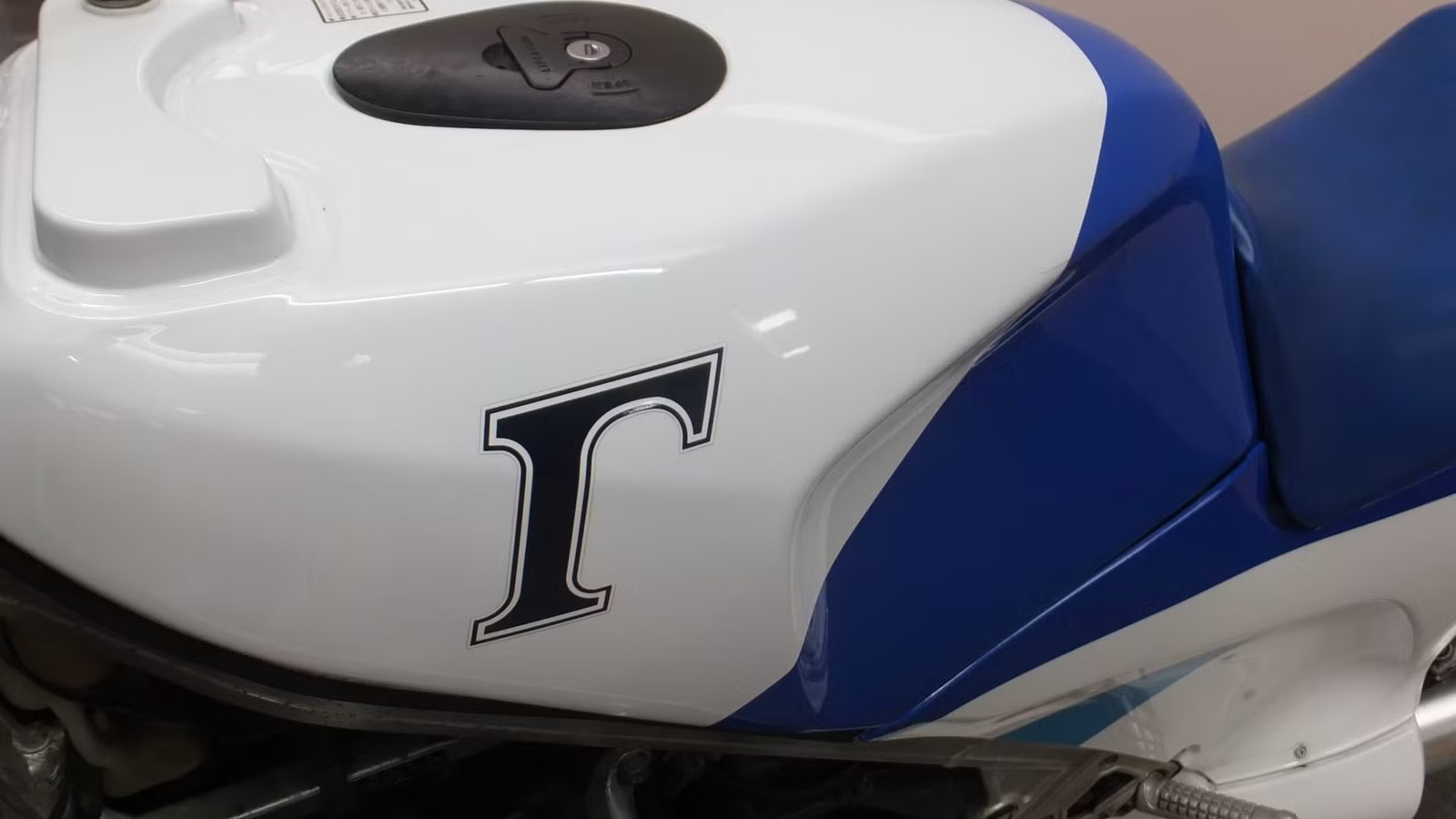
Everyone credits one bike with kickstarting the aluminum-frame sportbike era, and everyone is off by two years. Before that famous four-stroke supersport arrived and rewrote the rulebook, Suzuki had already built something smaller, stranger, and considerably more radical, a race-bred two-stroke that borrowed its frame technology straight from a factory Grand Prix program. It sold in small numbers, never officially reached American shores, and today is treated as a footnote next to its more famous descendant. That story deserves correcting.
The Race To Build A Lighter, Stiffer Sportbike Frame

By the early 1980s, Japanese manufacturers were locked in a technical race that had little to do with horsepower. Steel frames had defined motorcycle chassis design for decades, offering strength but adding weight exactly where engineers least wanted it: high in the chassis and far from the center of gravity. Grand Prix racing had already proven that aluminum could do the job with a fraction of the mass, and every manufacturer with a competition program understood that whoever brought that technology to a production motorcycle first would claim a genuine engineering headline. The problem was manufacturing aluminum at the volume and cost a road bike demanded, something nobody had solved yet.
Most manufacturers treated this as a problem for their flagship models, the big-displacement machines that got the marketing budget and the showroom spotlight. One manufacturer took a different approach, testing the technology first on a smaller, cheaper, far less glamorous machine that almost nobody outside Japan would ever see. That decision looked strange at the time. It also meant the real breakthrough moment in aluminum-frame sportbike history happened on a bike most enthusiasts today have never heard of, years before the machine that gets all the credit for it.
A Small Two-Stroke With Grand Prix DNA


The bike in question was built around a small-displacement two-stroke engine, but nothing else about it felt small. Its running gear came almost directly off the manufacturer’s premier-class Grand Prix racer, including anti-dive front forks, a rising-rate rear monoshock, and a front tire size borrowed straight from the race paddock rather than anything else sold to the public at the time. Even the instrument cluster gave the game away. The tachometer didn’t bother marking anything below 3,000 rpm, since the engine had no meaningful business operating down there, a small detail that told riders exactly what kind of machine they had actually bought before they ever twisted the throttle.
That single-minded focus came at a cost. The engine needed to be kept spinning hard to make any real power, and the chassis, brakes, and suspension were all tuned for a rider who intended to use every one of those revs. It was, in every meaningful sense, a Grand Prix racer with license plates and a horn, sold through ordinary dealerships to riders willing to accept a small-displacement two-stroke that demanded to be ridden like a race bike rather than a commuter. Few manufacturers were willing to sell something that uncompromising to the general public, which made this bike stand apart from almost everything else in showrooms.
The Suzuki RG250 Gamma Rewrote What A 250 Could Be

That bike was the Suzuki RG250 Gamma, introduced in 1983 as a genuine road-going expression of the manufacturer’s Grand Prix know-how rather than a styling exercise wearing race graphics. It kicked off what became Japan’s racer-replica boom almost single-handedly, and it did so without ever officially crossing the Pacific, remaining a Japanese domestic market machine that American riders could only read about in imported magazines. Power came from a 247cc liquid-cooled two-stroke parallel twin producing 45 horsepower at 8,500 rpm, a figure that hit the Japanese manufacturers’ voluntary ceiling for the 250cc class.
Suzuki paired that engine with a 16-inch front wheel, anti-dive forks, and Full Floater rear suspension lifted almost directly from its factory racing program, along with Michelin tires, a first for any Japanese production motorcycle. Suzuki’s own later model history credited the RG250 Gamma as the bike that proved race-bred technology could be sold to ordinary riders, a philosophy the company then carried into its larger four-stroke sportbikes that followed.
The Aluminum Frame That Beat Everyone To The Punch

The RG250 Gamma’s real historical significance had nothing to do with two-stroke power delivery and everything to do with what held the bike together. Suzuki built its chassis, badged AL-BOX, entirely from aluminum box-section extrusions rather than steel, and the finished frame weighed just 7.6 kg, a figure practically unheard of for any production motorcycle in 1983. That made the RG250 Gamma the first mass-production motorcycle ever built around a lightweight aluminum frame, full stop, not qualified by class or displacement. Suzuki’s own GSX-R750, the bike most enthusiasts credit with starting the aluminum-frame revolution, did not reach dealers until the 1985 model year on its own aluminum MR-ALBOX frame, one that weighed 8.1 kg, heavier than the two-stroke that beat it to market by two full years. The GSX-R750 got the magazine covers and the lasting fame. The RG250 Gamma got there first.
How The RG250 Gamma Compares To The Bikes It Influenced

Comparing the RG250 Gamma with the bike that eventually took credit for its breakthrough says a lot about how motorcycle history actually gets written. One machine was a small-displacement two-stroke sold in limited numbers outside Japan and never officially exported to the United States. The other became a global sales phenomenon that founded an entire supersport category and turned Suzuki’s GSX-R badge into shorthand for serious performance. Only one of them, however, can claim to have gotten there first.
The Bike That Got The Credit Two Years Later

The Suzuki GSX-R750 arrived for the 1985 model year with a 749cc air and oil-cooled inline four claiming around 100 hp, a dry weight of about 179 kg, and an aluminum frame that borrowed the same lightweight-extrusion philosophy the RG250 Gamma had already proven on a smaller scale. Where the RG250 Gamma stayed a niche, race-replica curiosity mostly confined to Japan and Europe, the GSX-R750 became a genuine commercial and cultural phenomenon, credited with founding the modern supersport class and inspiring nearly every aluminum-framed sportbike that followed it. The RG250 Gamma cracked the engineering problem first. The GSX-R750 simply had the displacement, the marketing muscle, and the timing to build on it.
That gap between quiet pioneer and global phenomenon shows up clearly in today’s collector market, though not in the direction most people expect. Original RG250 Gammas have sold at auction for figures in the $8,000 to $11,000 range in recent years, according to recent RG250 auction results, while its bigger sibling, the 500cc RG500 Gamma built from the same racing philosophy, has fetched over $25,000 at auction, per a recent RG500 sale result. That price gap has little to do with historical importance and everything to do with displacement and reputation; the smaller Gamma that actually pioneered the aluminum frame remains the more affordable entry point into genuine 1980s Suzuki racing history.
The Small Bike That Started A Revolution

Every aluminum-framed sportbike built since 1985 exists because Suzuki proved the concept could work in the real world, not in a lab or a Grand Prix paddock. That proof came from the RG250 Gamma two years earlier, a bike most casual enthusiasts have never heard of and one that never even reached American shores. Suzuki’s engineers took a lesson learned on a small, temperamental two-stroke and scaled it up into the machine that actually gets remembered for changing everything, and history has largely accepted that version of events without asking which bike came first.
That is worth correcting. The RG250 Gamma was not a warm-up act or a curiosity that happened to precede something more important. It was the actual origin point, the machine that proved aluminum belonged on a showroom floor and not just a factory racer, and every rider who has ever swung a leg over a modern aluminum-framed sportbike owes that small, screaming two-stroke a debt it has never publicly received. The GSX-R750 wrote the history books. The RG250 Gamma wrote the engineering.
Sources: Iconic Motorbike Auctions, Suzuki

Related posts




Latest Post


No Comments