
The Twin-Turbo V6 That Changed American Performance
Bob Dylan once famously sang “The Times They Are a-Changin’.” It’s unlikely that the Minnesotan folk singer was thinking about the downsizing and forced induction of performance internal combustion engines in the distant future, as well as the rapid introduction of EV and hybrid technology. However, the sentiment certainly fits with the current state of the automobile industry — the times are changing, and we can’t rely on thirsty V8s forever.

The song, incidentally (and perhaps coincidentally), comes from 1964, which ties it in nicely to another aspect of fast cars — it was the year the Pontiac GTO started the whole muscle car scene. This car helped to not only change the landscape for American fast cars, but remodel it based around the V8 engine. The eight-pot would be the cornerstone of the industry for decades to come, until one model dared to break the mold with a twin-turbo V6…
American Performance = Big V8s
Even before the Pontiac GTO created the template for fast American cars for decades to come, there were models like the Oldsmobile Rocket 88. This pre-muscle muscle car was fitted with a 303 V8 — already there is a trend forming, and it was eight-cylinder shaped. Even when America entered the supercar arena with cars like the Ford GT40, the De Tomaso Pantera, the Vector W8, and the 254 mph Callaway Sledgehammer, they all had V8s of some sort.

But this engine makes perfect sense. No matter what American company you look at, it will have a V8 that has been tried and tested across ranges, is tunable, powerful, reliable, mechanically straightforward, and torquey — the V8 has pretty much every base covered. So why would anyone change the formula? One manufacturer decided it was time.
The Second Generation Ford GT Decided To Change The Game

The year 2005 may not seem like that long ago, but in car years it is a different time altogether. The V8 muscle car was coming back into fashion, and Ford decided to celebrate its centenary with a supercar: the first GT. It looked like a ’60s GT40 but was completely modern, although looking back it wasn’t as groundbreaking as it seemed. At its heart was a hand-built 5.4-liter supercharged V8, linked to a six-speed manual. The street Ford GT40 Mk III of the ’60s was powered by a detuned 4.7-liter Ford small-block V8, linked to a five-speed manual. Same tech ballpark then.
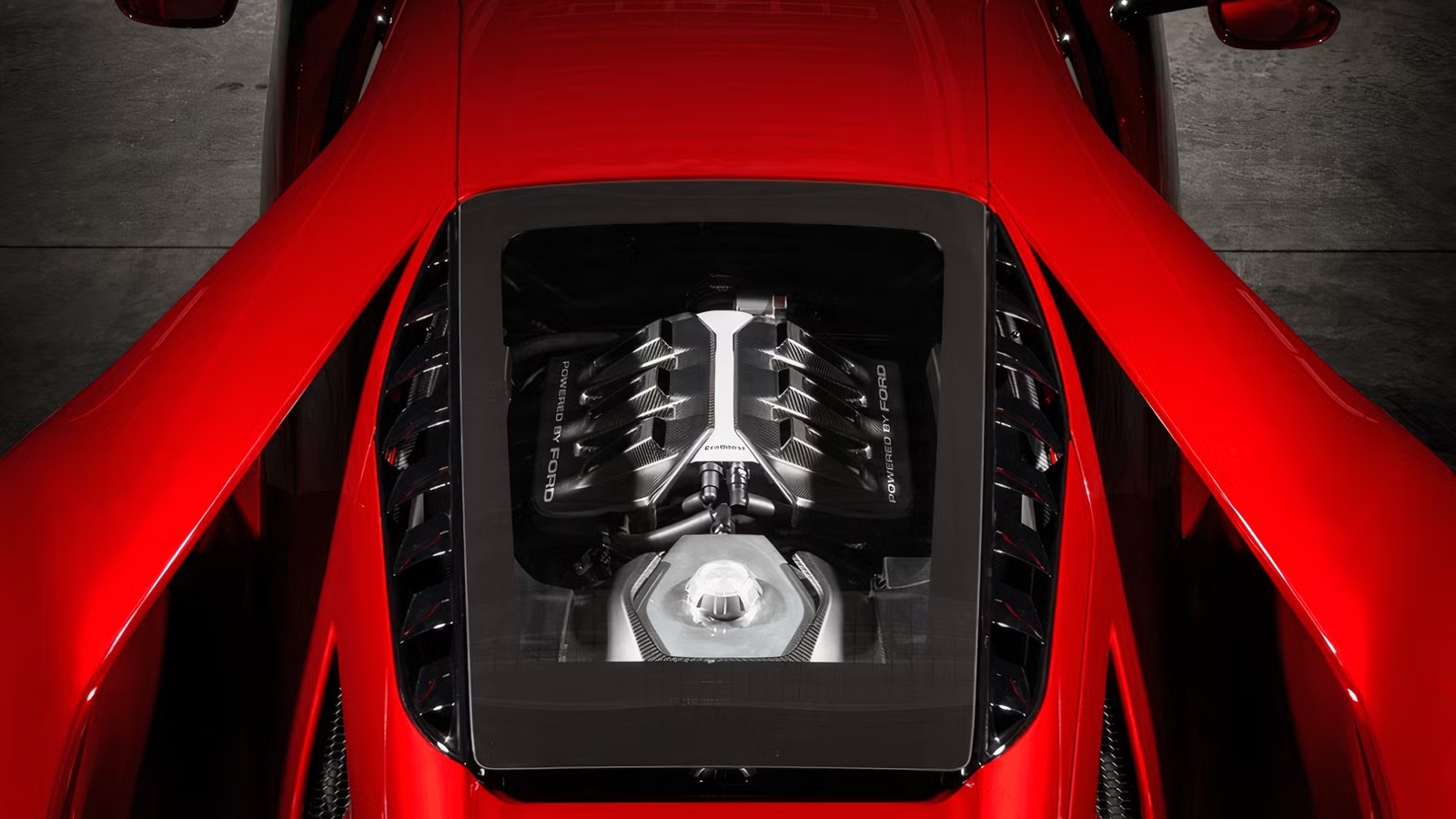
When Ford revisited its new GT supercar for a second version, which would debut a decade later, it would be very different. At the heart of the new GT was the most powerful EcoBoost production engine ever made by Ford, a 3.5-liter twin-turbocharged V6 producing more than 600 horsepower and 550 lb-ft. This unit was connected to a Getrag 7DCL750 seven-speed dual-clutch transaxle transmission with paddle shifters.
Ford Wasn’t Just Trolling Car Fans — Here’s Why It Went V6

There were multiple logical reasons that Ford switched to a V6, and none were to do with grabbing a few headlines. There was talk of it helping with the FIA’s Balance of Performance rules on a return to Le Mans, but in reality, it was mostly to do with packaging. The smaller engine also helped with the car’s aerodynamics. Having a narrow V6 allowed the GT to have a teardrop shape, with a narrow cabin and dramatic “flying buttress” rear pillars that funneled air cleanly around and over the car and over the rear spoiler. In front of the rear wheel arch, an intake feeds air to the turbo intercoolers, before shooting it out through the center of the rear lights.
The GT Helped Change Perceptions For The US Market

There was also the added benefit of promoting the EcoBoost technology that was just being launched in the Mustang. If the Blue Oval’s supercar had a boosted, smaller engine, then why couldn’t a Mustang? Finally, this was (and still is) an era of change, where V8s are a dying breed. Ford likely saw the opportunity to showcase how an American performance car could be incredibly fast without eight cylinders. Just as with hybrid supercars such as the Ferrari 296 GTB, it is a tall ask to get customers to downsize, but if the V8 is on its way out, then carmakers realize that they need to change customers’ perceptions fast.
The Ford GT Didn’t Give Anything Away To A V8

For anyone worried that the Ford GT would be lagging behind “proper” supercars with its V6, it was quick to prove them wrong. The 2017 Ford GT can reach 60 mph in a scant 3.0 seconds, with 100 mph arriving in 6.2 seconds, and the quarter mile demolished in 10.8 seconds. The top speed is 216 mph.
Compare that to the 2006 GT and you realize that when you have some clever engineering and a couple of turbochargers, the V8 isn’t necessary. The earlier GT, with its 500-hp supercharged V8, will reach 60 mph in 3.3 seconds, and cover the quarter mile in 11.6 seconds. The Ford GT wasn’t just impressive against V8s. Compared to a 2017 Lamborghini Aventador S, fitted with a roaring 730-hp V12, there really isn’t much in it, despite the GT only having half the cylinders and the engine being roughly half the size. The Lamborghini reaches 60 mph in 2.9 seconds, 100 mph in 6.2 seconds, and will clock a quarter mile in 10.7 seconds.
Fans Didn’t Seem To Care If The GT Had Two Fewer Cylinders

No one seemed to care whether the GT had a V8 or a V6; they wanted to buy the car anyway. The second version of the modern GT was reportedly sold out, and while buyers were apparently told to keep hold of their cars for two years after buying new, they had no trouble moving them on afterward. One report said that a 2017 Ford GT sold for $1.5 million in 2019, three times its original sticker price. In 2018, it was also widely reported that Canada’s Multimatic was asked to produce an extra 350 examples beyond Ford’s previously planned 1,000-unit run of the GT. In 2023, Ford unveiled the Ford GT Mk IV, a final track-only model with superior aerodynamics and 800 hp from the V6. Only 67 of them were scheduled to be built by hand.
Buying A Second Gen Ford GT In 2026

These days, a Ford GT from 2017 in good condition will cost you $788,000, says Hagerty’s Valuation Tool. That is considerably more than the $478,750 base price when new, and a strong indicator that the market is hot for these American supercars. Over at bringatrailer.com, Ford GTs from this era go for pretty much that kind of figure, with very low mileage examples naturally demanding more. Another Ford GT is rumored, but nothing has been confirmed officially by Ford. Whether this car will hang on to its V6, or have something completely different, only time will tell. But we now know that the future of American performance cars is not necessarily V8-shaped. One thing is certain: the Ford GT is a true supercar, whatever engine is bolted into the middle.
Sources: Hagerty, Ford

Related posts





Latest Post




No Comments