
A Guide To Buying A Chevrolet Corvette C7 (2014-2019)
1953 was a very important year for the American car industry. That year, at the General Motors Motorama, which they held at the Waldorf-Astoria in New York, they showed off a show car that was nearly production-ready, which they wanted to pitch against all the greatest established European sports cars. There was no plan to bring the show car into production, but the interest was so big, Chevrolet did just that, and they named it the Corvette.

Almost 70 years, plenty of special editions, and eight generations later, the Corvette still remains America’s patriotic answer to the greatest European sports cars. Up until the current C8, all Corvettes had their engine in the front, and the most recent iteration of the front engine Corvette breed, the C7, should definitely be on your used performance car short list.

Overview Of The C7 Corvette
The C7 Chevy Corvette, as the name implies, is the seventh generation of the iconic American sports car. Chevy first introduced it in 2013, for the 2014 model year, and lots of exciting changes were afoot for the ‘Vette. The C7 is the final generation to use a front-engine, rear-wheel drive layout, before the current C8 moved to a mid-engine layout. Incidentally, the mid-engine layout is something Corvette engineers wanted to do for decades and decades, trialing a variety of mid-engine prototypes throughout the 20th century. However, the C7 keeps things old school.
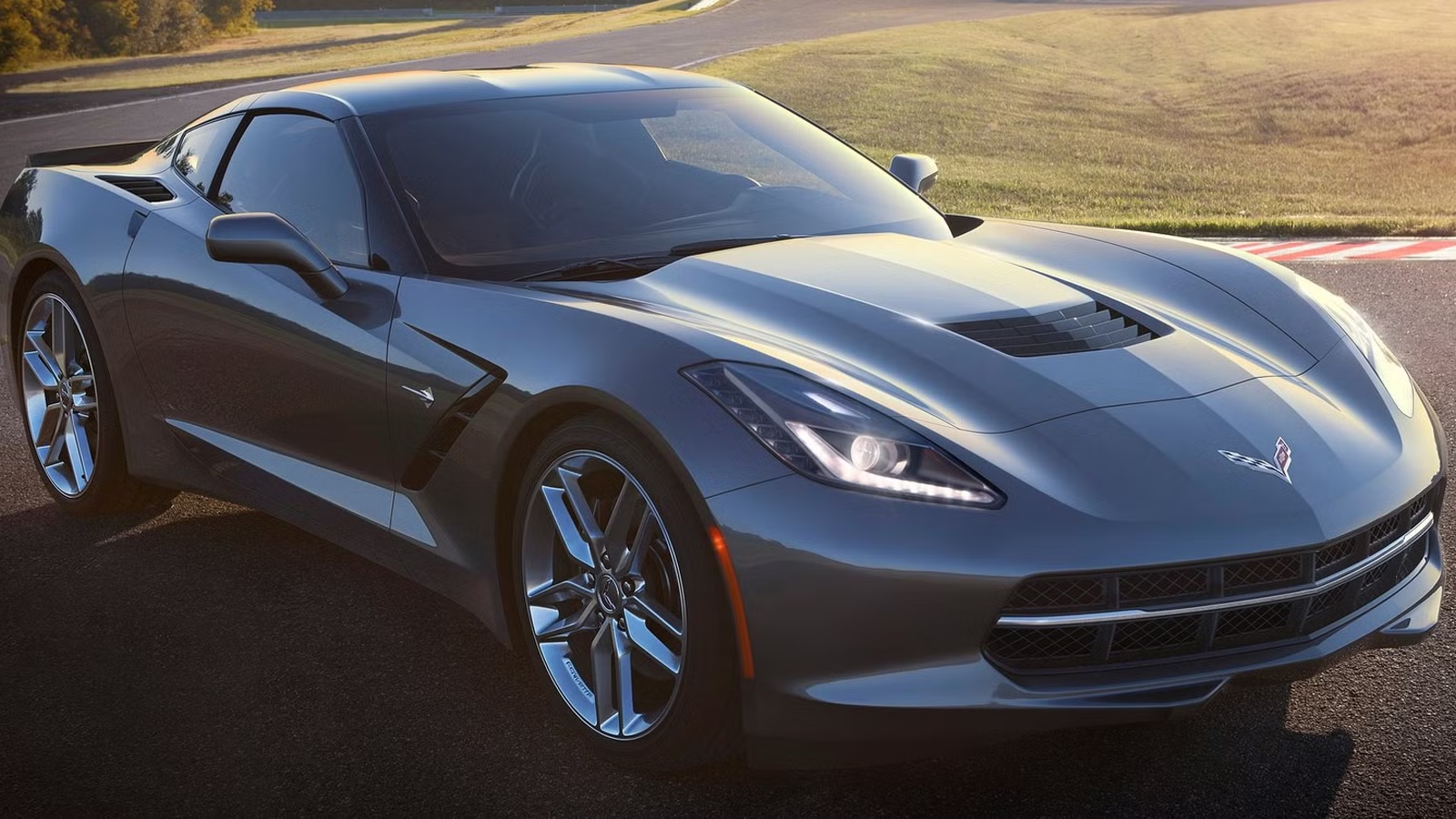
The styling was right in the middle of evolutionary and revolutionary. The C7 has the same iconic shape, but it foregoes the C6’s rounded design for a more squared off, sharp look. The front-end looks much more modern, but it still includes the iconic grille and vertical headlights with the signature L-shaped running lights. This is the only Corvette generation to get vertical taillights. The side still includes the iconic air vent on the front quarter panel, meanwhile the rear features the iconic quad taillights and centralized quad exhausts. Chevy modernized and redid all of these elements, meaning they perfectly fit with the Corvette’s new design language, and it still looks modern even today. Chevy offered the C7 Corvette as either a coupe or convertible, along with a variety of trim levels and option packages. It competed with the likes of the Porsche 911, Nissan GT-R, Aston Martin V8 Vantage, and Mercedes AMG-GT.
C7 Corvette Powertrain And Drivetrain

The major changes on the C7 Corvette were under the hood. It broke tradition, because it didn’t use the classic LS V8 like the previous two generations. Instead, Chevrolet used the C7 Corvette as a platform to debut the Generation V lineup of small block V8 engines. The unit under the hood of the base C7 is the LT1, displacing 6.2-liters, and it puts out 455 hp and 460 lb-ft of torque in base form. With the optional Performance Exhaust, this output jumps by 5 for each figure to 460 hp and 465 lb-ft of torque. Those may not seem like super high numbers nowadays, but it could do 0-60 in 3.9 seconds with the manual transmission, which isn’t too shabby. Also, Chevy offered a lot more power in other trims, but more on that shortly.
About that manual transmission, the C7 Corvette used a seven–speed manual, much like the Porsche 911 from the same time period. Chevy also gave the C7 Corvette active rev matching tech, so you don’t have to heel-and-toe on downshifts, but you can disable it if you prefer to do that yourself. The first model year also gave you the option of a six-speed automatic, but after that, Chevy brought along a much improved eight-speed automatic. Naturally, every C7 Corvette sent its power to the rear wheels, and with all the chassis tuning and improvements, the C7 was way more competent in the corners than its predecessors. This is especially true of the Z51 Performance Package-equipped cars, as they include Magnetic Ride Control, also found in a lot of other GM products, and Performance Traction Management.
From Stingray To ZR1: Every C7 Corvette Trim Explained

Chevy has long offered Corvettes at different performance levels, and the C7 was no exception. From the everyday thrills of the Stingray to the insane ZR1, the seventh-generation lineup had something for nearly every performance-car enthusiast, and the differences went far beyond horsepower.
The Stingray served as the entry point, pairing a naturally aspirated 6.2-liter LT1 V8 with 455 hp and 460 lb-ft. Opt for the performance exhaust, and output climbed to 460 hp and 465 lb-ft. Buyers seeking sharper handling could choose the Z51 package, which brought dry-sump lubrication, an electronic limited-slip differential, additional cooling, upgraded brakes, chassis revisions, and functional aero enhancements. A 2014 coupe carried a $51,995 starting price with destination included.

Chevrolet brought back the hardcore Z06 for 2015, this time with a supercharged 6.2-liter LT4 V8 generating 650 hp and 650 lb-ft. Built on strengthened LT1-family architecture, the engine powered a wider, more aggressive Corvette equipped with Magnetic Ride Control and serious track hardware. The optional Z07 package piled on carbon-ceramic brakes, track-focused Michelin tires, and extra aerodynamic components. The coupe originally cost $78,995. Arriving in 2017, the Grand Sport blended the naturally aspirated LT1’s 460 hp with Z06-inspired bodywork, brakes, and cooling. It was an enticing choice for drivers who wanted track-day capability without a supercharger. Its starting coupe MSRP was $66,445.

Chevy saved the grand finale for 2019. The 2019 ZR1 delivered 755 hp and 715 lb-ft from its supercharged LT5 V8, with the standard low-wing coupe capable of reaching 212 mph. The optional ZTK package added a larger adjustable rear wing, front-splitter extensions, stickier Michelin tires and revised chassis tuning. At high speed, its aerodynamic package generated up to 950 pounds of downforce, although the added drag reduced the coupe’s top speed to around 202 mph. Chevrolet built just 2,953 C7 ZR1s, and the coupe started at $119,995. Together, these models made the C7 lineup remarkably diverse, offering everything from an accessible V8 sports car to an outright supercar contender.
C7 Corvette Comfort And Quality

On the inside, the C7 Corvette made some massive strides to improve quality and fit and finish. The cockpit is still very much angled towards the driver, but this time, it no longer feels like you’re sitting inside a Cobalt or Malibu. The C7 is noticeably more high-quality compared to the lower-end Chevy models. However, it’s still not quite up to snuff compared to the Porsche 911 and Aston Martin V8 Vantage. It’s pretty easy to tell that this is a Chevy, and this is how they managed to give the Corvette a much lower price.
Still, that’s not to say the C7 lacked equipment. A partially digital gauge cluster, a large infotainment display, automatic climate control with heated and ventilated seats, cruise control, a heads-up display, SiriusXM satellite radio. The C7 also offers several selectable drive modes, as well as a variety of interior color and trim options, including some very premium looking light brown leather seats. The C7 Corvette seats only two passengers, and its cargo area boasts 15 cubic-feet of space. The convertible, unfortunately, drops to 10 cubic-feet. Chevy did offer a fitted luggage set, however.
C7 Corvette Prices

With C7 production ending in 2019, Chevrolet’s last front-engine Corvette has had nearly seven years to find its footing in the secondhand and collector markets. The Stingray offers the most affordable route into C7 ownership, averaging $47,963 on Classic.com, compared with the 2014 coupe’s original $51,995 starting price.
Stepping up to the Grand Sport means an average of $65,696, not far from its $66,445 launch price for 2017. The supercharged Z06 averages $79,382, similarly close to its original 2015 coupe MSRP of $78,995. Then there’s the ZR1, which is in a different league. Its average sale price of $188,169 far exceeds its original $119,995 coupe MSRP, reflecting its extraordinary performance and limited production of 2,953 cars.
These are market averages, not guaranteed prices. Mileage, condition, service history, options, and modifications can all affect what a specific Corvette is worth. From the accessible Stingray to the increasingly collectible ZR1, there’s a C7 Corvette for nearly every kind of enthusiast, but choosing the right one means balancing performance, rarity, and price.
Sources: Classic.com

Related posts




Latest Post


No Comments