
Here’s How Much It Actually Costs To Swap An LS Into A Classic Chevrolet
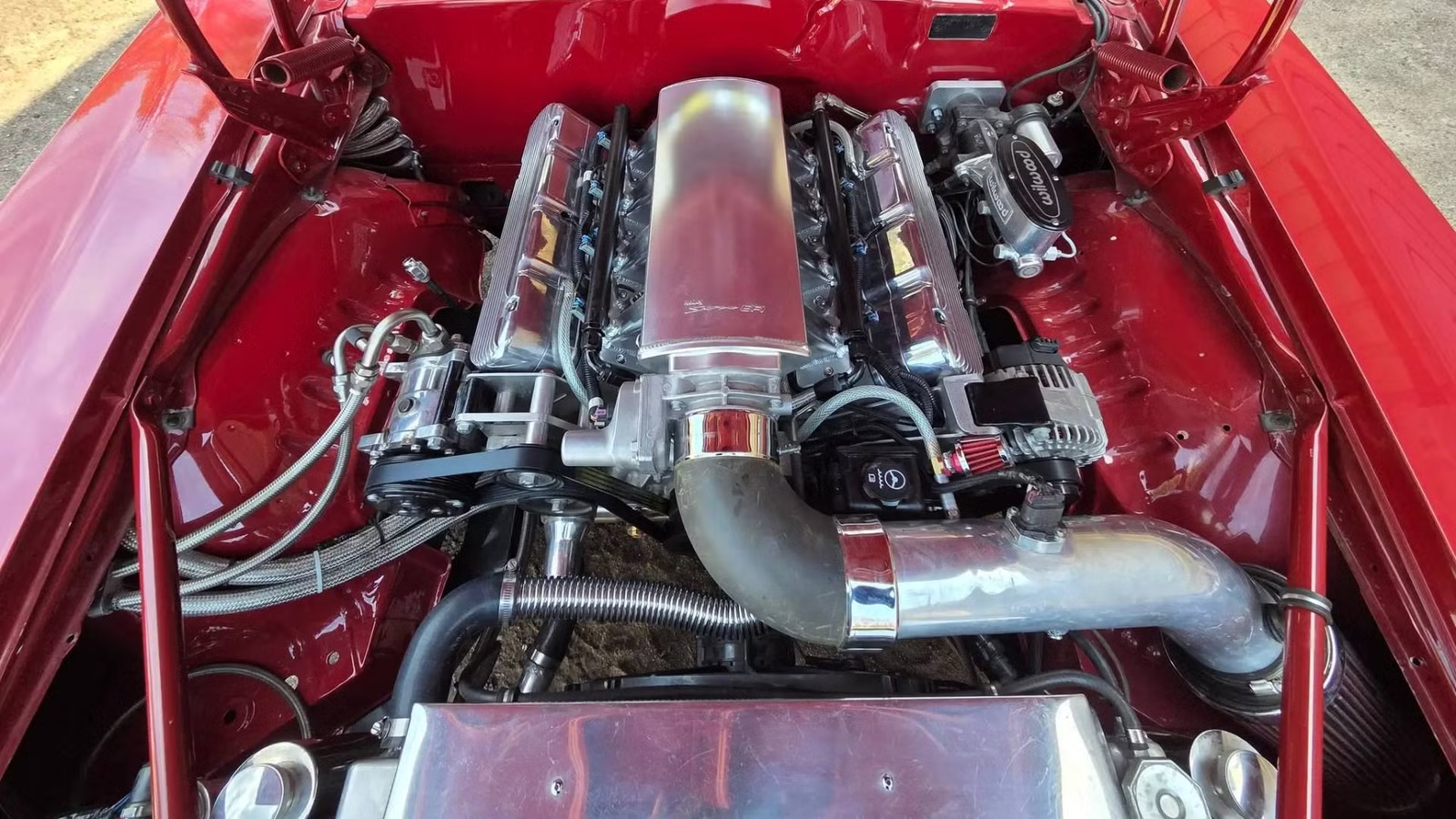
The General Motors LS V8 is the default engine for the resourceful DIY builder who wants to build a restomod without breaking the bank. There’s no set path to making it happen, but there are some considerations to make depending on how much power you want to put down, what kind of car you’re modding, and how much money you’re looking to spend. Today, we’re looking at the costs, facts, and figures behind the average LS swap, and maybe you’ll learn something new along the way. With an engine line this prolific, there’s always something novel to consider.
The LS: Not One Engine, but a Lineage

The LS V8 is far from a monolithic block of engines that all share the same hardware. It’s divided into a complex family tree spanning two primary generations of a larger small block V8 lineage. The saga began in 1997 with the introduction of the LS1 in the C5 Corvette, an all-aluminum marvel that changed the trajectory of the American V8. Yet the LS1 was more like a template than a single engine, and the democratization of the LS swap happened when GM rolled out the Gen III and Gen IV cast-iron variants—the legendary Vortec 4.8L, 5.3L, and 6.0L truck engines.
Found in millions of Silverados and Tahoes, finding a Vortec/4L60E gearbox combo in a junkyard for $1,500–$2,500 is a surefire way to save money on a restomod project. Suffice it to say, a $10,000 crate motor straight from GM is absolutely not a requirement. From a generational standpoint, the LS1 evolved into the Gen IV performance engines like the LS2, LS3, and the legendary 7.0-liter LS7.

The chances of finding one of these in a junkyard are minimal, but Gen-IVs found their way into a wide variety of cars over the years. Cars like the C6 Corvette, the revived Pontiac GTO, the fifth-generation Camaro SS, the Cadillac CTS-V, and even muscle trucks like the Chevrolet Trailblazer SS and SSR. Of course, that’s not counting niche super high-performance engines like the LS6, LSA, and LS9, as they all command prices in the five figures every day of the week. Without a blank check, iron blocks or wrecked LS1s and 2s are your best bet.

The Big Ticket Items: Powertrain and Placement

The specific LS you choose determines the scope of your entire budget. If you’re going the grassroots route, and we assume you are nine times out of ten, the above-mentioned junkyard iron block pull leaves you enough wiggle room to source your restomod base and have budget left over for the conversion components. Still, an engine on a stand is useless without the hardware to drop it into a vintage chassis, and this is where the costs begin to multiply. It doesn’t matter which classic Chevy or other vintage muscle car you choose—an LS block does not natively bolt up to traditional small-block Chevy (SBC) motor mounts, or any other for that matter.
In a DIY capacity, conversion adapter plates from companies like ICT Billet or Dirty Dingo typically cost around $150, but the cost in labor and equipment to mount the plates to a classic crossmember can easily inflate that price. Besides, you can’t even start to make alterations until you decide the platform you want. Fancy a smaller platform like a Gen-I Camaro or Nova? What about a Chevelle? Depending on the platform, your spatial challenges beneath the sheet metal differ entirely. Take the oil pan, for example. The deep rear-sump truck oil pans that come attached to those cheap 5.3L and 6.0L junkyard pulls hang agonizingly low, well past the cross member of classics.
A low-profile retrofit pan from a brand like Holley is practically mandatory, a $450 investment at the minimum. We’re still not factoring in custom exhaust headers that clear classic steering boxes, accessory drive brackets needed to keep the alternator from punching a hole in your hood, proper electrical work, ECU tuning, or forced induction. Added all together, and not factoring in items like brakes, suspension, or interior work, you’ll be out at least $4,500 to $5,000 just to get a naturally aspirated junkyard motor running safely under its own power. By the time it’s safely mounted in the car, that number looks more like $7,500 to $10,000 once you account for plumbing, cooling, and wiring. Even then, you’re not out of the woods yet.
Fuel, Fire, and the Brains
As any classic Chevy aficionado will tell you, most of them relied on low-pressure mechanical fuel pumps pushing anywhere from 5 to 7 psi to a carburetor. An LS requires a steady, high-pressure 58 psi to keep its fuel injectors happy. By the time you pair that with a modern fuel filter/regulator combo kit to manage system pressure and the return line, you’ll be out $500 to $1,000 on fuel delivery alone.
Cooling demands a similar upgrade. While some builders try to reuse an old radiator, an LS performs far better with an aluminum swap radiator with electric fans. More importantly, it requires proper steam port routing to prevent localized boiling and air pockets in the cylinder heads. A dedicated swap radiator setup will run between $400 and $800, or even more if you want additional capacity in the system.
Finally, there’s the wiring and engine management. If you kept the stock harness from your donor truck, sending it to a specialty shop to be stripped of VATS security, rear O2 sensors, and emissions equipment—plus a re-flash for a base tune—costs roughly $300 to $500. If you want a cleaner look and simple self-tuning capabilities, plug-and-play standalone systems like the Holley Terminator X take the headache out of the electrical phase completely, though they will set you back $1,000 to $1,500. Add it all up, and the powertrain alone will run $10,000 to $15,000. One can save big bucks if they grab the right white-box or used parts, but this is a fair general ballpark.
Sources: OnAllCylinders, Metalworks Speed Shop, Holley Performance Parts

Related posts




Latest Post


No Comments