
This 47-seat, 12.7-litre Kia is a metaphor for Korean industry
You know Kia as a car maker – but it’s an absolute industrial mega-power at home

It was the biggest Kia EV9 I’d ever encountered.
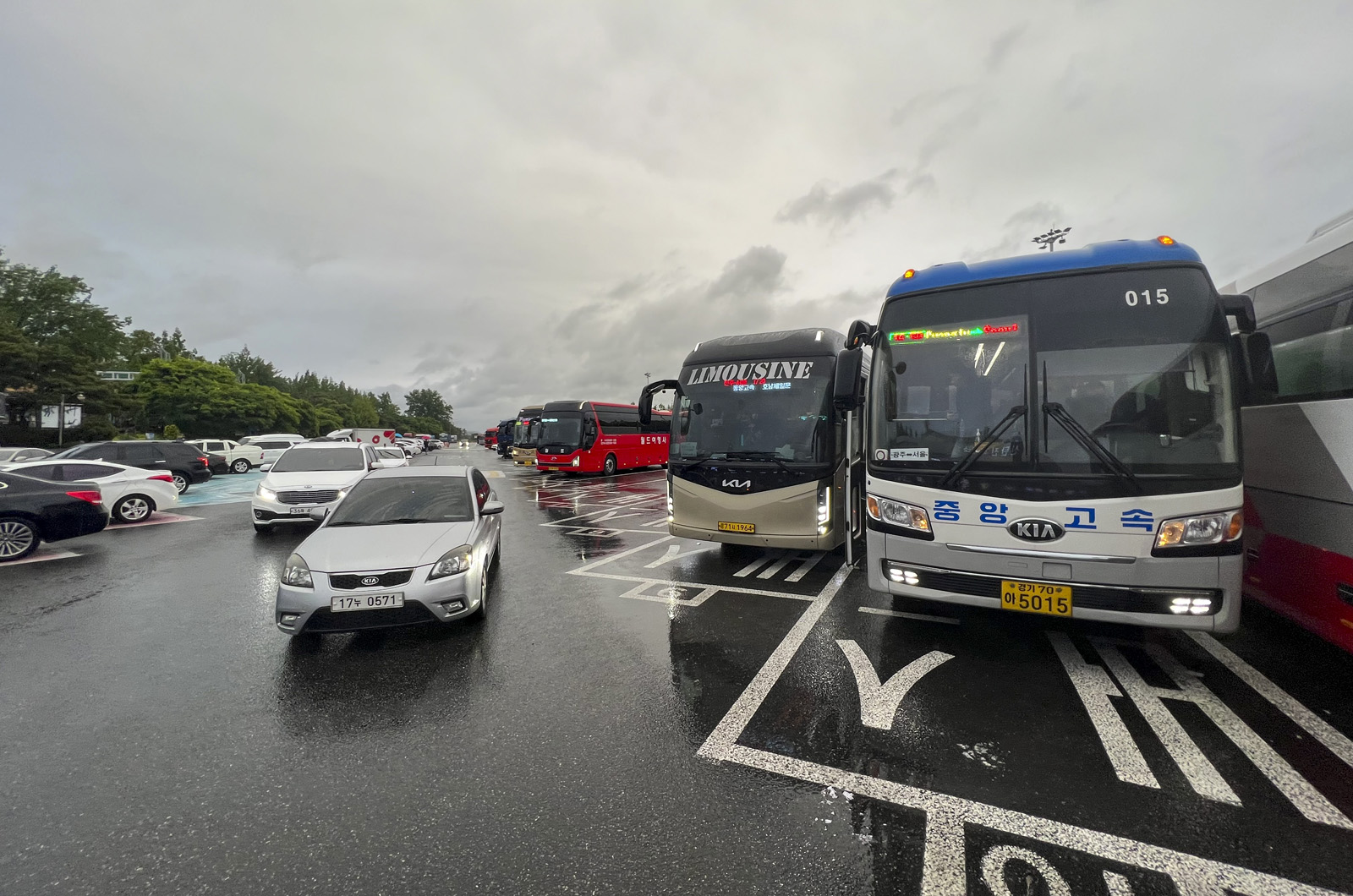
So big it could easily be identified even as it loomed over the horizon. But then, squinting through eyes bloodshot from the time difference to London, it dawned on me the Godzilla EV9 was no such thing but was in fact a coach.
A Kia Granbird Premium, no less, hauled by its 12.7-litre diesel six, which Google tells me can still be paired with a manual box. It was the vanguard of a long convoy heading to the Namyang R&D facility we’d just left, to shuttle workers home. But it had looked just like an EV9.

This was a striking reminder of industrial eclecticism – a realm where car makers stretch far beyond the products we deal with here at Autocar.
Honda makes everything from snow blowers to business jets; hop aboard the tram in Vienna and you’re effectively going for a ride in a Porsche; Subaru at one point made Apache helicopters under licence for the Japanese army and more recently has provided the wing boxes for Boeing 787 Dreamliners. And of course there are the commercial vehicles and car line-ups, but rarely are these made to look so similar.
Kia is perhaps the greatest exponent of using the same design cues across its portfolio, as I came to appreciate on a recent trip to Seoul. It’s very possible that Karim Habib, the company’s Lebanese design chief, has already left an equally omnipresent mark on the world’s roads as Willy Hofmeister, even with his six-decade head start.
Everything from the tiny, kei car-ish Ray to the mammoth Telluride SUV to the Tasman pick-up to the Granbird has the same look. The Bongo III compact pick-up is a notable exception, although its time will surely come. And Kia sensibly draws the line at its military portfolio, of course.
Or does it? The KMTV 6×6 cargo truck is a mine-resistant troop carrier useful for the crushing of insurgencies in the Philippines and for anti-terror operations in Chile. But inspect the ugly snout and, in a fabulous bit of covert branding, you will see the panels are discreetly stamped to show the Kia DRL bracket motifs. Pretty amusing-but the underlying story here is one of almost incomprehensible scale.
In South Korea, Kia and its sibling brands under the umbrella of the Hyundai Motor Group (HMG) really are everywhere. They aren’t simply props in the scene but often the scene itself, especially at rush hour, when the traffic is nose to tail, five lanes abreast.
There’s no comparison in Europe, because even Milan’s Stellantis-scape is dotted with German machinery and, in France, one of the most patriotic countries when it comes to indigenous car maker loyalty, not every single lorry or van you see is built by Renault.
HMG’s industrial dominance in South Korea is staggering. Never mind the Genesis-badged limousines and the crossovers and hatchbacks by Hyundai and Kia. Almost all the trucks, and the buses, and the refrigerated vans, and the fire engines, and the dustbin lorries, and the ambulances you see are also made by HMG. Oh, and the trains. Even the signals that keep the railway network running smooth. And remember that HMG also makes the steel for its various vehicle bodies. The degree of self-sufficiency is extraordinary.
At which point you begin to wonder how much this company is contributing to its country’s GDP. The answer is thought to be around 10% – a jaw-dropping stat that puts HMG alongside Samsung and LG as one of the countries foremost chaebols (the typically family-controlled conglomerates that make up the meat of the Korean economy). As for market share, HMG’s coverage is perhaps comparable only to Avtovaz in early post-Soviet Russia – a closed economy, let us not forget.
The only gap in that coverage is given away by the sight of the odd Porsche 911 in Seoul. HMG, for all its breadth, doesn’t currently make a pedigree sports car. But even this is about to change, with Genesis keen to go GT3 racing. If that Magma project comes good, a road-going counterpart will be required.
Then the hegemony will be complete. A street corner in Gangnam will feel uncanny – as though you’re wearing 3D goggles, immersed in an HMG corporate showroom. Everything will have been built by the same people. Deeply impressive, surreal and a little bit unnerving.

Related posts
Latest Post


No Comments