
The Convertible Catastrophe That SUV Enthusiasts Never Understood
America’s automotive landscape has spent the past decade falling in love with SUVs and crossovers. Buyers embraced their elevated driving position, family-friendly practicality, and year-round versatility, transforming the segment into the industry’s dominant force. At the very same time, another once-iconic body style steadily disappeared. Convertibles, long associated with carefree driving rather than everyday usability, became an increasingly rare sight in showrooms. That created an unusual contradiction: what happens when a manufacturer combines the market’s fastest-growing segment with one that consumers are steadily abandoning? One luxury automaker decided to find out.
SUV Buyers Wanted Practicality—Convertible Buyers Wanted Freedom

SUVs and convertibles have traditionally appealed to different buyers because they promise very different ownership experiences. SUVs prioritize versatility, passenger space, cargo capacity, and confidence in changing weather conditions. Convertibles, meanwhile, ask owners to accept compromises in exchange for something less tangible: the enjoyment of open-air driving. Emotion becomes just as important as practicality.
Those compromises are unavoidable. Removing a fixed roof weakens a vehicle’s structure, forcing engineers to reinforce the chassis to recover lost rigidity. The folding roof mechanism also consumes valuable space, reducing cargo capacity while adding weight that can affect both efficiency and handling. For most manufacturers, those trade-offs made little sense on an SUV, where practicality is often the primary reason customers buy one.
That mismatch largely explains why the industry avoided combining the two. As SUVs became increasingly refined and luxurious throughout the 2010s, manufacturers focused on maximizing usability rather than sacrificing it. Yet one luxury brand believed conventional wisdom underestimated buyers who valued exclusivity and character just as much as utility.

Meet The Range Rover Evoque Convertible


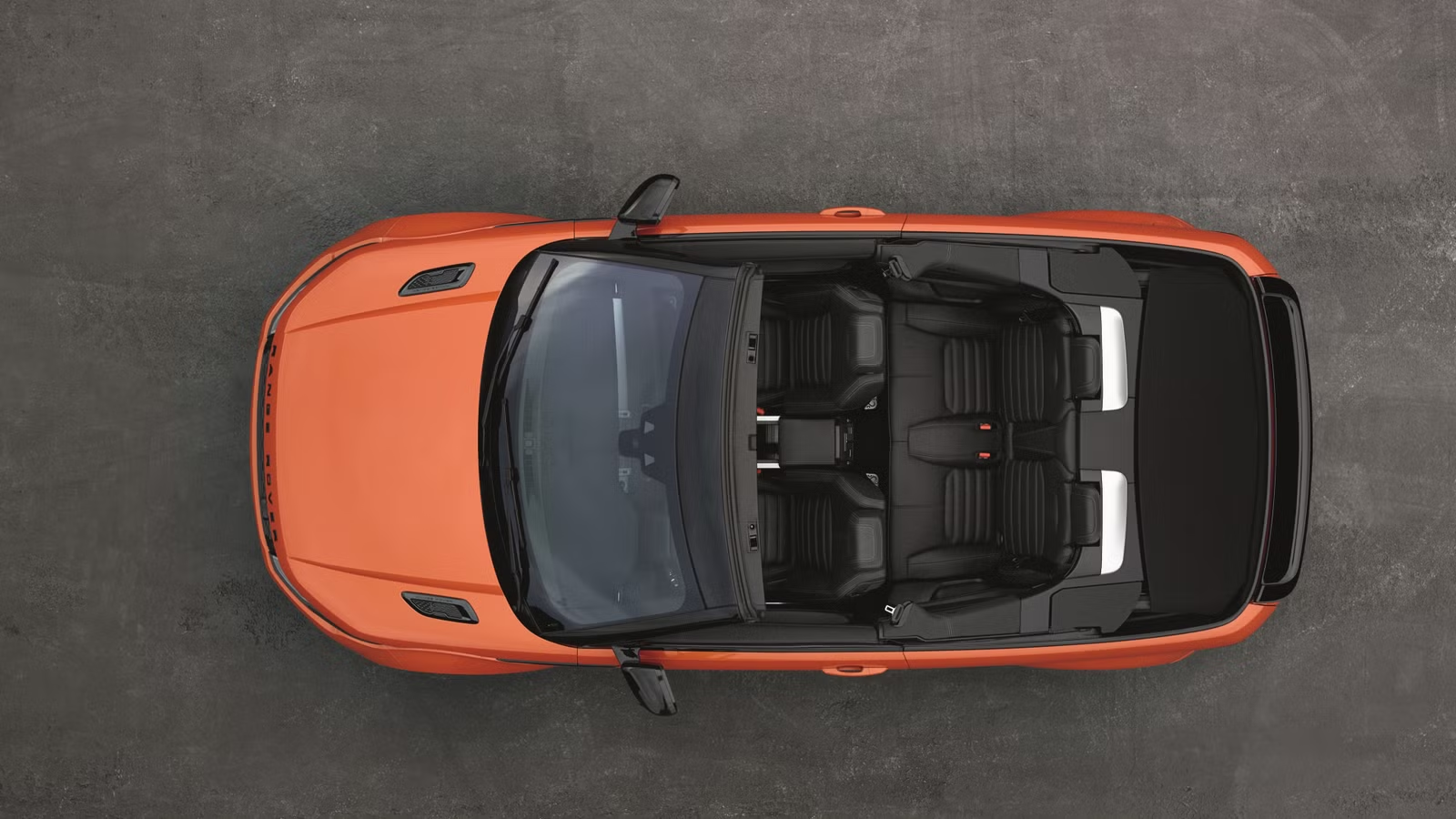
Land Rover unveiled its answer at the 2015 Los Angeles Auto Show with the Range Rover Evoque Convertible, which reached U.S. dealerships for the 2017 model year. Rather than creating a styling exercise, the company developed what it described as the world’s first luxury compact convertible SUV from a premium manufacturer, expanding the Evoque lineup into territory that none of its established rivals had been willing to explore.
U.S.-specification models were powered by Land Rover’s 2.0-liter turbocharged Ingenium four-cylinder producing 240 horsepower and 250 lb-ft of torque, paired with a nine-speed automatic transmission and standard all-wheel drive. Those specifications underscored Land Rover’s objective: despite losing its roof, the Evoque Convertible remained engineered to deliver the capability expected of a Range Rover instead of becoming little more than a fashionable boulevard cruiser.
Its power-operated fabric roof could be lowered in around 18 seconds or raised in approximately 21 seconds at speeds of up to 30 mph. Beneath that soft top sat a dedicated four-seat layout, while Terrain Response, Hill Descent Control, and All-Terrain Progress Control remained part of the package. Behind the scenes, extensive structural modifications compensated for the missing roof, allowing the Evoque Convertible to retain the refinement, safety, and off-road credibility associated with the Range Rover badge.
It Was Far More Capable Than Its Critics Ever Gave It Credit For

Turning the Evoque into a convertible required far more than removing its roof. Engineers reinforced the floorpan, strengthened the side sills, redesigned sections of the rear body structure, and stiffened the windshield frame to restore much of the rigidity lost with the fixed roof. Hidden behind the rear seats were deployable rollover protection systems, while the suspension was recalibrated to account for the additional structural reinforcement. The result was a purpose-engineered convertible rather than an SUV that had simply undergone cosmetic surgery.
Those engineering revisions preserved far more of the Evoque’s capability than many expected. The Convertible retained 8.3 inches of ground clearance, a 19.7-inch wading depth, permanent all-wheel drive, and the same Terrain Response system that defined the standard model. It remained capable of tackling gravel, mud, snow, and shallow water crossings with a level of confidence virtually unmatched by any other convertible on the market.
Ironically, those achievements rarely became the focus of the conversation. Much of the criticism centered on whether a convertible SUV should exist in the first place rather than on how successfully Land Rover had engineered one. The Evoque Convertible was judged more by its concept than by its execution.
The American Market Never Really Knew Who It Was For

The Evoque Convertible entered the U.S. market at an awkward moment. Luxury compact SUVs were booming because buyers increasingly demanded cargo space, flexible interiors, and everyday usability, while the convertible segment continued to shrink. By combining one of the industry’s fastest-growing body styles with one of its fastest-declining, Land Rover created a vehicle that many consumers struggled to categorize.
Its premium pricing compounded that challenge. Accommodating the folding roof and additional structural reinforcement inevitably reduced cargo capacity and practicality compared with the standard Evoque. Buyers seeking maximum utility could choose similarly priced luxury SUVs with more interior space, while those interested primarily in open-air driving still had traditional convertibles offering a more focused experience. The Evoque Convertible occupied the narrow space between those two markets, asking buyers to value exclusivity and versatility over outright practicality.
That perception ultimately became its greatest obstacle. Land Rover never intended the Evoque Convertible to replace the standard model or become a high-volume seller. Instead, it served as a halo product that demonstrated the brand’s willingness to challenge convention. Yet many buyers dismissed it before appreciating the engineering that made the concept possible.
Time Has Been Kinder To The Evoque Convertible Than Buyers Were

Viewed through today’s automotive landscape, the Evoque Convertible appears considerably less outlandish than it did at launch. Manufacturers now routinely build niche products for highly specific audiences, from coupe-style SUVs to high-performance off-road trucks and limited-production halo models that prioritize character over universal practicality. The market has become far more accepting of vehicles designed around emotion rather than broad commercial appeal.
Its rarity has also helped reshape perceptions. Produced only between 2016 and 2018, the Evoque Convertible remains an uncommon sight on American roads, attracting growing curiosity from enthusiasts who appreciate unusual chapters in automotive history. While it has yet to establish itself as a blue-chip collectible, it is increasingly recognized as a bold engineering exercise rather than a misguided marketing experiment.
Perhaps the strongest indication that Land Rover accomplished something genuinely difficult is that no major luxury manufacturer has seriously revisited the formula. The Evoque Convertible wasn’t a catastrophe because it failed as an SUV. It retained the engineering integrity, off-road technology, and all-wheel-drive capability expected of a Range Rover despite sacrificing one of its most important structural components. Its greatest obstacle was perception: enthusiasts judged it against preconceived ideas of what an SUV should be, rather than what Land Rover had actually built.
Sources: Land Rover

Related posts



Latest Post



No Comments