
5 Legendary Two-Strokes That Pushed The Envelope Too Far
Two-stroke engines once gave motorcycle makers a simple deal with huge power from a small, light package, plus enough smoke to locate the rider from space. Engineers kept improving that advantage until the engines overwhelmed fuel systems, tires, frames, and sometimes common sense. The five machines below represent the wildest edge of that pursuit.
5
Bimota V-Due 500
Launch Year: 1997

The Bimota V-Due 500 pushed too far because it tried to solve almost every two-stroke problem at once. Bimota wanted the power and low weight of a 500cc smoker without the dirty exhaust that had driven such engines from many showrooms. Its answer used direct fuel injection, which added fuel after the piston had nearly closed the exhaust port. On paper, that prevented raw gas from escaping through the pipe. The 90-degree V-twin also used two counter-rotating crankshafts, a dry clutch, a cassette gearbox, and an early quick-shifter. It produced a claimed 105 horsepower in a package that weighed far less than most liter-class four-strokes.

Then customers became unpaid test riders. Early V-Dues suffered from rough fueling, fouled plugs, sudden power delivery, oil leaks, and engine failures. Preproduction bikes had reportedly used precise Weber injectors, but Bimota could not obtain the same parts for regular production. Engineers struggled to make replacement Siemens hardware behave consistently, and Bimota recalled the bikes and later fitted some versions with Dell’Orto carburetors, yet mechanics also found crankshaft-seal trouble. The costs hit a small company that already had little room for error. The firm’s later financial collapse involved other problems too, but the V-Due delivered a heavy shove toward the edge.
4
Suzuki RG500 Gamma
Launch Year: 1985


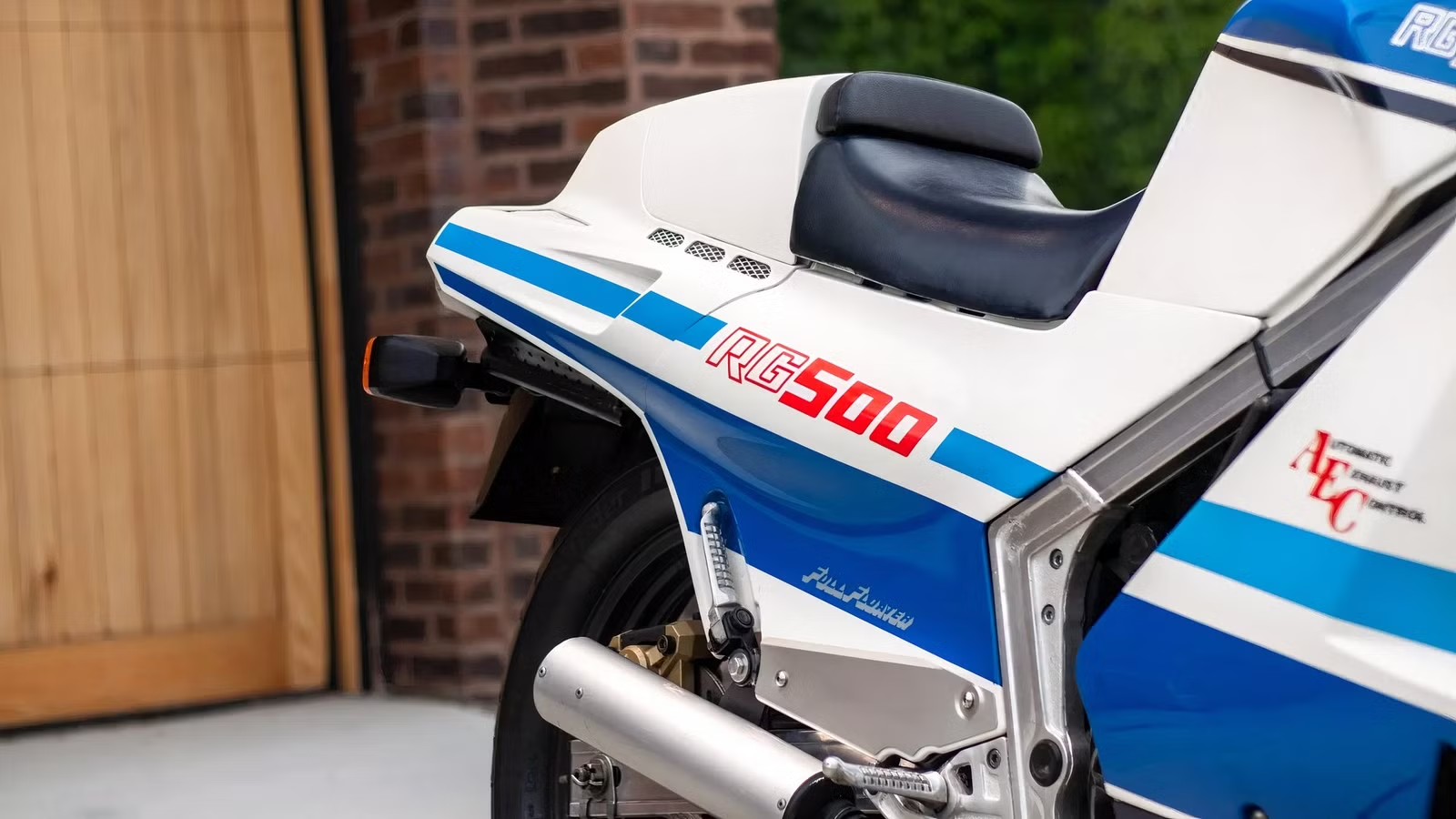
The Suzuki RG500 Gamma gave ordinary riders something dangerously close to a Grand Prix machine with a license plate. Its 498cc engine arranged four cylinders in a square, with two crankshafts and rotary-disc intake valves. In simple terms, Suzuki joined two parallel twins and asked them to cooperate at very high speed. A cassette-style six-speed transmission made internal gear changes easier, just as it did on race bikes. Suzuki mounted the engine in a box-section aluminum frame and quoted roughly 95 horsepower. The Gamma weighed about 340 pounds dry, so it did not need modern superbike numbers to feel violent.

The clever part involved how closely Suzuki kept the road bike tied to its racing roots. Many replica motorcycles copied paint schemes and bodywork, then hid a mild engine underneath. The RG500 carried the same basic square-four thinking that powered Suzuki’s premier-class racers. Those machines had delivered world titles to riders including Barry Sheene, Marco Lucchinelli, and Franco Uncini. Yet the road version still had lights, mirrors, oil injection, and enough low-speed manners to cross town without requiring a pit crew. It never received official U.S. sales, with emissions rules helping to keep it outside American dealerships, although Canadian bikes later crossed the border through private imports.
3
Honda NSR500
Launch Year: 1984

Honda built the NSR500 to beat the best machines in Grand Prix racing, not to flatter the rider. Its new 499cc V4 replaced the company’s lighter three-cylinder NS500 concept and gave engineers more room to chase high-rpm power. Honda used four nearly square cylinders, crankcase reed valves, and a single crankshaft when major rivals favored twin-crank layouts. That choice helped create a compact and fairly light engine, but the first chassis took the real leap. Honda placed the fuel tank under the engine to lower the center of gravity, and then routed four hot expansion chambers over the engine, directly beneath the rider’s chest. The layout lowered the fuel, raised the exhaust, and probably made the rider wonder whether asbestos underwear counted as safety gear.

The radical 1984 design created cracked exhaust pipes, extreme heat, and handling that changed as the low-mounted fuel load disappeared. Honda abandoned the upside-down layout after one season, even though the bike still won four Grands Prix. The NSR500 then became much more than an interesting mistake, and the firm refined it for 19 seasons and used its vast power to win 10 riders’ championships. By the early 1990s, engineers faced a fresh problem: the engine could make more power than the rear tire could use. Honda’s “Big Bang” firing order grouped combustion events closely, then gave the tire a longer recovery gap. Riders gained traction and could open the throttle earlier.
2
Yamaha TZ750
Launch Year: 1974

The first Yamaha TZ750 carried a misleading badge, because the 1974 TZ750A displaced 694cc. Yamaha created its inline-four engine by joining the ideas behind two liquid-cooled TZ350 twin-cylinder units. The production racer made about 90 horsepower, used a six-speed gearbox, and entered a world where chassis and tire technology had not fully caught up with large two-stroke power. Giacomo Agostini won the bike’s international debut at the 1974 Daytona 200, which gave the design instant credibility. Yamaha soon increased displacement to a true 747cc, while later versions reached about 120 horsepower. The motorcycle became a privateer weapon and overwhelmed Formula 750 racing.

Its most famous detour took place on dirt. In 1975, a team placed a TZ750-based engine in a flat-track frame for Kenny Roberts. The machine sent roughly 100 horsepower to a rear tire that already had little interest in gripping loose soil. It also delivered its power in a sudden two-stroke rush. Roberts struggled in practice and started near the back at the Indianapolis Mile, but he learned how to control the wheelspin during the race. He charged through the field and won on the final lap. The story became racing folklore because the combination made almost no sense: a brutally fast road-racing engine, a dirt oval, and no normal way to use the power.
1
Kawasaki H2 750 Mach IV
Launch Year: 1972

Kawasaki designed the H2 750 Mach IV around one clear question: how quickly could a street motorcycle reach the next stoplight? Its 748cc air-cooled triple produced a claimed 74 horsepower, which made it one of the strongest production bikes of its era. Period testing placed it around the 12-second mark in the quarter-mile. The engine also made more low-end torque than Kawasaki’s earlier H1 500, so the H2 did not need endless revs before causing trouble. It could lift its front wheel with little warning, surge through its powerband, and consume fuel with the restraint of a pirate at an open bar. Kawasaki gave it a single front disc, with a second disc available as an option.

Its fearsome handling reputation sometimes ignores the standards of 1972. The H2 did not have a cardboard frame, and it handled better than the smaller H1 that came before it. However, its flexible chassis, basic suspension, short swingarm, narrow tires, and rear drum brake had to control acceleration that few road riders had experienced. Kawasaki even fitted both friction and hydraulic steering dampers to the first version, which feels like an engineering footnote written in capital letters. Later models gained changes that softened the power and improved stability, but the original had already earned its place in motorcycle culture. The H2 showed manufacturers that raw acceleration could create an entire brand image.
Source: Cycle World, Old Bike Australasia

Related posts
Latest Post


No Comments