
Honda’s Legendary Six-Cylinder Monster Made Every Other Cruiser Sound Broken
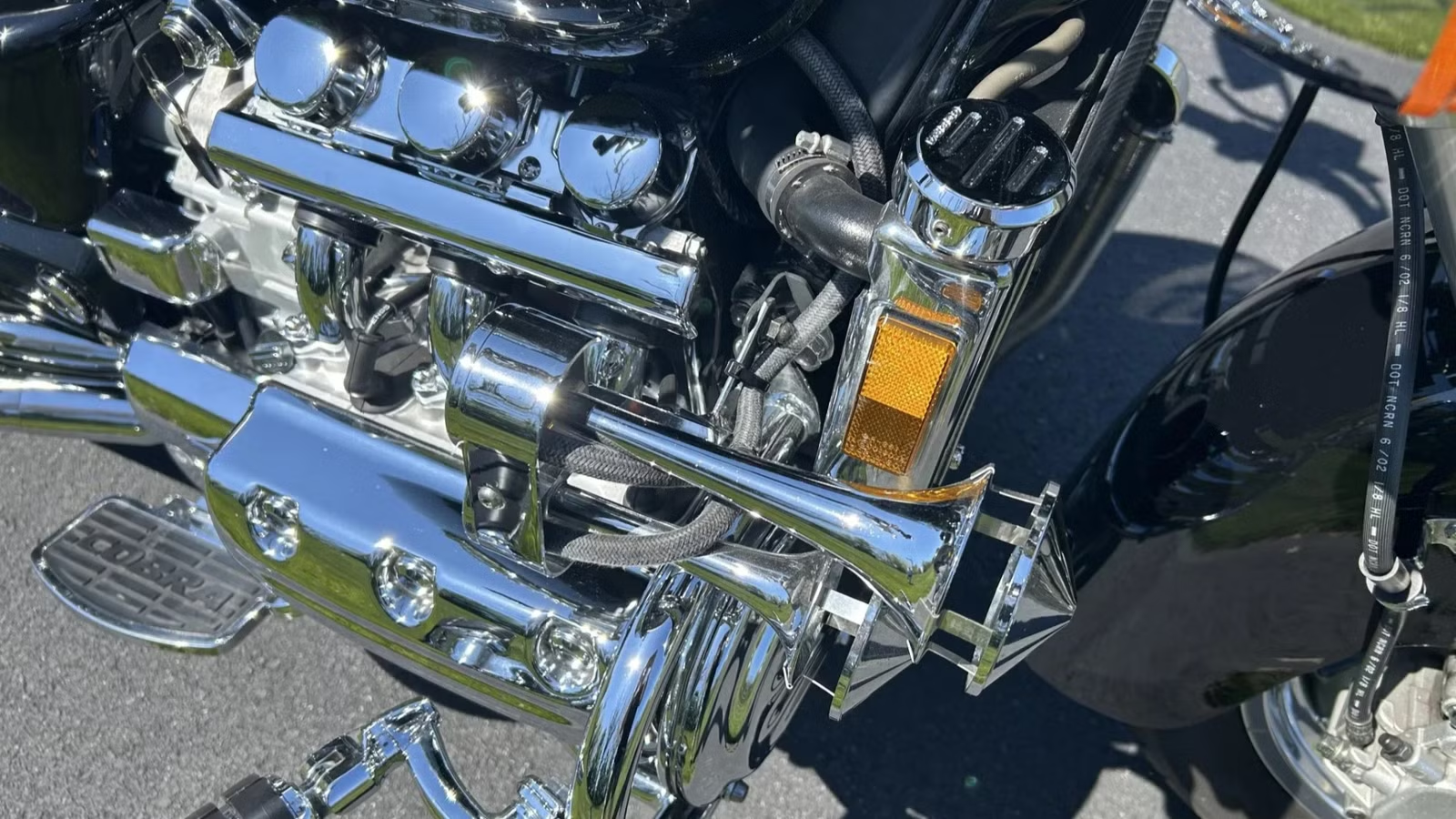
Every cruiser motorcycle sold in the 1990s ran on the same unwritten rule: a rough idle was part of the charm. Riders paid extra for that uneven thump, treating a lopey exhaust note as proof of authenticity rather than a limitation. Honda looked at that rule and decided it made no engineering sense whatsoever. What the company built instead didn’t just break with tradition, it made the whole segment sound like it needed a tune-up.
The Sound That Defined Cruiser Culture

Cruiser buyers of the era treated a rough idle almost like a personality trait. That familiar lopey rhythm, born from the uneven firing intervals of a 45-degree V-twin, became shorthand for authenticity long before anyone stopped to ask whether it was actually good engineering. Manufacturers leaned into it hard, tuning cam timing and exhaust notes to preserve that lope rather than smooth it out.
By the mid-1990s, that formula had calcified into something close to an industry law. A cruiser without a V-twin barely qualified as a cruiser in most buyers’ eyes, no matter how well the alternative was built. Smoothness, if anything, read as a mark against a machine’s character rather than a point in its favor, and few manufacturers dared to argue otherwise.
A Smoother Engine Aims At A Rougher Segment


Honda had spent decades building some of the smoothest engines in motorcycling, largely for touring machines where vibration was the enemy rather than the appeal. Somewhere inside the company, an engineer looked at the cruiser market’s obsession with roughness and saw an opening nobody else wanted to touch. The contradiction alone made it worth exploring.
The plan was to take a touring engine built for continent-crossing comfort and drop it into a leaner, more aggressive chassis meant purely for presence. It sounded backwards on paper. A smooth-running, high-cylinder-count motor had no obvious business anywhere near a segment that treated vibration as a virtue, and that tension between refinement and expectation is exactly what made the project worth greenlighting.
The Honda Valkyrie Broke The Cruiser Sound Barrier

The bike in question is the Honda Valkyrie, and its numbers explain why the segment sat up and paid attention. Honda pulled the horizontally opposed six-cylinder engine from its fourth-generation Gold Wing, a 1,520cc touring unit engineered purely for vibration-free comfort, and reworked it for a naked custom platform instead. Output landed at 100 horsepower at 6,000 rpm and 96 lb-ft of torque at 5,000 rpm, and a period road test recorded a radar-measured top speed of 128 mph, figures that put it ahead of nearly every traditional cruiser sold at the time.
Those figures alone made the Valkyrie quick for its class. What mattered more, though, was character rather than raw output. A flat-six spins with an inherent smoothness no V-twin geometry can match, since its opposing pistons cancel out much of the primary vibration a 45-degree twin simply cannot avoid. Honda built the whole bike around exposing that engine rather than hiding it, chrome-plated and fully visible in the frame, turning mechanical smoothness into the entire point of the machine.
Six Carburetors, One Unmistakable Idle

Honda fed the flat-six with six individual 28 mm Keihin carburetors, one per cylinder, instead of a shared or simplified induction setup. That decision kept the engine responsive through its rev range and gave the Valkyrie an idle and induction note unlike anything else parked at a bike night. Riders raised on the familiar V-twin lope often described their first cold start as genuinely disorienting, smooth to the point of sounding almost turbine-like.
Running six carburetors instead of one or two meant more work at service time, and that reputation followed the bike through its entire production run. Owners largely accepted the tradeoff anyway, since a properly synchronized set of six carbs delivered a level of mechanical refinement a V-twin, by its very architecture, was never going to offer.
What A Six-Cylinder Cruiser Costs Today

Honda stopped building the Valkyrie in 2003, so the only market left standing today is the used one. Part of what keeps interest alive is engineering nobody else in the segment bothered to attempt: rather than merging six cylinders into a pair of shared mufflers, Honda ran a full six-into-six exhaust system, with six individual pipes sweeping back along each side of the bike. It is a genuinely rare layout on any production motorcycle, and it gives collectors a mechanical rarity that goes well beyond badge recognition.
Recent transaction data compiled across the current used market puts the average sale price for a Honda Valkyrie at $5,125, a modest number given how mechanically ambitious the bike actually was when new. A contemporary Harley-Davidson Fat Boy, the bike most buyers still treated as the segment’s benchmark, ran a 1,337cc Evolution V-twin producing 67 horsepower and 72 lb-ft of torque, noticeably less than the Valkyrie on both counts. One largely stock, factory-condition 1997 example sold under the hammer for $10,000, roughly double what a comparable Valkyrie typically commands despite offering noticeably less engine for the money.
An Engine That Still Embarrasses Its Segment

The Valkyrie never outsold the V-twin cruisers it was built to challenge, and Honda eventually let the model wind down in the early 2000s. That commercial reality does not diminish what the engine proved. A flat-six borrowed from a touring machine and reworked for a naked custom could out-refine, out-idle, and out-spin the segment’s biggest names without breaking a sweat doing it.
Its reputation persists among riders who value mechanical originality over badge loyalty, and clean examples remain a favorite with buyers chasing a sound no V-twin can replicate. Against the cruisers it was built to embarrass, the Valkyrie still proves that presence was never just about displacement or heritage. Sometimes it just took an engineering team willing to make everyone else’s engine sound broken by comparison.

Related posts





Latest Post


No Comments