
The Dealer-Built Dodge Demon Chrysler Pretended Never Existed
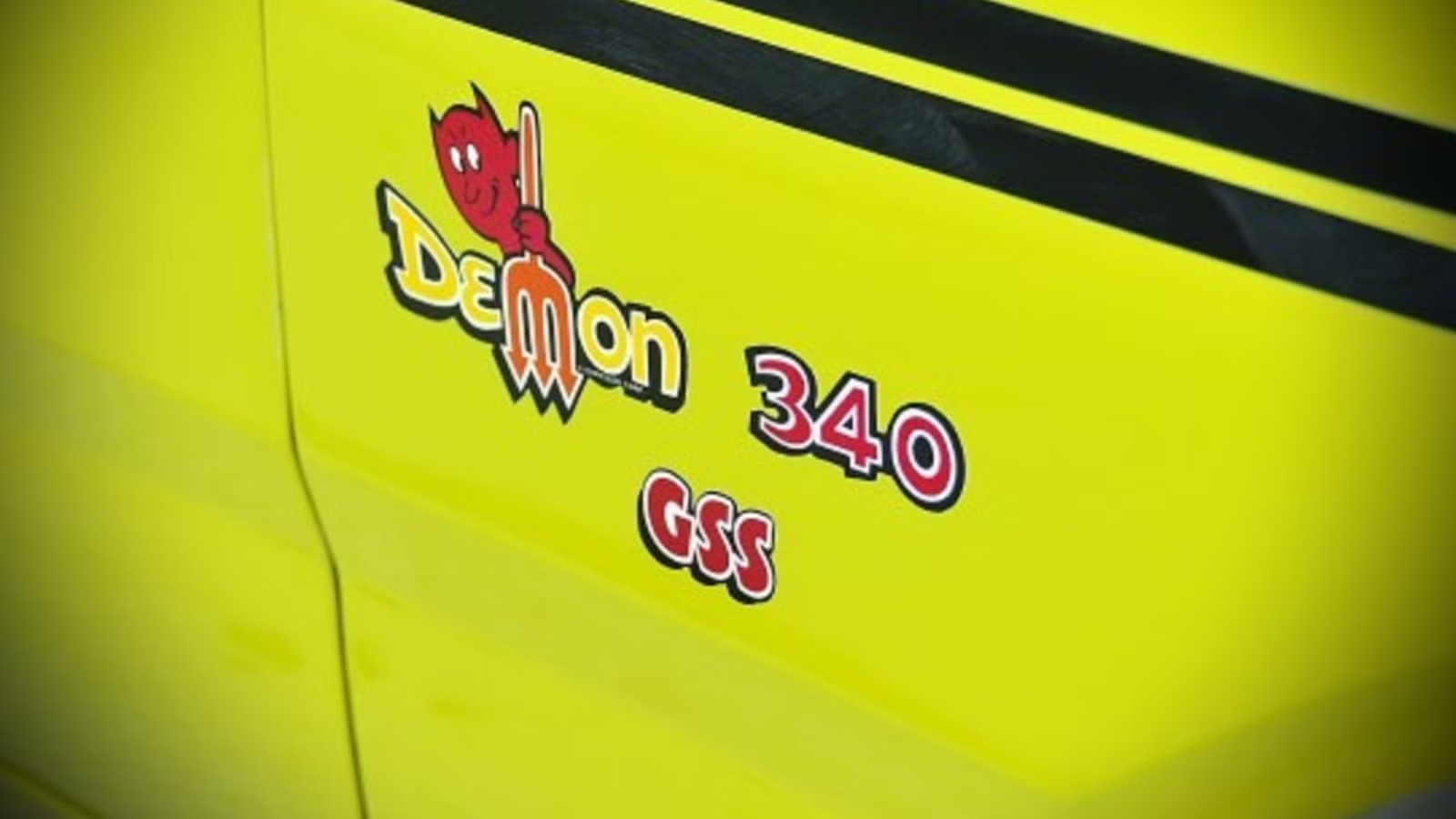
During the Golden Age of American Muscle, dealerships didn’t just sell street machines; they built them. AMC dealers had a performance package that took the 1970 Rebel Machine from a modest 360 horsepower to an impressive 470+ pony street dominator. Some dealers even built and marketed their own proprietary models, the most famous of which were the Yenko Chevrolet Super Cars, which were Camaros, Chevelles, and even Novas equipped with 427 V8s. For the most part, these dealer specials were encouraged by the automakers, or at least tolerated, but there was one dealer-built Dodge Demon that Chrysler pretended didn’t even exist.
Dodge Swipes The Plymouth Duster

In 1970, Plymouth introduced the Duster compact fastback, built on the A-body platform that offered killer styling and great performance for a fraction of the cost of the intermediate Mopar muscle cars. They moved 217,000 units of this new nameplate, which was more than all Dodge and Plymouth street machines combined, making it a runaway success. Dodge, which had already borrowed the concept of a bare-bones speed machine from the Plymouth Road Runner with the 1968 Super Bee, demanded its own version of the Duster, which became the 1971 Demon. Available with a variety of small-blocks from a 125-horsepower 198 slant-six to a 275-horsepower 340 V8, the Demon had something for everyone, and it too was successful, moving 67,000 units, with around 10,000 of them being the top tier Demon 340s.
The 1971 Demon Was Almost a Beaver

Except for the Super Bee, all of Dodge’s Golden Age muscle cars had “C” names like the Challenger, Charger, and Coronet, but for some reason they almost named their version of the Duster the “Beaver.” That might have been a decent moniker for a rugged trim on the D100 pickup, though not really, but for a performance vehicle, it was absurd. Luckily, someone in marketing or design pointed out that beaver was slang for a certain female body part, and they dropped it. Even the name “Demon” was not without controversy as it irked religious groups as borderline blasphemous, and the devil with a pitchfork mascot didn’t help things. After just two years, the Demon name was retired and the vehicle continued on as the Dodge Dart Sport, which was so unremarkable it offended no one.
Grand Spaulding Dodge Mopar Master

Grand Spaulding Dodge in Chicago, Illinois was the premier Mopar high-volume and performance dealer during the classic muscle car era. Run by Norm Kraus, affectionately known as “Mr. Norm,” the dealer forged a reputation for building more aggressive versions of already formidable Dodge muscle cars, which was something of an embarrassment for Chrysler. The automaker was adamant that a 440 Magnum V8 wouldn’t fit in the engine bay of a Dart, but in 1968, Mr. Norm dropped some of those 375-horsepower big-blocks under the hoods of the compact muscle cars, making a 13-second ride that rivaled 426 Hemi Mopars. Though they were impressive straight from the factory, Mr. Norm also upgraded Dodge R/T muscle cars, including Hemis, but his most famous contribution to the Golden Age was his GSS (Grand Spaulding Sport) builds, which have since become high-value collectibles.

Mr. Norm’s ’71 Demon GSS

The 1971 Dodge Demon was a neat idea with some hot styling, but even the top performance trim was a bit underwhelming. With a 275-horsepower engine, the Demon 340 was acceptable, but not mind-blowing. Mr. Norm at Grand Spaulding Dodge saw the massive potential of this compact muscle car and modified the Demon to live up to it. Starting with a Six-Pack manifold, Mr. Norm put in a bank of three two-barrel Holley carburetors. He then added a hotter ignition, headers, and performance exhaust, as well as upgraded suspension and gearing. Since these are dealer builds, there’s no way of telling if a 1971 Dodge Demon GSS is real from the VIN and, unfortunately, Grand Spaulding Dodge’s records went up in flames, so nobody knows how many of them were made. The best estimate is that there were probably around 100-200 of these killer dealer mods and far fewer that actually have a dealer invoice to confirm their existence.
Crack Open a 340 Six-Pack

The stock 1971 Dodge Demon 340 produced 275 horsepower and 340 pound-feet of torque, which was respectable for a budget muscle car, and the reality is it was probably more like 310 ponies. The 1970 Dodge Challenger T/A, which was designed for competition in the Sports Car Club of America’s (SCCA) Trans Am racing series, came equipped with a 340 Six-Pack V8 with a trio of two-barrel carburetors, rated at 290 horsepower and 345 pound-feet of torque. Mr. Norm’s ’71 Demon GSS, with the 340 Six-Pack and all the other performance modifications, was claimed to make 400 horsepower and 380 pound-feet of torque, though the dealer’s claim was probably a bit optimistic, and most experts think it was around 360 horsepower, which, again, is not bad for an inexpensive performance car.
GSS vs. Bone-Stock 340s

First up is the 275-horsepower 1971 Dodge Demon 340, which could accelerate from 0-60 in 6.5 seconds and run a quarter-mile in 14.5 seconds. The 1970 Plymouth Duster, from which the Demon was ripped, had the same 275-horsepower 340 V8, and was quicker from 0-60 with a 6.0-second time, but slower in the quarter-mile with a 14.7-second ET. The 1970 Challenger T/A, which wasn’t built as a drag car, still managed to utilize its 340 Six-Pack 15-pony advantage for a 5.9-second 0-60 time and a 14.3-second quarter-mile. Mr. Norm’s ’71 Demon GSS, whether it was 400 or only 360 horsepower, could sprint from 0-60 in 5.4 seconds and run a quarter-mile in 13.3 seconds — acceleration on par with Hemi-equipped Mopars, which may confirm the dealer’s claimed output.
Supercharged Evil in ’72

1972 marked the official beginning of the Malaise Era, in which all the classic muscle car engines were detuned to meet government emissions standards as well as consumer demand for better fuel economy. The Chrysler 340 was down to 240 horsepower in ’72, and Mr. Norm could have certainly jacked that back up with better compression, but instead he went for forced induction. The 1972 Demon GSS featured a Paxton centrifugal supercharger with 7 psi of boost that brought the output back up to 360 horsepower. While not quite as impressive as the ’71 Six-Pack, the ’72 supercharged Demon GSS was still a 13.9-second car, which was enough to outrun virtually everything on the street that year. Again, the production records don’t exist for this one, but it’s fairly certain that less than 100 were made.
Dodge Demon Value

A base 1971 Dodge Demon with a 318 V8 has a Hagerty Concours condition value of just $26,800, which means it is the perfect candidate for an awesome build, and here at HotCars we’re rooting for a Hemi crate. The ’71 Demon 340, on the other hand, is more valuable, with a range from $18,600 for a driver-quality example to $94,600 for a concours-level car. As it turns out, that valuation is on the conservative side, as a near-perfect Plum Crazy ’71 Demon with only 1,638 miles on the odometer sold for $126,500 at Mecum Kissimmee 2026. We couldn’t even find a 318 Demon listed for auction, which is probably due to its limited collector value. We did come across a number of ’71 Demon restomods, however, and chances are they all started life as 318 cars.
Mr. Norm’s Demon GSS Value

Hagerty sometimes has values for dealer builds like the ’69 COPO Camaro, but no such luck with Mr. Norm’s Demon GSS from either year. Luckily, there have been a few that were listed for auction, to give a good sense of what they are worth. Surprisingly, a ’71 Demon GSS Six-Pack commands relatively modest money, with the highest recorded sale at just $62,700, or about half as much as the top stock Demon 340. When it comes to the 1972 Mr. Norm’s supercharged 340 GSS, values are considerably stronger, with one bringing down the gavel at Mecum Indy 2022 for $126,000. The factory Demon 340 beat it by $500, but that was a low-mileage ride, and generally they don’t sell for nearly that much. The big takeaway here is that the Dodge Demon and Demon GSS are mostly the best value in classic era Mopar, along with the Plymouth Duster 340.
Wicked Legacy of the Demon GSS

In the Modern Muscle Car Age, Dodge was keen to pay homage to the Golden Age rides that put Mopar performance on the map, and in 2018 brought back the Demon as a trim for the Challenger SRT, which featured an 840-horsepower 6.2-liter supercharged Hellcat Hemi V8. They raised the bar in 2023 with the Challenger SRT Demon 170 that was capable of 1,025 horsepower with E85 racing fuel, but was otherwise a 900-horsepower powerhouse on 91 octane. Both of these amazing rides were not inspired by the stock 1971 Demon and its mediocre performance, but rather Mr. Norm’s jacked-up Demon GSS, which was the Golden Age equivalent to these modern super-muscle cars. The ’71 GSS was more than competitive, but the ’72 supercharged GSS was the most formidable car on the street, just as the ’18 SRT Demon and ’23 Demon 170 had no peers.
Sources: Hagerty, Mecum

Related posts


Latest Post


No Comments