
The Most Anticipated Roadster Motorcycle In The U.S. In 2027
If you were to trace back the roots of retro roadsters, you’ll realize these bikes have been around since the inception of motorcycles. Sure, they’ve changed shape every few years, but they’ve kept the core retro theme intact all these years. Add to the fact that nostalgia sells well, and it becomes quite clear why this still remains a popular segment for bikemakers to exploit. Among these brands, Yamaha is a firm believer in this particular idea, evident from its extensive XSR lineup. And it’s taking another stride in the same direction for model year 2027 by bringing a globally popular machine to US shores.
There Is No Shortage Of Retro Roadsters In The Market Today

As we mentioned, this is a popular space for bikemakers to exploit. Accordingly, nearly all bikemakers have their toes in here, giving us a massive variety of midweight and large-capacity machines. Triumph dominates the scene with its dedicated Speed Twin and Bonneville lineup, while Japanese giants resort to part-sharing. The XSR duo and Z RS duo are prime examples, and even Suzuki has jumped into the ring with its new-for-2026 GSX-8T duo. From Europe, BMW leads the way with its R 12 range, and Moto Guzzi serves as one of the underrated picks.
But The True Entry-Level Space Still Has A Large Void

Looking at the above bikes, you’ll quickly realize there’s a scarcity of beginner-friendly roadsters. And if Asian markets have taught us anything, it’s that entry-level bikes can drive some serious revenue into the brand. Thus, some bikemakers are now trying to introduce such small-capacity retro bikes in the US.

Kawasaki did that with its W175 and W230 duo recently, and this seems to have inspired Yamaha to pull off a similar move with its baby XSR. This is arguably more exciting than the W range’s arrival news, though. After all, we know XSRs ride really well due to their sports bike/naked bike-derived mechanicals.

The 2027 XSR155 Will Be Yamaha’s Answer To Your Entry-Level Retro Roadster Needs

The motorcycle in context is the Yamaha XSR155. The bikemaker has filed the machine with the National Highway Traffic Safety Administration for the 2027 model year, alongside other bikes produced in Indonesia (MT-03, R3, WR125, and XMAX). This would make it the smallest XSR ever (sitting under the XSR700 and XSR900) and the second smallest full-size motorcycle by the brand in America.
Why The XSR155’s Arrival Is A Big Deal In America

More importantly, it will give the brand the ability to tackle beginner retro bike fanatics. This is something Team Blue attempted to do with the ultra-outdated V-Star 250 in recent times, but the baby cruiser simply doesn’t make sense unless a beginner is hell-bent on a V-twin cruiser. You should also know the V-Star isn’t listed in the 2027 filing, suggesting it is going away with the XSR taking over duties.
There’s Plenty To Impress You On The XSR155

The XSR155 has big shoes to fill in replacing the V-Star, but the XSR should make a stronger case. We say so because this is an important motorcycle for Yamaha in Asian markets like Indonesia and India. So the bikemaker has made sure the package is solid and likable, rather than being a dated product brought here to clear stock. Let’s dive into the nitty-gritty.
Powered By A VVA-Equipped Single-Cylinder Engine

We start with the engine, and it’s a surprisingly modern single-cylinder setup. The liquid-cooled 155cc mill (also seen on the MT-15) runs Yamaha’s popular Variable Valve Actuation–a rarity on single-cylinder engines. This has intake valve-side cams for low and medium speeds and high speeds, and switches between 7,000 RPM and 7,400 RPM depending on the throttle opening to spread power and boost tractability.
This is topped with a near-square construction (58 mm X 58.7 mm), an 11.6:1 compression ratio, a DiASil cylinder, and a forged piston. All of that enables an output of 19 horsepower and 10 pound-feet (US figures might differ), sent to the wheel via a six-speed transmission. For reference, the peak power is in the ballpark of the twin-cylinder V-Star, but the torque is five pound-feet less here. You can, however, expect brilliant fuel efficiency (Yamaha claims 113 MPG for the 155).
A Proven Deltabox Chassis With USD Forks Make Up The Underpinnings

It’s a similar sight in the underpinnings department. The XSR boasts Yamaha’s popular and proven Deltabox chassis, inspired by the sporty flagship bikes like the YZF-R1. This joins hands with a delta-shaped aluminum swingarm and modern suspension to boost handling. The latter comprises 37 mm USD forks (similar to the bigger MT-03) and a monoshock, both of which attach to 17-inch cast alloy wheels.
A 267 mm front and a 220 mm rear disc make up the braking package, both of which have dual-channel ABS. These anchors might seem small, but you should know the XSR is really compact dimensionally. The curb weight is just 302 pounds, while the wheelbase and length are 52.1 and 79 inches, respectively. So the brakes don’t have too much on their hands anyway.
A Gorgeous Design Sweetens The Experience
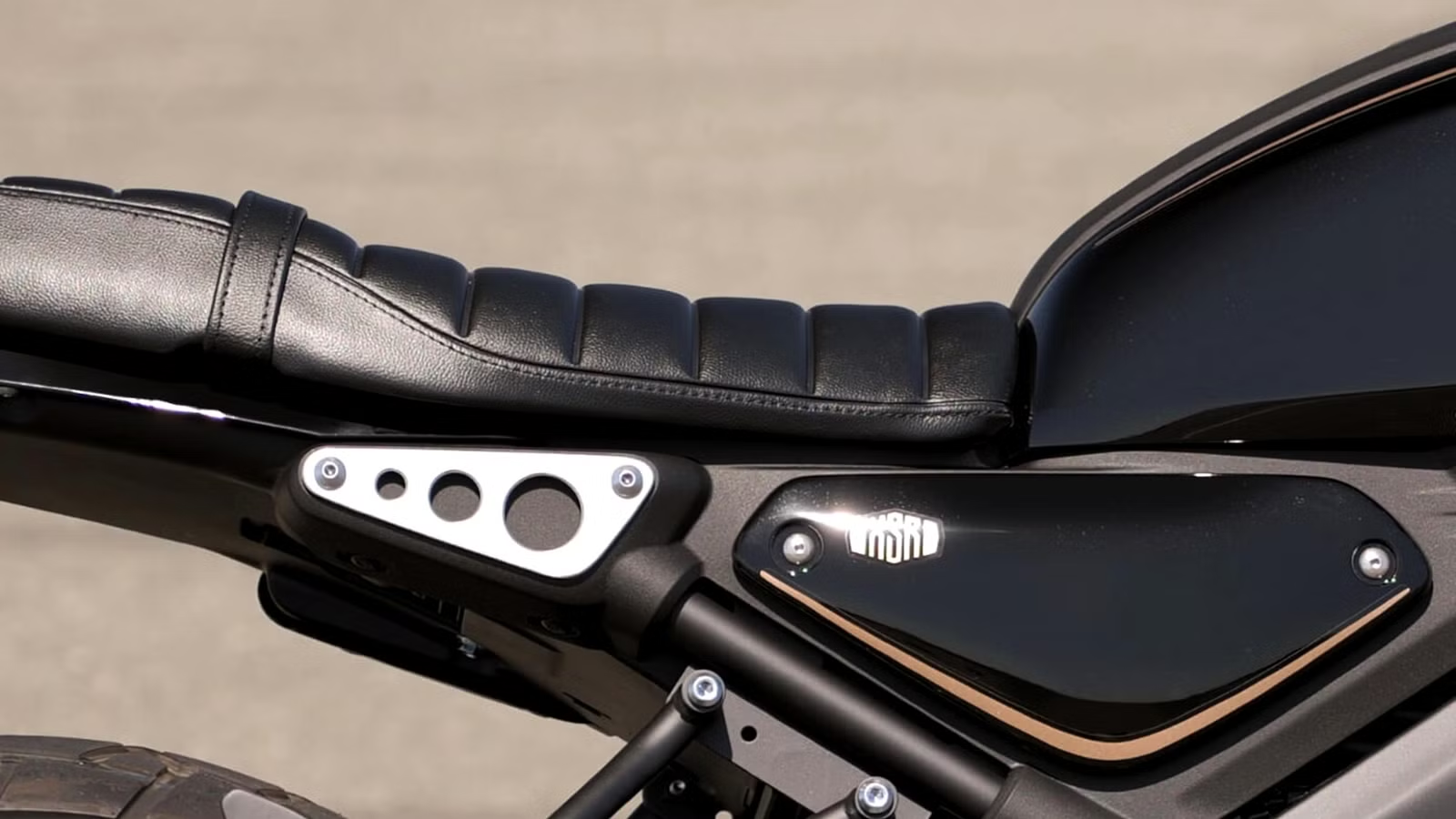
The mechanical package is one thing, but XSRs have always been about aesthetics. And we’re happy to report the 155 follows in the footsteps of its elder siblings–like the XSR900–to be a head-turner. A round LED headlight with internal XSR badging is present up top, housed on aluminum brackets and flanked by golden forks. Then, there’s an indented fuel tank (with a contrasting central plastic panel) that blends into a premium-looking tuck-and-roll seat. This seat sits 31.9 inches from the ground, in case you’re curious.
The attention to detail elevates the appearance. This includes:
- Contrast colored wheels
- Aluminum inserts under the pillion saddle
- Color-matched side sections between the chassis and seat
- Punched exhaust shield
- Chrome nacelle on digital instrument cluster
Source: Yamaha

Related posts

Latest Post



No Comments