
The 243-MPH Dodge Daytona That Plymouth’s Superbird Pushed Into The Shadows
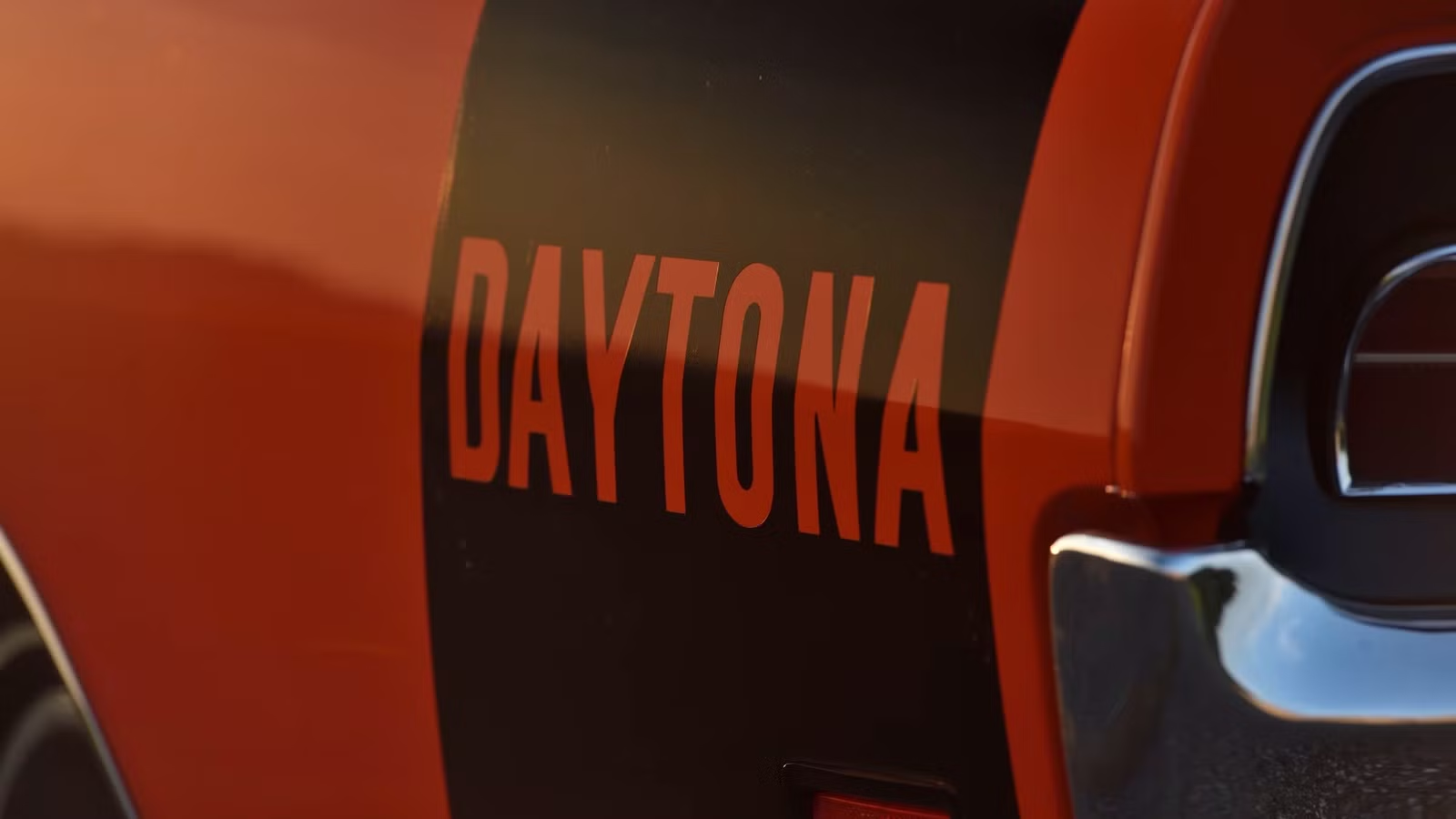
Supercars are fast; that’s why they exist. Hitting more than 200 mph is probably quite difficult, unless you live close to a German autobahn or have a private test track in your garden, but having this kind of top end capacity is expected of modern-day, mid-engined exotics. But almost 60 years ago, there was a new breed of muscle car that could do this speed with ease. Racing and demand for ever wilder models in the showrooms meant that American carmakers were pushing the boundaries in a way that even today would seem truly shocking. And you can buy one today for less than a modern mid-engined supercar.
Muscle Cars Were Evolving Quickly In The Late ’60s

Most people agree that the Pontiac GTO of 1964 really kicked off the muscle car genre. There had been a number of powerful V8 two-doors before this groundbreaking model, but the GTO was the one to solidify this new type of American performance car. The GTO was so popular, selling in the tens of thousands within months, that virtually every carmaker in the country was scrambling to bring a competitor to market.
But while the original Pontiac Tempest-based LeMans GTO package had up to 348 horsepower, manufacturers quickly realized that these kinds of figures wouldn’t sell muscle cars forever, and the horsepower wars erupted, with outputs climbing into extraordinary territory. The 1968 Dodge Charger Hemi was rated conservatively at 425 horsepower and 490 lb-ft of torque, which made it one of the fastest cars in America. Period. But Dodge, and Plymouth for that matter, were not finished, leaning on motorsport to take muscle cars to the next level.
NASCAR Was Driving Development In A New Era

NASCAR has its roots in Prohibition-era bootlegging, with cars being modified to outrun the police. Some of the drivers had come from running illegal moonshine, having honed their skills hauling liquor as fast as possible. It was in the ’60s that this form of motorsport made the transition from modified factory showroom cars to high-speed, factory-backed racing testbeds.

Towards the end of the decade, NASCAR started seeing the emergence of the purpose-built race chassis for safety. But there was a new frontier that was based on aviation engineering: aero. Ford and Chrysler were pouring millions of dollars into creating the fastest cars for tracks like Daytona International Speedway and Talladega Superspeedway. Grilles were made flat and flush; Ford created long-nose versions of its race cars called the Ford Torino Talladega and Mercury Cyclone Spoiler. While these measures were undoubtedly helping with top speeds, Dodge then delivered a mic drop moment.
The Dodge Charger Daytona Was Built To Destroy The Competition

Chrysler’s engineers had calculated that the Dodge Charger needed an extra 5 mph to beat the Torino-based Talladega. This may have sounded easy, but it wasn’t, requiring another 85 horsepower from the 426 Hemi, or a 15% drag reduction, says Hemmings. As they say, necessity is the mother of invention, and with a complete redesign of the Hemi out of the question, Dodge was forced to go down the aero route.
The company quickly got to work on an evolution of the Charger 500 that would be called the Daytona. The car was designed to be fast and stable, with the proof of concept coming in 1969 when it was launched. A Hemi-powered Dodge Charger Daytona won its first race, the Talladega 500, demolishing the competition and reshaping NASCAR.
The Secret To The Daytona’s Success

The 1969 Dodge Charger Daytona was a true homologation special, with bodywork so wild that it is reported that dealers struggled to sell the road versions. The 23.5-inch-tall rear wing looked like something from a soccer goal, not a NASCAR car, and instantly made the car look like no other. At 58 inches wide, the cast-aluminum rear spoiler was designed to use the clean air flowing over the car to create downforce. The new tapered steel nose increased the overall length by 18 inches but helped reduce drag. Thanks to wind tunnel testing, the engineers managed to reduce drag by 20%, far better than expected.
The ’69 Charger Daytona was fitted with the legendary 426 Hemi, the ultimate race engine, but dealers could offer them with a few other options. The 425-hp 7.0-liter Hemi V8 was the top dog, with either an A833 four-speed manual (topped by a Hurst shifter) or a TorqueFlite 727 three-speed automatic, but buyers could also choose a 7.2-liter Magnum V8 Daytona, with 375 hp and the choice of the same two gearboxes.
The Daytona Was Fast Even By Today’s Standards

Considering the top speed of a modern Lamborghini Temerario is 213 mph, it may come as some surprise that the Daytona was rumored to go a lot faster. Buddy Baker claimed to have hit 235 mph, while test driver Charlie Glotzbach apparently hit a top speed of 243 mph at Chrysler’s five-mile oval in Chelsea, Michigan. On March 24, 1970, at Talladega, Baker set a closed-course record in a Dodge Charger Daytona, clocking a lap at 200.447 mph. The Daytona was fast by any standards.
How A Plymouth Outshone The Daytona

The Plymouth Superbird of 1970 may look like the Daytona, but it was actually quite a different winged warrior. Plymouth’s engineers had learned from the Daytona, and also developed the car in a wind tunnel. The Superbird’s front is less pointed and the rear spoiler leans back more, which, to some eyes, made it look better than the Dodge. Paired with the iconic Road Runner decals, the Superbird had a more distinctive aesthetic, making it more of a pop culture icon.
While it may have looked better, the Superbird was not more aerodynamic. The Superbird has a .31 coefficient of drag to the Daytona’s .29, which meant that it was actually 1 to 3 mph slower. But what really made the Superbird an icon was the fact that it was the car that lured Richard Petty back to Plymouth for the 1970 NASCAR season. Petty had reportedly said he would return to Plymouth if the brand built an aero car, and the Superbird was it.
The Daytona And Superbird Won’t Be Cheap Whatever You Pick

The Superbird was built in bigger numbers, with between 1,290 and 1,935 sent to dealers against the 503 Dodge Daytonas. You can expect to pay $188,000 for a 1969 Dodge Charger Daytona with a 440, and $472,000 for a Hemi. The 1970 Superbird starts at $128,000 for the 375-hp 440, with asking prices of $247,000 for the Six-Barrel 440, and Hemi cars going for $300,000. That’s a lot of money for a muscle car, big wing or not, but how does it stack up to a modern supercar? That Lamborghini Temerario we mentioned earlier will cost you $387,649, and, in theory, won’t be as fast as the top-flight Hemi Daytona (although it would take a brave owner to push a near-60-year-old muscle car to its limits). So you could get a Hemi-powered Plymouth Superbird and a brand-new Chevrolet Corvette Stingray (C8) for the same price as the Lamborghini. Now that is a tempting proposition.
Sources: Hagerty, Hemmings, Dodge, Plymouth

Related posts



Latest Post


No Comments