
The 1990s Twin-Turbo AWD Coupe That Out-Engineered The Supra For A Fraction Of The Price
If you’re looking for one of the kings of ‘90s Japanese legends, your mind is going to be drawn to the all-conquering Toyota Supra and Nissan Skyline GT-R. These cars arrived with incredible levels of technology, and performance that punched well above their weight.

Yet today, both models are continuing to skyrocket in price, making them unobtainable for the vast majority of auto enthusiasts. Naturally, that means we have to look a rung down the ladder if you want a more affordable, yet still sublime, high-tech coupe to come from Japan. We may just have the answer.
The JDM Kings Are Well Established
Before that, here’s another reminder of just how legendary the A80 Toyota Supra and the R34 Nissan Skyline GT-R have become. Introduced at arguably the peak of the Japanese car industry in the 1990s, both of these models packed in plenty of technology that allowed them to frighten exotic supercars.

Take the Supra, for example, featuring active aerodynamics and, in its most desirable forms, twin-turbocharging. Similarly, the R34 GT-R boasts rear-steering and a complex all-wheel drive system that allowed it to compete at the very top of its game. Both cars would go on to get spotlights in the Gran Turismo video game series and The Fast and The Furious movies, causing them to explode in popularity.

Now that kids of the ‘90s are all grown up with adult money, though, it’s been no surprise to see those cars surge in value in recent years. Today, a clean twin-turbo Toyota Supra will set you back around $80,000, and well beyond that for mint-condition cars, while you can double that for an R34 GT-R.
What about a car that has just as much technology, though, for a fraction of the price?
Mitsubishi Had Its Own Challenger

While the series of Mitsubishi Lancer Evolutions may be the most loved cars the brand has made, it wasn’t its most technology-advanced car of the decade. That honor goes to the Mitsubishi 3000GT (known in Japan as the GTO), designed to compete squarely with the Supra, as well as the Mazda RX-7, Nissan 300ZX and Honda NSX.
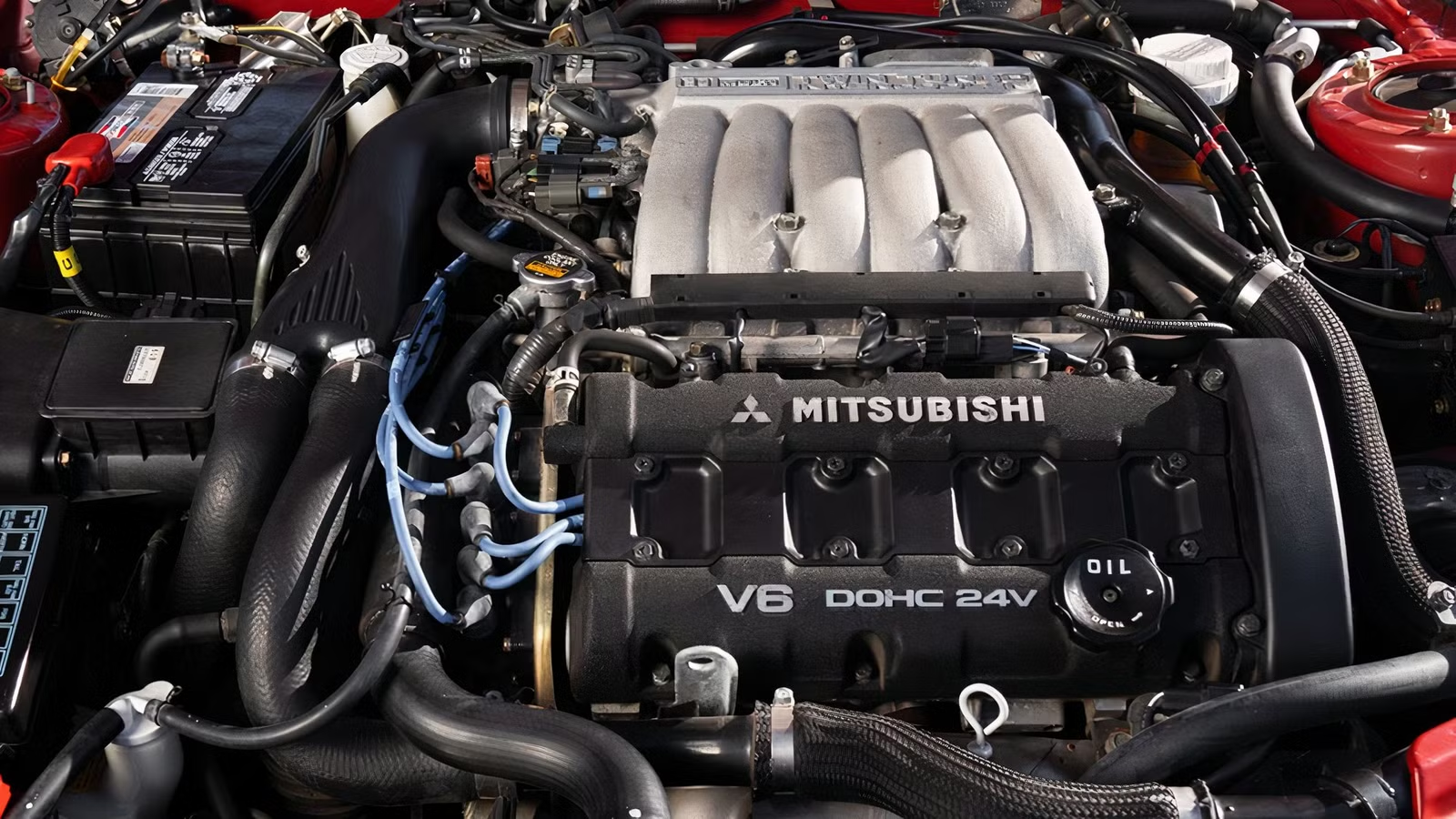
Its base model wasn’t a great deal to shout about, using a naturally-aspirated, 3.0-liter V6 engine producing 222 horsepower and 205lb ft of torque. However, real excitement came in the VR-4.

Using a twin-turbo variant of the 6G72 engine, the V6 in this spec produced 300hp and 307lb-ft at its launch in 1991, while cars introduced from 1994 had larger turbochargers that freed those figures up to 320hp and 315 lb-ft of torque. The JDM-spec GTO Twin Turbo officially had its power capped at 276hp to meet the Japanese Gentleman’s Agreement, but with matching torque figures, the real-world power figure was likely identical to the US cars.
Although never officially quoted by Mitsubishi, magazine tests in-period had both versions of the VR-4 covering 0-60mph in around 5 seconds and with a 155mph top speed (electronically limited to 112mph for the GTO). Those figures were pretty much on the ball with its main rivals.
It Had More Technology Than Its Rivals

Its technology punched above anything else it competed with directly, though. For a start, as standard, the Mitsubishi 3000GT VR-4 came equipped with an advanced active aerodynamic system.
At the front, a panel would lower from around 50mph by two inches to reduce lift and improve high-speed stability, while at the same speed, early cars with the lower rear wing would see that tilt up to add a little downforce but also help cut lift, too. These systems would retract to their resting position when speed was reduced to 30mph.
Along with that, the 3000GT VR-4 and GTO Twin Turbo utilised a rear-steering system that would allow the rear wheels to turn opposite to those at the front by 1.5 degrees, improving its maneuverability at speed by effectively shortening the wheelbase.

Early cars also came with Electronically Controlled Suspension (ECS) as standard, using adaptive dampers at a time when the technology was incredibly scarce. Selectable Tour and Sport modes would slacken or stiffen the suspension respectively, allowing the 3000GT and GTO to have a wider breadth of character.
Rounding all of that out was a full-time all-wheel drive system with a central viscous coupling differential and a rear limited-slip differential.
While many of its rivals had similar technologies, none of the direct competition combined all of them into the same package as the Mitsubishi 3000GT VR-4 and GTO Twin Turbo.
It’s A Relative Bargain Today, But Maybe Not For Long

Despite all of its cutting-edge technology and performance, the Mitsubishi 3000GT VR-4 never quite stole hearts in the way the likes of the Toyota Supra, Nissan Skyline GT-R and even Mazda RX-7 quite did.
A lack of prominence in video games (despite being in Gran Turismo) and other media arguably kept its profile low, and reviews in-period praised its technology but criticized its weight, complexity and price new.
For that reason, though, it has remained a relative bargain compared to the competition on the used market. According to Hagerty, concours-condition 3000GT VR-4s have seen a rise of 31.3% in value over the last 12 months at the time of writing, now costing around $67,500.

Gains for lower-condition cars aren’t quite as dramatic, but there’s still an upward trend. Excellent condition examples are said to have seen a 19.7% increase to around $47,000, while good condition cars are up to around $27,000, representing an 8% rise. Expect similar for an imported Mitsubishi GTO, though they very rarely come up for sale in the US, likely owing to its existing availability as a left-hand drive car.
The base models command a much lower price, but we think you should avoid them entirely if you’re looking for a sporty front-driven coupe anyway, given how many exciting alternatives there are out there. Think the Acura Integra Type R, the Honda Prelude, or even some versions of the Mitsubishi Eclipse.
Worth keeping in mind if you buy a VR-4, though, you should consider the high costs that are likely to come if any of its technology fails and needs restoring. Perhaps that’s the biggest scare of all when it comes to the Mitsubishi 3000GT.
You Could Even Have It As A Dodge

Here’s something you may have forgotten about. Built alongside the Mitsubishi 3000GT over in Japan was the Dodge Stealth, a directly rebadged equivalent that was born from Diamond-Star Motors, a joint venture between Chrysler and Mitsubishi. This same partnership led to the Mitsubishi Eclipse, Plymouth Laser and Eagle Talon, for a bit of extra trivia.
The Dodge Stealth was virtually identical to the Mitsubishi, bar its badging and some minor styling changes, and lasted in production from 1991 to 1996, despite the Mitsubishi 3000GT lasting through to 1999 on the US market.
Ignore the base versions entirely, and look towards the Dodge Stealth R/T Twin Turbo, which was identical to the early VR-4. Yet, with lower prices still. Concours cars fetch around $40,400, excellent ones around $24,900 and good condition around $17,5000, once again according to Hagerty.
An Even Rarer High-Tech Alternative

“I’d like my Japanese-built, technology-packed Grand Tourer to be even rarer, more complicated to maintain and never sold in the US”, we hear you say. Well, we have the solution just for you.
For less money upfront, you could find your way into a Mazda Eunos Cosmo. Introduced in 1990, this was the very best Mazda could put into a car, with a 2.0-liter twin-turbocharged, tri-rotor engine, a complex suspension system that used four shocks on the rear axle and even a touchscreen infotainment system that served to debut GPS navigation in a production car.
Exclusive to Japan in its five-year production run, fewer than 9000 examples of the Eunos Cosmo were ever produced, and less than half used the tri-rotor engine (the same twin-rotor as the RX-7 was also available).
Cars in the US command a relatively low asking price of around $20,000, though we suspect its potential nightmare maintenance and complete obscurity can be attributed to that.
Sources: SupercarWorld, Machines With Souls

Related posts



Latest Post


No Comments