
The Cheapest Inline-Four Sports Bike In 2026
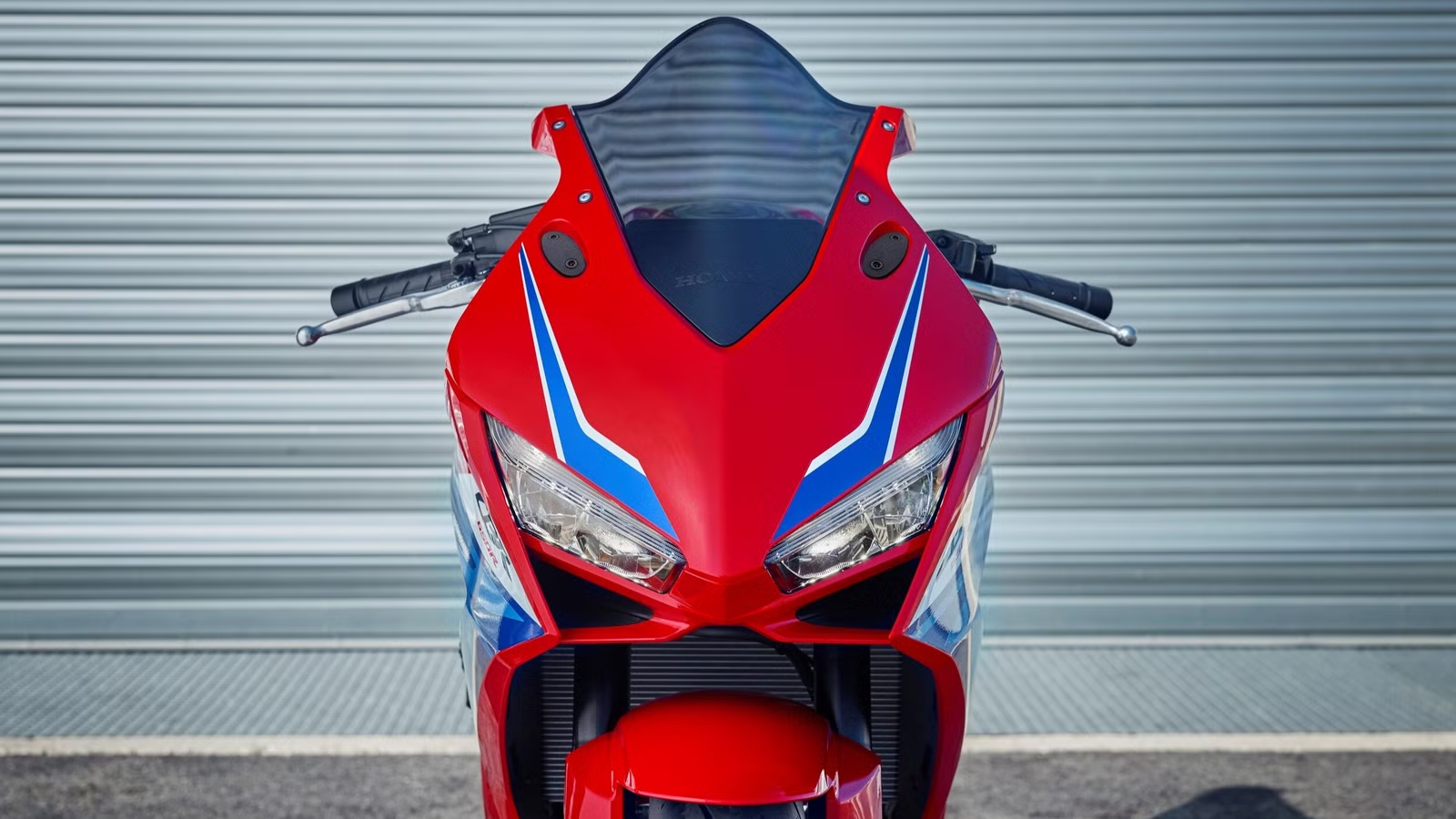
No matter how popular or good other engine layouts get, the charm of an inline-four powerhouse is unmatched in the automotive world. This appeal is further amplified in the sports bike segment, where such engines have long been the staple for smooth performance. So even with V4s and parallel-twins taking over, some bikemakers are putting a conscious effort into keeping inline-four sports bikes alive in these tough times. As a result, one of the most affordable four-pot full-faired machines has just become even more affordable. So much so that the bike in context undercuts its parallel-twin rivals by a fair chunk.
The Cost Of Admission For Inline-Four Sports Bikes Has Dropped Well Below $10,000

A while ago, the inline-four sports bike segment started from around $11-12,000. These were mainly 600cc supersports that broke your back and wrists, but helped you set the racetrack ablaze. In the last 3-4 years, though, the cost of admission has dropped with the influx of less-stressed four-pot sports bikes. The Kawasaki Ninja ZX-4R is one of the prime examples in the recent past.

It was priced as low as $8,999 until last year, attracting a large set of customers worldwide. At the time, the 4R held the title of the most affordable inline-four sports bike money could buy. But in 2026, its price has risen to around $9,300. While that’s still cheap, its low price seems to have inspired another Japanese bikemaker to take an aggressive approach and make its 650cc four-pot machine cheaper than the current 4R.
The Honda CBR650R Is The Cheapest Inline-Four Sports Bike In 2026


If you haven’t guessed already, we’re talking about the 2026 Honda CBR650R E-Clutch. Its price has dropped from $9,399 to $9,199, making this the cheapest inline-four sports bike in 2026. Interestingly, that MSRP also undercuts its parallel-twin and inline-triple rivals. The Yamaha YZF-R7 and Suzuki GSX-8R cost $200 and $500 more, respectively, while the Triumph Daytona 660 is priced at $196 more. So you’re getting extra cylinders at a lower price than all of its rivals, boosting the overall value prospect.
The CBR’s title might go away soon, though. That’s because Honda itself has shown a 500cc inline-four motorcycle in Japan and China. This could undercut the 650R. Additionally, both Kove and CFMoto are looking to bring their small-capacity inline-four machines to the US in the future. Oh, and in typical Honda fashion, we also expect the CBR650R to get a small price hike next year.
Recent Updates Help The CBR650R Justify Its MSRP Well

A price drop is always impressive. But when it is paired with new updates, the value prospect rises tenfold. That’s precisely the case with the CBR650R. The latest model has notable changes in the design, transmission, and feature department, all of which make the package more up-to-date with the times. Let’s dive into them.
The New E-Clutch Setup Brings Class-Leading Practicality

We have to start with the class-leading element: the electronic clutch. Called E-Clutch, this tech is a souped-up version of a conventional quickshifter and blipper setup. It uses an electronic actuator for the clutch, letting you shift up or down without using the clutch lever. At the same time, you can come to a complete halt and roll on from a halt without the clutch, too. Considering some of its rivals have a one-way quicksifter, this is a big plus. Plus, in case you want to do things traditionally, you can simply use the physical lever and take full control.
“In situations where the driving force changes, such as starting, shifting and stopping, electronic control technology provides instantaneous, fine-tuned optimum clutch control, enabling smooth starting/shifting/stopping without the need for the rider to operate the clutch lever.” – Honda
A 649cc Four-Cylinder Engine Promises Over 90 HP

The E-Clutch setup is paired to Honda’s long-running 649cc, inline-four powerhouse. This has not only proven highly reliable over the years, but it is still one of the most powerful units in the segment. The figures lie at ~94 HP and 46.5 LB-FT, where the former is considerably higher than all of its Japanese rivals and right in line with the Daytona.
These numbers also kick in lower than your usual four-pot supersport, so you get plenty of tractability. The redline is still around 12,000 RPMs, meaning a top speed of 155 miles per hour if you keep it pinned. Having ridden the 650R, we can confirm this is one of the sweetest and friendliest engines in the class.
Showa Suspension And A Steel Chassis Keep Things Simple

While the engine is near-class-leading, the underpinnings are simple. Showa separate function forks up top and a Showa monoshock at the back soak up the bumps, where only the rear is adjustable. This is topped with 17-inch cast alloy wheels, wearing dual 310 mm front rotors and a 240 mm rear disc. Nissin calipers bite all three. All that, along with the steel diamond chassis, are just average compared to its rivals. For instance, both the 2026 YZF-R7 and Daytona 660 have adjustable front suspension in comparison.
This Is One Of The Heaviest Bikes In The Segment

All that use of steel and the two extra cylinders equate to a hefty curb weight. The figure is 466 pounds fully fueled–higher than all of its middleweight rivals. Luckily, the saddle height is sub-32 inches, meaning you can confidently plant both your feet on the ground. Oh, and the CBR’s ergonomics are comfortable, too. The clip-ons are high, and the pegs are mid-set rather than being rear-set like rivals.
The Feature-List Checks All The Right Boxes

Until 2024, the CBR650R was one of the most basic bikes in its class. Now, with the latest updates, that has properly changed. The cockpit comprises a new TFT instrument cluster, with different display modes and smartphone connectivity as standard. Safety aids like traction control, dual-channel ABS, slipper clutch, and the E-clutch are part of the package as well. Would we want a six-axis IMU here? Sure. But is its absence a deal-breaker? Absolutely not. Considering the predictable performance, the current set of rider aids serves the purpose just right.
Source: Honda Powersports

Related posts

Latest Post


No Comments