
The Forgotten Chevy Wagon That Hit 1 HP Per Cubic Inch With Corvette Hardware
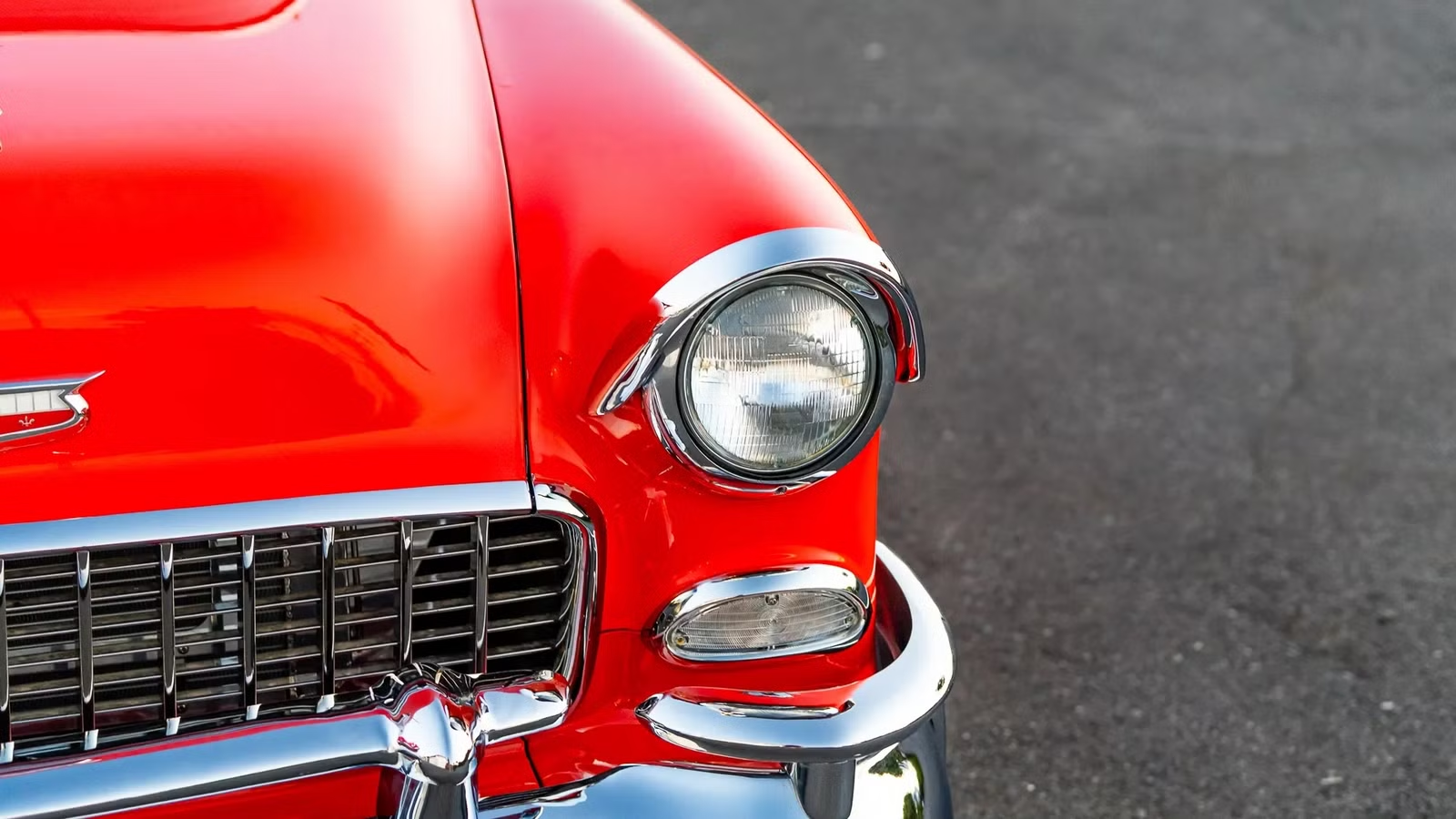
Prepare for a bit of a plot twist today. Because who expects a station wagon to have the same power output as a Corvette? That’s an insane idea. However, one forgotten Chevrolet wagon achieved one-horsepower-per-cubic-inch during the same year as the Corvette. The luxurious family hauler achieved a new milestone by blending power and comfort and doesn’t deserve to live in the shadows of sports cars. At least it’s still recognized as a holy grail find by avid collectors. In fact, it’s one of the rarest wagons in automotive history.
The Chevy 283 V8 Changed Everything

When the Chevy 283-cubic-inch 4.6-liter small-block V8 arrived in 1957, it quickly became known for its power and adaptability. Plus, it was the first mass-production engine to achieve 1 horsepower per cubic inch in America. As a lightweight and modular option, it rose to fame among hot rodders and drag racers. It evolved from the 265 small-block V8 that debuted in 1955.
Chevy engineers created the 283 Fuelie V8 by maintaining the 265’s 3.00-inch stroke while enlarging the cylinder bore from 3.75 to 3.875 inches to enhance displacement. Redesigned cylinder heads allowed the 283 to maximize its power. The engine was also shaved to reduce its overall weight. The 283 delivered between 175 and 315 hp and 275 to 305 lb-ft of torque depending on configuration.
With the base two-barrel carburetor setup, you get between 170 and 195 hp with 275 lb-ft of torque. Then the four-barrel carburetor setup increases the power to 220 to 270 hp and 285 to 300 lb-ft of torque. Adding the Rochester Ramjet fuel injection allows this engine to churn out 250 to 283 hp and 305 lb-ft of torque. Last but not least, 283 engines with 305 hp were specialized, heavy-duty options.

The 1957 Chevy Bel Air Nomad Is The Ultimate Sports Wagon

Chevrolet wanted to build upon the success of sports cars and shed its reputation for standard or boring family haulers by combining raw power with luxury performance. So, the 1957 Chevy Bel Air Nomad arrived with a sleek, two-door fastback design to provide a confident and sporty style. General Motors Design chief Harley Earl was determined to prove that station wagons didn’t have to be bland and boxy.
With the available 283 cid Ramjet V8, the wagon produces 283 hp and 300 lb-ft of torque. It can accelerate from 0 to 60 mph in about 7.7 seconds and complete a quarter mile in roughly 16.7 seconds. The sports wagon has a top speed of around 110 mph. It was ready to battle the Pontiac Safari with its 347 cubic-inch engine.
Along with potent power, this wagon features 14-inch wheels with wider tires for a smoother ride. Plus, it has an independent front suspension with unequal-length A arms and coil springs. You’ll find a live rear-axle suspension in the rear with semi-elliptic leaf springs. The heavy-duty mile-leaf spring setup also features staggered, tubular-style shocks.
Corvette Power Was Under The Hood Of A Wagon

The Corvette and Bel Air Nomad were announced with the same power output at the same time, and both went on sale during the same month in 1957. However, while the 283 V8 was available for the wagon, it came standard on the Corvette. While the Corvette was celebrated for being the first American sports car to achieve 1 HP per cubic inch, the wagon emulated a sports car.
With 283 hp and 300 lb-ft of torque, the 1957 Chevy Corvette can accelerate from 0 to 60 mph in about 5.7 seconds and complete a quarter mile in around 14.3 seconds. It features a top speed of 132 mph. The Fuelie Corvette is at about 2,848 pounds, while the Bel Air Nomad Fuelie tips the scales at 3,500 pounds.
Also, the Corvette features an independent front suspension with unequal-length A-arms and coil springs and a standard anti-roll bar. The rear includes out-rigger-mounted, semi-elliptical leaf springs with a solid rear axle. There are direct double-acting hydraulic shock absorbers on each corner. This suspension is paired with heavy-duty finned drum brakes, vented brake plates, and metallic linings.
Immense Power Was Wrapped In Luxury Features

You could call the 1957 Chevy Bel Air Nomad a sleeper wagon, as it was viewed as a luxurious family hauler hiding considerable power under the hood. It had an original MSRP of $2,857, making it one of the most expensive models in the lineup. Adding the Fuelie package added another $550 to the price. The Corvette Fuelie rang in at around $3,902 but was clearly marketed as a high-performance sports car.
Luxury Bel Air Nomad features include a two-tone vinyl and cloth interior with color-matched plush rubber-backed carpeting. The premium padded dash has an anodized aluminum insert, and a deep-dish steering wheel with a horn ring. Plus, the dual-cowl dashboard includes deep-set gauges for a simulated jet roll design.
The cargo fold pops with chrome cargo strips and ribbed metal tailgate trim. It has fold-down rear seats to enhance cargo space, which is a standard modern feature for most SUVs these days. Insane available features include a tissue dispenser in the glove box, an electric clock, and a Wonderbar AM signal-seeking radio.

Unfortunately, the sports wagon was too expensive for its own good, and it faced remarkably low sales. It was seen as impractical compared to more affordable wagons with convenient four-door access. Only about 6,264 models were sold in 1957, and only 100 of those were sold with the Fuelie upgrade before it was discontinued by the end of the year.
Collectors Don’t Sleep On The Chevy Bel Air Nomad

As you can imagine, because the 1957 Chevy Bel Air Nomad Fuelie was produced in such small numbers while utilizing Corvette hardware, hardcore collectors are willing to throw insane amounts of money at it. Factory-correct, numbers-matching models typically sell for between $73,600 and over $180,000 at auction. The average retail price is about $129,000.
Chevrolet built about 6,339 Corvette models in 1957, and about 1,040 got the Fuelie package. Models in good condition and driving quality fetch between $95,000 and $110,000, while models in great condition go for between $120,000 to over $175,000. Only 43 Airbox race-ready models are made, and they go for between $500,000 and $750,000.
Of course, the historic sports car with a moniker that still delivers high-performance power today is more popular than the family hauler wagon. However, they both feature the same power output and the 283 engine. Plus, the sports wagon features iconic 1950s style with unique luxurious amenities.
Source: Automobile Catalog, Curbside Classic, Hagerty

Related posts


Latest Post


No Comments