
10 Performance Cars Sold Before Safety Caught Up
There was a golden era in the automotive world when performance cars were defined solely by power-to-weight ratio, mechanical grip, and the skill of the driver behind the wheel. Before computers began monitoring throttle inputs and wheel speeds hundreds of times per second, going fast was a conscious decision that engaged every sense in your body. During this period, car manufacturers built some of the most legendary analog machines designed to push the limits of performance and driver engagement. However, these cars came at a time when we had none of the fancy safety features to save you if you made a mistake.
10
Ferrari F40
(1987–1992)

The Ferrari F40 has to beone of the most iconic supercars in the brand’s history. Commissioned to celebrate Ferrari’s 40th anniversary—and the final road car personally approved by Enzo Ferrari—the F40 was built with a single-minded goal: pure performance. Weighing just over 2,700 pounds thanks to its Kevlar and carbon-fiber bodywork, its 2.9-liter twin-turbocharged V8 churned out an astonishing 478 hp and 426 lb-ft of torque, sending power to the rear wheels via a five-speed manual. It was also the first production road car to break the 200 mph barrier.
Ferrari stripped the car of any unnecessary weight. It had pull-string door releases, sliding plastic windows, exposed bolts, and barely concealed adhesive on the tub. Naturally, electronic nannies were completely absent. There was no ABS, no traction control, no power steering, and no servo assistance for the brakes. Owners have said the turbo sometimes had a mind of its own, and when the boost kicked in from those massive twin turbos, you had to be ready to catch it or total your car. This was the last pure mechanical supercar from Maranello.
9
Ruf CTR “Yellowbird”
(1987–1989)


When Alois Ruf took a 1987 Porsche 911 Carrera and fitted it with a lighter body, twin turbochargers, and a custom five-speed transmission, he created a legend. The Ruf CTR, affectionately dubbed the “Yellowbird,” stunned the world by hitting 211 mph on the Nardò Ring, outrunning the top supercars of its era. With 469 hp and 408 lb-ft of torque sent to the rear wheels, the Yellowbird was immortalized in the famous Faszination on the Nürburgring film, sliding sideways through turns with tire smoke in tow.
Handling that much horsepower in an air-cooled 911 required a lot of skill. The car had no traction control, no stability control, no ABS, and no airbags. The combination of classic 911 lift-off oversteer and explosive 1980s turbo lag meant that any lapse in concentration could result in rapid snap-oversteer that would total the car.
8
Porsche 911 Turbo (964)
(1990–1994)

The Porsche 964 Turbo arrived in 1990 to carry the torch of scary turbo 911s into a new decade. It originally used a 3.3-liter turbo flat six making 316 hp, while the 1994 model got a larger 3.6-liter turbo flat six making 335 hp. It was a very recognizable vehicle with classic wide-body fender arches, that unmistakable tea-tray rear wing, and blistering straight-line speed.
While the base 964 Carrera had ABS across the 911 range, early 964 Turbos lacked any form of electronic traction control or stability management to tame the sudden surge of turbo boost. Coupled with the engine hanging out past the rear axle, hitting boost mid-corner could leave you facing backward.
7
Dodge Viper RT/10
(1992–2002)

Conceived by Bob Lutz and Carroll Shelby as a 1990s homage to the classic AC Cobra, the Dodge Viper RT/10 was raw American muscle to the max. Under its massive front clamshell hood sat an 8.0-liter V10 engine producing 400 hp and 450 lb-ft of torque. It was built to accelerate hard, look menacing, and deliver an unfiltered, raw driving experience.
In early RT/10 roadsters, Chrysler omitted almost every modern comfort and safety feature imaginable. There was no ABS, no traction control, no stability control, and not even real glass side windows or exterior door handles. Taming all 450 lb-ft of torque required a delicate right foot, and you could easily lock up under hard braking. Driver and passenger airbags were introduced in 1996 for the GTS Coupe and in 1997 for the RT/10 Roadster. ABS was finally added to the Viper lineup for the 2001 model year. Subsequent Vipers didn’t even get traction control until required by federal law on the fifth-gen Viper in 2013.
6
Lotus Elise Series 1
(1996–2001)

When the Lotus Elise Series 1 debuted at the Frankfurt Motor Show, it revolutionized light-sports-car philosophy. Built around an extruded aluminum chassis bonded with epoxy and clad in fiberglass bodywork, the S1 weighed a mere 1,600 pounds (725 kg). It had a mid-mounted 1.8-liter inline-four Rover K-Series engine with only 118 hp, but it didn’t need massive horsepower to deliver supercar handling and razor-sharp steering feedback.
Colin Chapman’s famous ethos—”Simplify, then add lightness”—was applied to every nut and bolt. This extreme weight-saving regimen meant no driver aids. The Elise S1 had no power steering, no power-assisted brakes, no ABS, no traction control, and no airbags. Since speeds were modest, none of these systems were strictly necessary, and the result is one of the most connected and engaging cars to drive.
5
Lotus Esprit V8
(1996–2004)

The Esprit was Lotus’s flagship wedge supercar for nearly three decades, but its ultimate evolution arrived in 1996 with the introduction of an all-aluminum, in-house-designed 3.5-liter twin-turbo V8 making 350 hp, although this engine was capable of 500 hp. Lotus gave the Esprit basic necessities like dual airbags and ABS. However, the Esprit V8 had no traction control or dynamic stability control. Managing twin-turbo V8 torque delivered directly through a six-speed manual transaxle required skill, especially on damp roads where grip was low. Lotus refined the Esprit’s braking system and interior ergonomics until production ceased in 2004, but there was no traction control during its 28-year lifespan.
4
Shelby Series 1
(1999–2000)

The Series 1 holds a unique place in automotive history as the only sports car Carroll Shelby designed from scratch. Featuring an aluminum honeycomb chassis and carbon-fiber body panels, the roadster boasted a near-perfect 49/51 weight distribution. Power came from an Oldsmobile 4.0-liter Aurora V8 producing 320 hp and 290 lb-ft of torque in naturally aspirated form. There was a supercharged variant that bumped power to 450 hp.
True to Carroll Shelby’s vintage racing roots, the Series 1 prioritized a raw, dynamic driver feel. So there was no traction control, stability control, or ABS. It did have standard dual airbags and power steering to satisfy federal requirements, but pushing the limits of this car relied entirely on the mechanical chassis tuning and driver input.
3
TVR Tuscan
(1999–2006)

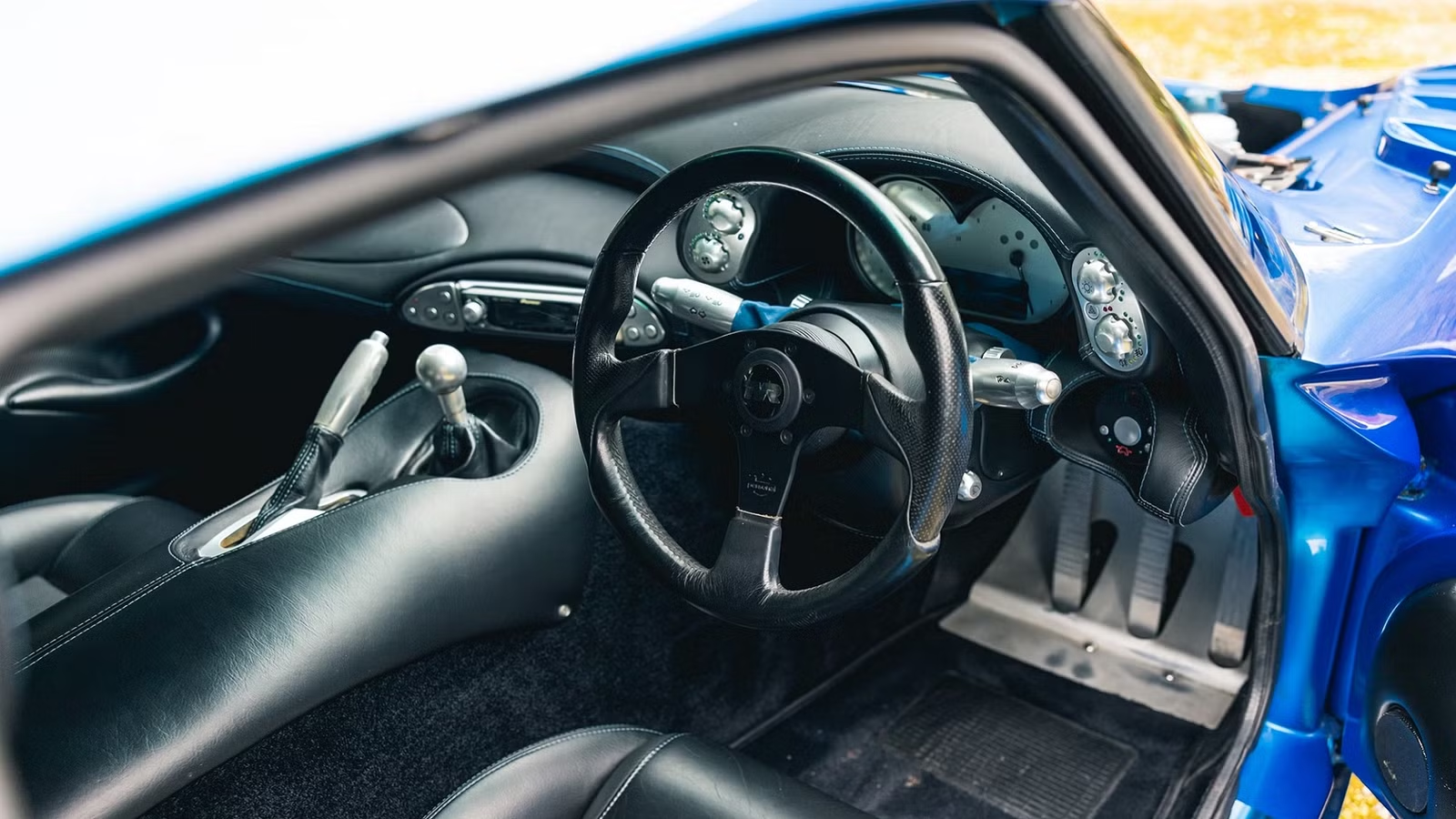
Under the leadership of Peter Wheeler, British sports car manufacturer TVR gained a legendary reputation for building beautiful, insanely fast, and completely raw machines. The Tuscan was a prime example, featuring a curved fiberglass body, removable targa roof, and TVR’s proprietary “Speed Six” inline-six engine producing up to 400 hp and 315 lb-ft of torque in a car weighing around 2,400 pounds.
TVR had an explicit corporate philosophy against electronic driver aids. Wheeler famously argued that driver aids gave drivers a false sense of confidence, leading to larger crashes. As a result, the Tuscan had no ABS, no traction control, no stability control, and no airbags. The interior featured gorgeous CNC-machined brass and aluminum switchgear, but zero padded airbag covers. TVR refused to add ABS or airbags to the Tuscan throughout its entire lifespan. The company proudly advertised its lack of driver aids until production ended.
2
Noble M12 GTO
(2000–2008)

Designed by British engineer Lee Noble, the Noble M12 GTO was engineered with one purpose: to crush lap times with utter precision. Built around a rigid steel spaceframe with double-wishbone suspension and fiberglass bodywork, power came from a mid-mounted, 2.5-liter twin-turbo Ford Duratec V6 making 310 hp and 320 lb-ft of torque. There was a bigger 3.0-liter version of this engine making 352 hp and 350 lb-ft of torque in the M12 GTO-3 and GTO-3R, sending power to the rear wheels via a six-speed manual.
Weighing roughly 2,300 pounds, it could sprint to 60 mph in 3.7 seconds and embarrass contemporary supercars costing three times as much. To keep weight down and maintain pure mechanical feel through the hydraulic rack, the M12 was completely stripped of electronic aids. It lacked ABS, traction control, stability systems, and airbags. It relied purely on massive four-piston AP Racing brakes and the driver to keep this car on the tarmac.
1
TVR Sagaris
(2005–2006)

The TVR Sagaris stands as the crowning achievement of TVR’s golden era—a street-legal track car named after a deadly ancient battleaxe. It featured slashed fender vents, a clear rear spoiler, side-exit exhaust pipes, and a 4.0-liter Speed Six engine making 406 hp and 349 lb-ft of torque. The Sagaris weighed just 2,376 pounds; it was loud, outrageously styled, and lightning fast.
Continuing TVR’s strict tradition, the Sagaris deliberately omitted all electronic safety nets. No ABS, no traction control, no stability control, and no airbags. The chassis setup was dialed in for endurance racing durability, leaving the driver in total control of 400 naturally aspirated hp. The Sagaris was the final flagship model produced before TVR closed its Blackpool factory gates.
Sources: OEM Manufacturers

Related posts
Latest Post


No Comments