
The Cadillac-Swapped Fiberglass Sports Car That Outran The 1954 Corvette
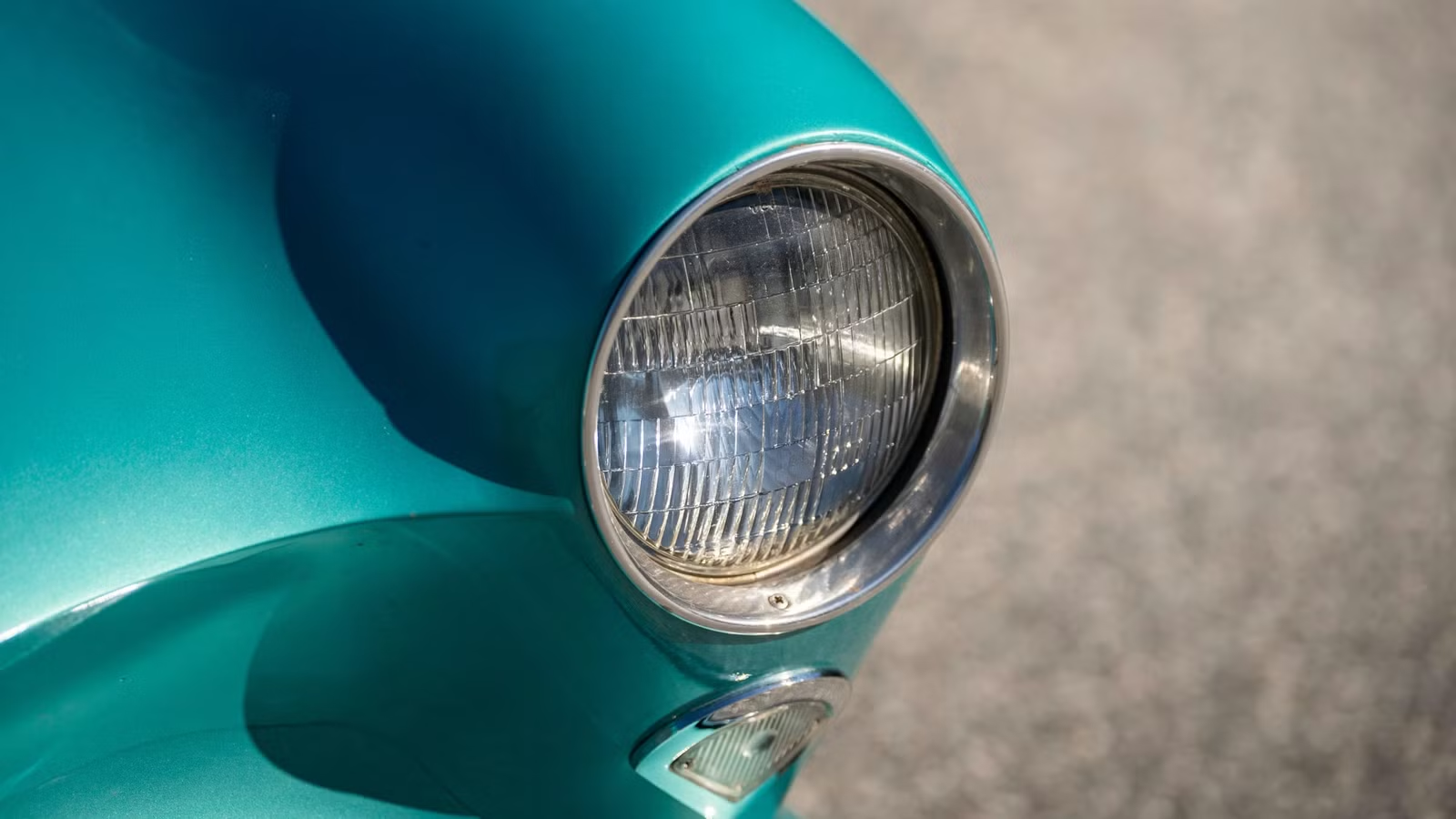
The end of production usually marks the end of a car’s story. Once assembly lines stop and manufacturers move on, even ambitious projects often fade into obscurity, remembered only by collectors and historians. Few designers ever get a second chance to improve the cars they originally envisioned.

Howard “Dutch” Darrin wasn’t interested in letting that happen. When Kaiser abandoned its sports car after just one model year, he decided the car deserved a better ending—and in doing so, created one of America’s earliest and most overlooked performance specials.
Howard Darrin Wasn’t Ready To Watch His Sports Car Disappear
Howard Darrin had already established himself as one of America’s most respected automotive designers before lending his name to the Kaiser Darrin. His sleek fiberglass roadster introduced distinctive sliding pocket doors and styling that stood apart from the chrome-heavy American norm. Yet despite attracting attention for its appearance, the car struggled to find buyers after entering production in 1954.

Kaiser-Frazer’s financial troubles only compounded the problem. With the company withdrawing from the passenger-car business, the Darrin’s future appeared sealed almost as soon as it had begun. Rather than watching unsold roadsters disappear into storage yards, Darrin personally acquired the remaining inventory through his Hollywood dealership. Historical accounts differ on exactly how many cars he purchased, with contemporary sources generally placing the figure somewhere between 50 and 100 examples, but they agree on one point: Darrin believed the car itself wasn’t the problem. He was convinced buyers wanted the styling—they simply expected performance that matched it.
Instead Of Accepting Defeat, He Reengineered The Car

The production Kaiser Darrin relied on Kaiser-Frazer’s 161-cubic-inch inline-six, producing around 90 horsepower. While adequate for everyday driving, it struggled to compete in a sports-car market that was becoming increasingly performance-focused. Chevrolet’s Corvette wasn’t especially quick either, but it benefited from far greater corporate backing and public attention. Darrin believed the answer wasn’t redesigning the body. It was transforming what lay beneath it.
Some of the cars received McCulloch superchargers and revised induction systems that lifted output to roughly 135 horsepower, enough to push the lightweight fiberglass roadster beyond 100 mph. Others received a far more radical transformation that abandoned the original Kaiser engine altogether. That decision would completely redefine what the Darrin was capable of.
Meet The Cadillac-Powered Darrin Special

For just six cars, Darrin reached beyond the Kaiser parts catalog and borrowed one of the most powerful engines available in America. The result became known as the Darrin Special.
Each received Cadillac’s 331-cubic-inch Eldorado V8, producing approximately 304 horsepower and paired with a Hydra-Matic automatic transmission driving the rear wheels. The increase in performance was extraordinary, yet the roadster’s defining characteristics remained untouched. Its lightweight fiberglass body, distinctive sliding pocket doors and elegant proportions all survived the conversion, making the mechanical transformation almost invisible from the outside.
Buyers unwilling to step all the way up to Cadillac power could instead choose one of the supercharged six-cylinder cars, which delivered a substantial improvement over the standard model while preserving the original drivetrain architecture. Priced at roughly $4,350 to $4,400, the V8-powered Darrin Special wasn’t inexpensive. But it offered something no other American sports car could match at the time: luxury-car V8 power inside one of the country’s lightest fiberglass roadsters.
It Quietly Became America’s First True Restomod

Today, enthusiasts use the word “restomod” to describe classic cars updated with more modern mechanical components while preserving their original identity. Howard Darrin applied exactly that philosophy decades before the term entered the automotive vocabulary.
Rather than designing an entirely new sports car, he took an existing production model, retained its unmistakable styling and dramatically upgraded its performance using contemporary Cadillac engineering. It was an approach that prioritized better driving rather than historical originality.
The concept would later become famous through builders who paired lightweight bodies with far more powerful engines, most notably Carroll Shelby’s Anglo-American sports cars during the 1960s. Yet Darrin had already demonstrated the same basic philosophy years earlier by refusing to accept that his original design had reached its limits. In hindsight, the Darrin Special looks less like an unusual one-off and more like the blueprint for an entire segment of enthusiast car culture.
It Was Faster Than The Corvette That Beat It In Showrooms

The greatest irony of the Darrin Special is that it finally solved the very criticism that had followed the original car from its launch. Period reports credited the Cadillac-powered cars with top speeds approaching 145 mph—an astonishing figure for a fiberglass American sports car in the mid-1950s. By comparison, the 1954 Corvette still relied on Chevrolet’s 235-cubic-inch Blue Flame inline-six producing 150 horsepower. While the Corvette would eventually evolve into America’s definitive sports car, its first production year offered little to challenge a properly prepared Darrin Special.
The showroom battle, however, had already been decided. Chevrolet possessed a nationwide dealer network, enormous manufacturing resources and a commitment to continuously developing the Corvette. Kaiser had none of those advantages, and by the time Darrin perfected his creation, the company itself had already exited the passenger-car business. History ultimately remembered the slower car because it survived long enough to improve.
Collectors Are Finally Beginning To Appreciate What Darrin Built

Only 435 production-spec Kaiser Darrins were built before production ended, making every surviving example uncommon. The Cadillac-powered Specials are rarer still, with just six conversions believed to have been completed, placing them among the rarest American performance cars of the decade.
Collector interest has steadily grown as enthusiasts rediscover the model’s significance. A supercharged six-cylinder Darrin sold for approximately $220,000 at Barrett-Jackson, illustrating how the market increasingly values these factory-authorized performance upgrades. Yet even that result doesn’t fully reflect the rarity of the Cadillac-powered Specials, which almost never appear publicly and remain difficult to value because so few change hands.

That makes the Darrin Special one of the collector market’s more intriguing contradictions. It combined a lightweight fiberglass body with more than 300 horsepower, anticipated the philosophy behind the modern restomod movement and comfortably outperformed the contemporary Corvette it was supposed to rival. Yet it continues to trade in the shadow of the car history chose to celebrate.
Howard Darrin never received the commercial success he envisioned for his sports car. What he left behind instead was something arguably more enduring: proof that a determined designer could rescue his own creation, give it the performance it always deserved and, in the process, build one of America’s earliest V8-powered restomods nearly a decade before the idea became famous.
Sources: Mecum, Chevrolet

Related posts

Latest Post


No Comments