
Here’s What The 1967 Chevy Camaro Z/28 Is Worth Today
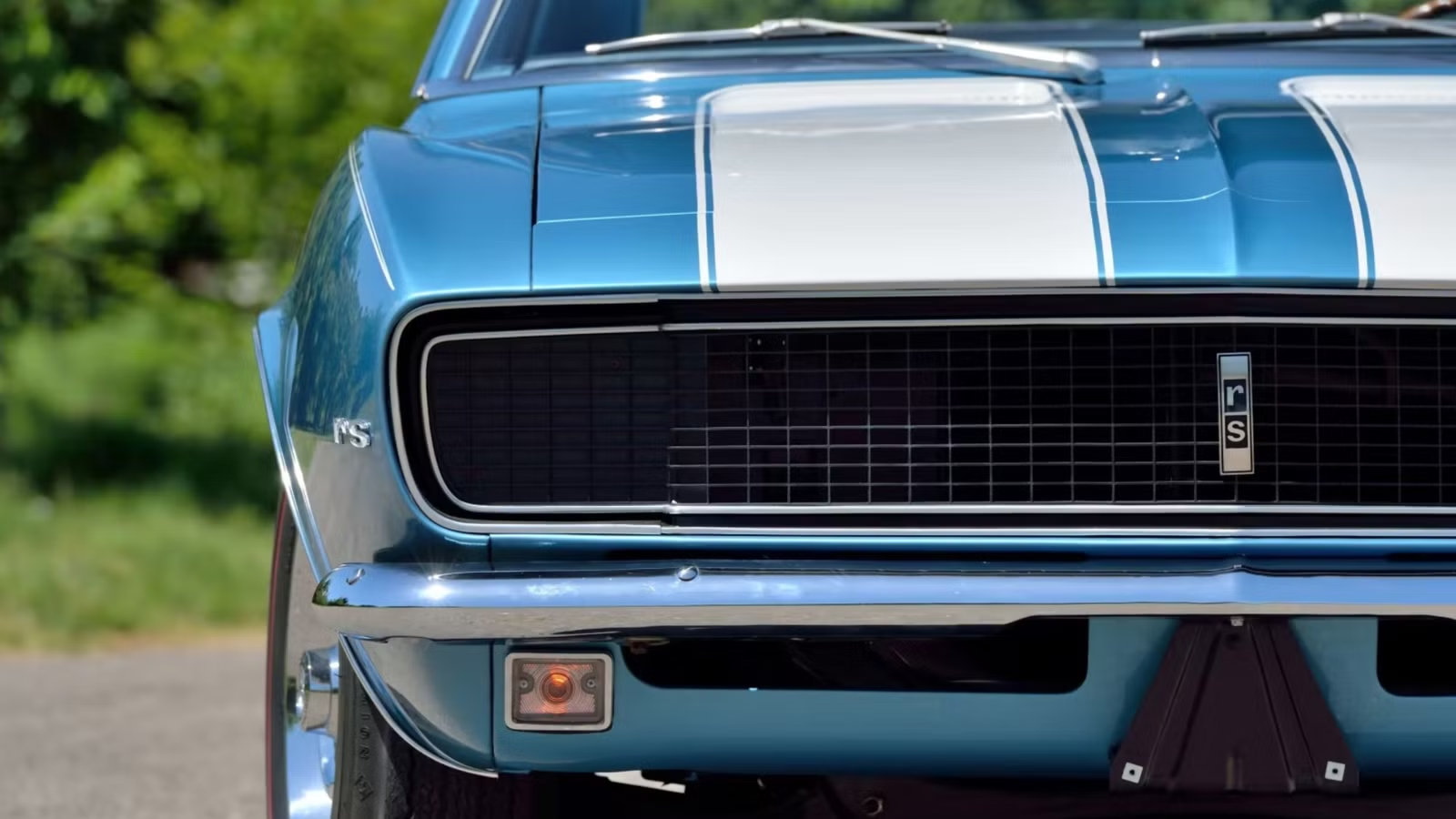
Few cars in American automotive history were born as quietly — or proved as consequential — as the 1967 Chevrolet Camaro Z/28. While Ford’s Mustang was already a cultural phenomenon and the Shelby GT350 was racking up SCCA victories, Chevrolet was scrambling to answer. The new Trans-Am racing class had debuted in 1966, and Chevy desperately needed a weapon that could compete on the track and sell on the showroom floor. What emerged wasn’t a flashy, badge-heavy halo car — it was a low-profile, purpose-built Regular Production Option that most buyers didn’t even know existed. That quiet confidence is exactly what makes the Z/28 so compelling decades later.

A product of smarter times, the Z/28 earned its reputation not through marketing but through results. Chevy built just 602 Z/28 Camaros for 1967 and deliberately underrated their power outputs. It wasn’t until ’68 and ’69 that Chevy began actively marketing the Z/28 to the public — by which time it had already established itself as a motorsports icon. Six decades on, that makes the debut Camaro Z/28 arguably one of the coolest muscle cars you could own.
But while many rare and badass muscle cars end up becoming priceless icons, some take longer than others to appreciate in value. Here’s how the 1967 Camaro Z/28 stacks up and what you can expect to pay to own one today.
The 1967 Camaro Z/28 Is A Rare Treasure
1967 Camaro Z/28 Highlights
- The only generation to get Chevy’s underrated 302ci V8
- It was cheaper and more powerful than a Shelby GT350
- No unique external badging or giveaways
- Only 602 units were made in 1967
- Worth $84,000 on average, but climbing in value fast

One of the coolest and most important performance cars in Chevy’s illustrious history, the Camaro Z/28 has Chevy’s product promotion manager Vincent W. Piggins to thank for its existence. The brand knew it needed to beat Ford on the track, but it simply didn’t have the right car to do it. The 1967 Camaro’s 350ci V8 was too large and too heavy to comply with SCCA’s 305ci displacement cap. Piggins proposed a new engine built by combining a Corvette’s fuel-injected 327ci V8 with the shorter stroke of the 283’s crankshaft, yielding a 302ci displacement. It would form the heart of a special equipment package for the Camaro — one engineered to meet SCCA’s Trans-Am standards — later designated the RPO Z28.
This 302ci V8 was not only extraordinarily capable but also exclusive to Z/28 Camaros. The engine’s camshaft was lifted from the 375-hp Corvette’s 327 and used solid lifters. The shorter stroke and solid lifters made the Z/28 a high-revving monster. Announced in November 1966, the first Z/28s left Chevrolet’s Norwood, Ohio, and Van Nuys, California, Camaro plants in January 1967.
Available only for Camaros fitted with a 4-speed Muncie manual gearbox and power-assisted front brakes, the Z/28 package combined the new 302ci engine with a single Holley 4-barrel carb, dual exhausts, a 3.73:1 ratio rear axle, and 15×6 steel Corvette wheels. Essentially a race-spec road car, you couldn’t order a ’67 Camaro Z/28 with an automatic transmission or air conditioning.
All Z/28s rode on heavy-duty F41 suspensions with leaf springs, which Chevy found worked nearly as well as a far more expensive independent rear suspension setup. Because it was built to homologate a true race car package, all the most critical components of the Camaro Z/28 were race-spec. This made the Z/28 one of the greatest road-legal muscle cars of the ’60s Chevrolet continued to refine the Z/28 throughout 1967, dialing in its suspension geometry to improve power delivery and eliminate brake fade. When it was sorted, the car took home the last two wins of that year’s Trans-Am series and went on to dominate the 1968 and 1969 Trans-Am Championship. The race car’s engine made a staggering 420 hp.
The ’67 Is The Rarest Of All Z/28 Camaros
The Z/28 Camaro is also by far the rarest. Only 602 examples left the factory. In fact, when this model debuted, Chevy never even featured it in any of its sales brochures. For comparison, Chevy made almost 12 times as many Z/28s the following year. And in 1969 — the last year for the first-gen Z/28 — a staggering 20,302 units left the factory.
The 1968 models are essentially the same as the ’67s, except they were no longer “under the radar” and feature exterior Z/28 badging on the fenders along with more feature and color options and suspension tweaks. Meanwhile, 1969 models received a more aggressive facelift with grille and fender badging setting them apart. They also featured suspension upgrades, a cowl induction hood option, and improved rear axles. While these are all incredibly cool classics, the ’67 models appear to be just starting to gain traction on the market, driven by their exceptional rarity.
You’ll Pay Approximately $84,000 For An Average ’67 Z/28 Camaro
Prices for ’67 Z/28s currently range from the merely steep to the head-spinningly high. Hagerty’s valuation tool estimates the average value of the ’67 Z/28 Camaro at “just” $84,000. However, a look at Classic.com, which collates recent auction data, shows the average price paid for a ’67 Z/28 reaching a stratospheric $147,371 (based on 14 recent sales).
The most expensive example sold in recent years fetched a staggering $275,000 — a full-package example with optional cowl induction. With later first-gen Z/28 models being far more common, average values drop considerably for 1968 and 1969, with sales averaging at $83,911 and $102,262, respectively.
Some buyers optioned their first-gen Z/28 Camaros with the Rally Sport visual package, which expands the grille to conceal the headlights and adds revised taillights along with chrome rocker panels, wheels, and RS fender badging. While it looks cool, we didn’t find any significant pricing premium for Rally Sport-optioned Z/28s over standard examples.
The ’67 Camaro Z/28 Left Ford In Its Dust
Engine Specs
|
Engine |
302ci (4.9L) V8 |
|
Bore |
4.00 inches |
|
Stroke |
3.00 inches |
|
Compression |
11.00:1 |
|
Transmission |
Muncie close-ratio 4-speed manual |
|
Power |
290 hp (underrated) |
|
Torque |
290 lb-ft (underrated) |
|
Redline |
7,000 rpm |
Chevrolet
Even though it’s a race-bred muscle car, you wouldn’t be wrong to call the first Z/28 Camaro a sleeper. It looked almost identical to the base Camaro, and its official factory rating of 290 hp was laughably far from its actual output of around 375 hp. The naturally aspirated powerhouse pulled hard from 3,500 rpm all the way to the 7,000 rpm redline. The Z/28 was, in fact, more powerful than a 1967 Shelby GT350 which pushed 306 hp from its 289ci V8.
That’s because the debut 1967 Z/28 was considered a Regular Production Option (RPO) and therefore carried no emblems or badges. Even the racing stripes enthusiasts commonly associate with the Z/28 weren’t a mandatory option. Buyers also had the choice of adding the Rally Sport package, but not all ’67 Z/28s were optioned with it. So the only reliable ways to identify a Z/28 are its 302ci Corvette-sourced engine and 15-inch wheels.
Back in the ’60s, only gearheads in the know were aware of what a beast the Z/28 was. A few years later, Chevy pulled a similar move with the low-profile L88 Corvette which is now almost priceless.
The Camaro Z/28 Was Cheaper Than The Shelby GT350
1967 Camaro Z/28 Unique Features
- Unique 302ci V8 with a Holley 4-barrel carb
- 3.73:1 ratio rear axle
- Dual exhaust with mufflers
- F41 suspension with stiffer springs
- 15×6 stamped steel wheels
- Quick-ratio manual steering
- E70-15 Goodyear Wide Tread GT tires
- Tube header exhaust system (optional)
- Fresh-air intake system (optional)
The ’67 Camaro Z/28 wasn’t just more powerful than a Ford Mustang or the race-bred Shelby GT350 — its pricing also undercut the GT350 by roughly $1,000. Not a standalone model, the base Z/28 option in 1967 added $328 to the base Camaro’s $2,572 sticker (totaling $2,900), compared to the GT350’s $3,995 MSRP (J.D. Power). The most comprehensive options package (dubbed the Z/284) ran $858.40 and included exhaust headers and a fresh-air intake. A further list of additional optional features was available at extra cost.
The Legacy Of The Camaro Z/28

The Z/28 had a quiet start in 1967, but after word spread about its motorsports success — winning the 1968 and 1969 Trans-Am championships — it sold like hotcakes. The Z/28 kept improving in 1968 and 1969 with suspension refinements and expanded options, but it always retained Chevy’s sole 302.
Second-Gen Camaro Z28 Fell Victim To The Malaise Era

The Z/28 returned for the second-generation Camaro in 1970, this time offering a Corvette-sourced 350ci LT1 V8 good for 360 hp and 380 lb-ft. The much torquier engine allowed the Z/28 to be paired with an optional 3-speed Hydramatic transmission alongside the standard 4-speed manual. In ’72, the Z/28 was rebadged as the Z28 we know today.
With newly imposed emissions standards forcing its compression ratio down and net horsepower ratings becoming the industry norm, Chevy now advertised a paltry 255 hp for the Z28. Malaise-era regulations continued to sap the Z28’s output until it produced merely 190 hp by ’81. Classic.com puts these second-gen Z28s at around $36,000 on average, with 1970 models fetching approximately $58,000 and prices declining steadily with each newer model year.
The Third-Gen Camaro Z28 Soldiered On With Less Power Than Ever

The Z28 continued as the top performance trim for the Camaro throughout the model’s third generation in the ’80s. Emissions regulations had reduced the muscle car segment to a shadow of its former self, but despite that, the 145-hp ’82 Camaro Z28 — now equipped with a smaller 305ci V8 — took home Motor Trend’s Car of the Year Award.
The Z/28 also received the beloved IROC-Z trim in 1985, which added Corvette’s 350ci V8 with tuned port injection for 25 extra horsepower and improved the suspension with new shocks and sway bars. The Z28’s output kept climbing as Chevy refined the tuned port injection setup, reaching an impressive 275 hp by 1991. On average, these third-gen Z28s can be had for around $19,458 (Classic.com) — making them a relative bargain in the collector market.
Fourth-Gen Z28s Are The Cheapest

The fourth-generation Z28 once again used a 350ci LT1 V8 — a new unit sourced from the Corvette — while the IROC-Z package was replaced by the SS trim. Offering a choice of manual and automatic transmissions, the Z28’s power climbed steadily through the ’90s. In 1996, the Corvette’s LS1 replaced the outgoing LT1, bumping output from 285 hp to an impressive 305 hp. Despite being a capable performer, the fourth-gen Camaro struggled to find buyers, and Chevy discontinued the model after 2002. Expect to pay around $15,146 on average for a regular fourth-gen Z28, while SS trims command more at approximately $24,000 (Classic.com).
The 2014-15 Camaro Z28 Returns For One Final Lap

The Camaro returned in an all-new modern form for 2010, but Chevy was hesitant to revive the iconic Z28 badge until 2014. When it did return, it arrived as arguably the greatest muscle car Chevy ever produced. Rather than relying on a small-displacement engine as before, the new Z28 borrowed a monstrous 7.0-liter LS7 from the Corvette Z06, producing 505 naturally aspirated horsepower and more torque than the Corvette itself, thanks to a new tri-Y exhaust manifold.
The latest Camaro Z28 was conceived as a stripped-down, track-focused machine and, like the original, skips amenities such as air conditioning. It launches to 60 mph in 4 seconds flat. This is likely the last Z/28 Chevy will ever produce, and Classic.com values it at an average of $63,415 — a genuine bargain, if you ask us.
Sources: Chevrolet, Classic.com, Hagerty, J.D. Power.

Related posts


Latest Post


No Comments