
The Motorcycle Built Before Complexity Took Over
Imagine getting stranded in the middle of nowhere because of a warning light on the dash of your expensive adventure motorcycle. You’d call roadside assistance, but there’s no cell service. You’re dependent on a friendly passerby to help get you (and your motorcycle) to safety. The sad truth of today’s high-tech motorcycles is that a single small sensor failure can throw a spanner into the works of your ride. Electronic complexity and the great outdoors do not always mix well, which means that the most sophisticated motorcycles can be the most fragile. That’s where the market for simple machines lies, and it is where you’ll find a dual-sport relic from Honda that just keeps going.
Dual-Sport Bikes Are Arguably The Simplest Bikes On Sale
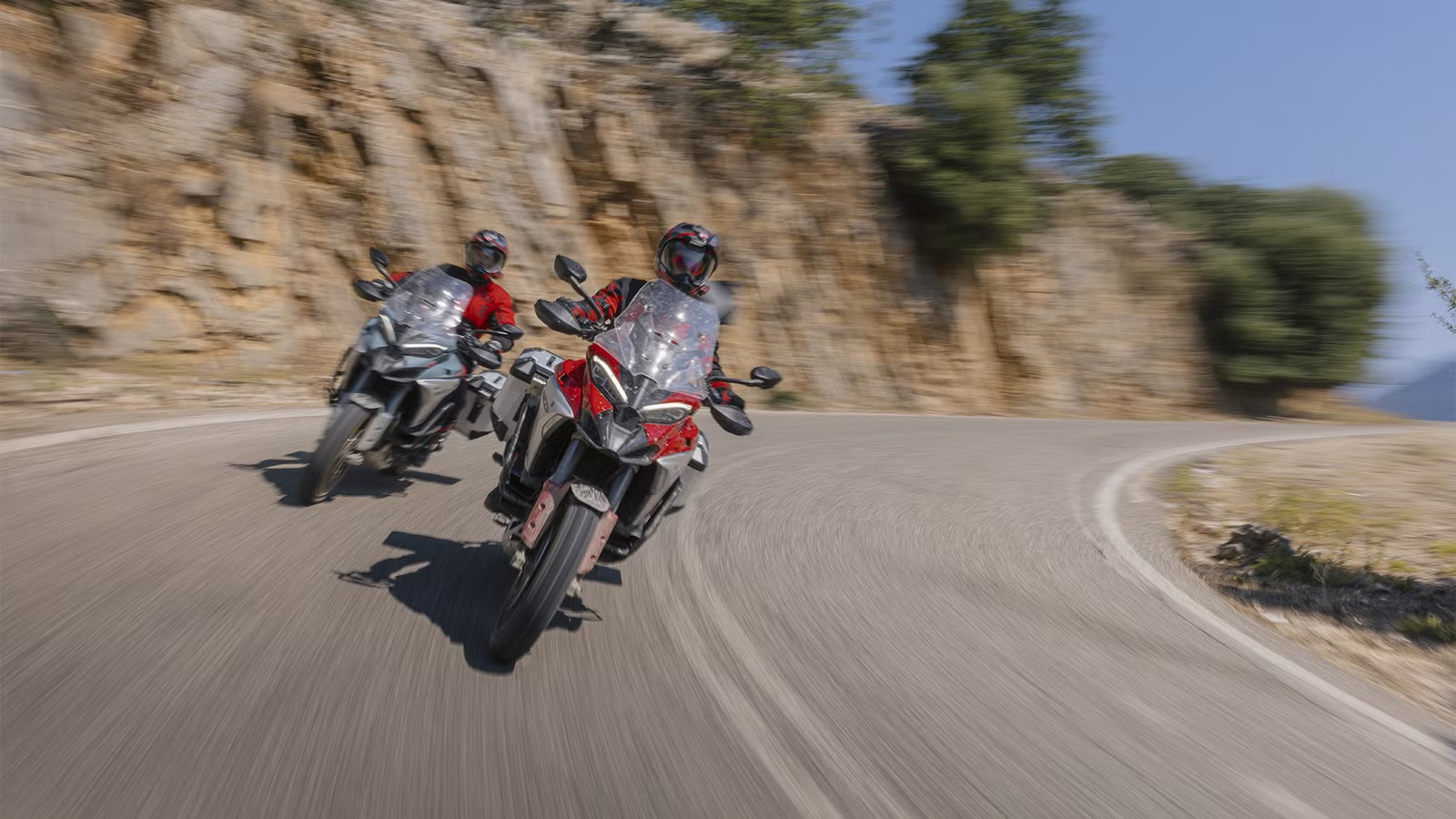
Dual-sport motorcycles are largely immune to this tech creep. That’s interesting because on either side of them (dirt bikes and naked bikes), there is continuous rapid development to make better, quicker, more efficient products. Dual-sports, on the other hand, prefer to prioritize longevity and reliability. If that means giving up on a few electronics and development cycles relative to other segments, then so be it. It can be viewed either as a stubborn unwillingness to develop or as allowing things to mature organically so that you get a product with bulletproof reliability.
Honda Has Been A Flagbearer Of Simplicity

Honda is the world’s largest motorcycle manufacturer. It gets those world-beating numbers thanks to tiny single-cylinder, air-cooled motorcycles and scooters that are sold in developing markets in Southeast Asia. At the same time, its biggest profitability comes from developed markets and premium motorcycles in markets such as ours. Oh, and did we mention that it is the most successful manufacturer in history when it comes to two-wheeler racing across all disciplines? So, Honda knows a thing or two about technology and when to deploy it. That is why the motorcycle built before complexity that has lasted through the decades is a dual-sport with a winged badge on the tank.
The Honda XR650L Is The Motorcycle Built Before Complexity Took Over


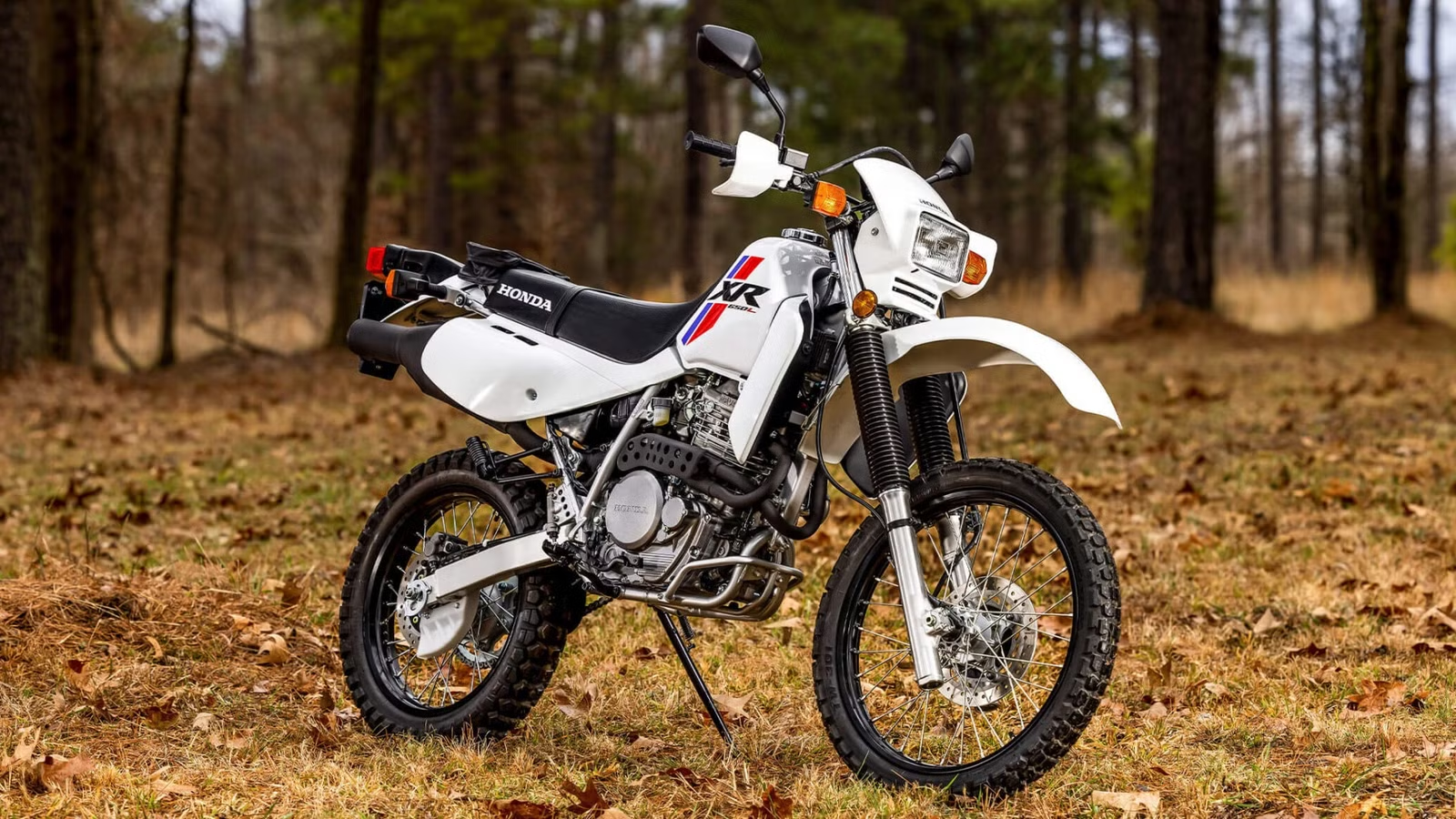
The XR650L was launched in the early ’90s before electronics were a thing with motorcycles. The only digital thing on it is its ignition system, and the only thing that has changed about it in the intervening years is the color. It hasn’t needed to change because it is one of the dual-sport motorcycles perfect for both commuting and touring. The lack of change over the decades has allowed the platform to mature.
So it is perfect for its purpose. In its segment, the XR is very much an apex predator. Despite the lack of TFT displays, traction control, Bluetooth, or even fuel injection, it rarely breaks down, and if it does, you can repair it yourself with a very basic toolkit. There are many bikes that will take you out into the wild; the XR is one of the few that will bring you home.
The Pricing Is On Par With The Competition

Honda has priced the XR650L at $6,999. When you look at the price of the KTM 390 Enduro R, it doesn’t seem like Honda has delivered value, because the more modern, more powerful European bike costs significantly less. But the direct competition of the XR is the Suzuki DR650S, and that is priced above the Honda. Whatever the case may be, you will recover the extra money you spend via rock-bottom costs and effortless ownership if you are the kind of person who is going to keep this motorcycle for a long time.
The Old-School Engine Has Some Surprises Up Its Sleeve

On the surface, the XR’s engine looks like every ordinary single-cylinder engine from the early ’90s. In fact, one can trace the origins of this engine to the NX650 Dominator, but it is one of the legendary Japanese engines still going strong today. In the XR650L, this is an air-cooled SOHC engine with four valves arranged radially: think Dodge’s Hemi design.

Where it gets interesting is the fact that this is a dry-sump engine, which makes the engine quite compact vertically. It displaces 644 cc and has a short-stroke design coupled with a very relaxed 8.3:1 compression ratio. It generates 43.6 horsepower at 6,000 RPM and 38.2 pound-feet at 5,000 RPM. It is fed by a 42.5 mm CV carburetor and puts its power down through a five-speed manual transmission and chain drive.
The XR’s Dirt Bike-Like Chassis Is Surprisingly Highway-Capable

The XR uses a semi-double cradle steel frame derived from a dirt bike, namely the XR600R. And just like the dirt bike, the XR650L also stores its engine oil in the frame, which then doubles up as an oil cooler. The suspension consists of 43 mm air-adjustable Showa cartridge forks at the front with adjustable compression damping and a Pro-Link Showa monoshock at the rear that is adjustable for preload, compression damping, and rebound damping. There is 11.6 inches of travel available at the front and 11 inches at the rear.

The brakes consist of a 256 mm disc at the front paired with a two-piston floating caliper and a 220 mm disc at the rear with a single-piston caliper. These are mounted on a 21/18-inch spoked wheel combination, and this being an old-school dual sport that is serious about going off-road, it needs tubes for its tires. This low-tech approach is what makes it quietly dominate long-term ownership.
Tall Ride Height And Sub-400-Pound Heft

This is a genuinely large motorcycle with a length of 86.2 inches, a width of 33.7 inches, and a wheelbase of 57.3 inches. The seat is notorious because it is 37 inches off the ground in stock form — you need to be well over six feet tall to comfortably tackle this Honda. However, the dry-sump engine also helps with ground clearance, giving it an eye-popping 13-inch clearance. Mitigating its height is the 346-pound weight with the tank fueled up. Speaking of which, it holds a mere 2.8 gallons. So if you intend to ride to work and then to the mountains with it, you might need to rethink the purchase. Or carry fuel.
The XR Is About The Go And Not The Show

The XR was launched in 1993, and since then, its features have been updated with exactly nothing. It still has the all-analog instrument cluster with the square and rectangular design. It doesn’t have anything as modern as a tachometer; there is an analog speedometer on the left with the odometer, and on the right, there are the warning lamps. That is the extent of its instrument cluster. Despite all its apparent shortcomings, this is a surprisingly bang-for-the-buck purchase.
We should mention that the XR is one of the few remaining dual-sport bikes that come with a USFS-approved spark arrestor in the exhaust from the factory, so if you intend to ride around on government land, this is ideal. Also, it might be carbureted, but it is legal in all 50 states. Another positive is the fact that since it has been around for so long and has been so popular, there is a massive aftermarket.
The XR650 Has Only One Direct Rival Today

The XR is old-school, but there are other new-age competitors in the segment. The Suzuki DR-Z4S and KTM 390 Enduro R both offer different flavors of modern dual-sports, but they both use quite a lot of technology to their advantage. That makes them complex. Meanwhile, the Kawasaki KLR650 used to be a competitor to the XR before it started putting on weight and fancying itself an adventure motorcycle rather than a dual-sport.

That leaves us with the Suzuki DR650S, another analog motorcycle that can run forever without breaking a sweat. It costs a couple of hundred bucks more than the Honda and makes almost identical power and torque, but has a slightly more flexible engine. It even weighs a similar amount and has the same kind of features. The only area where it has a true advantage over the XR is that you can get a lower seat height via a dealer-level suspension lowering kit, but that reduces its ground clearance and suspension travel.
Source: Honda Powersports, Honda Newsroom

Related posts




Latest Post


No Comments