
What Makes Toyota’s 745-Mile Solid-State Battery Different From Honda’s
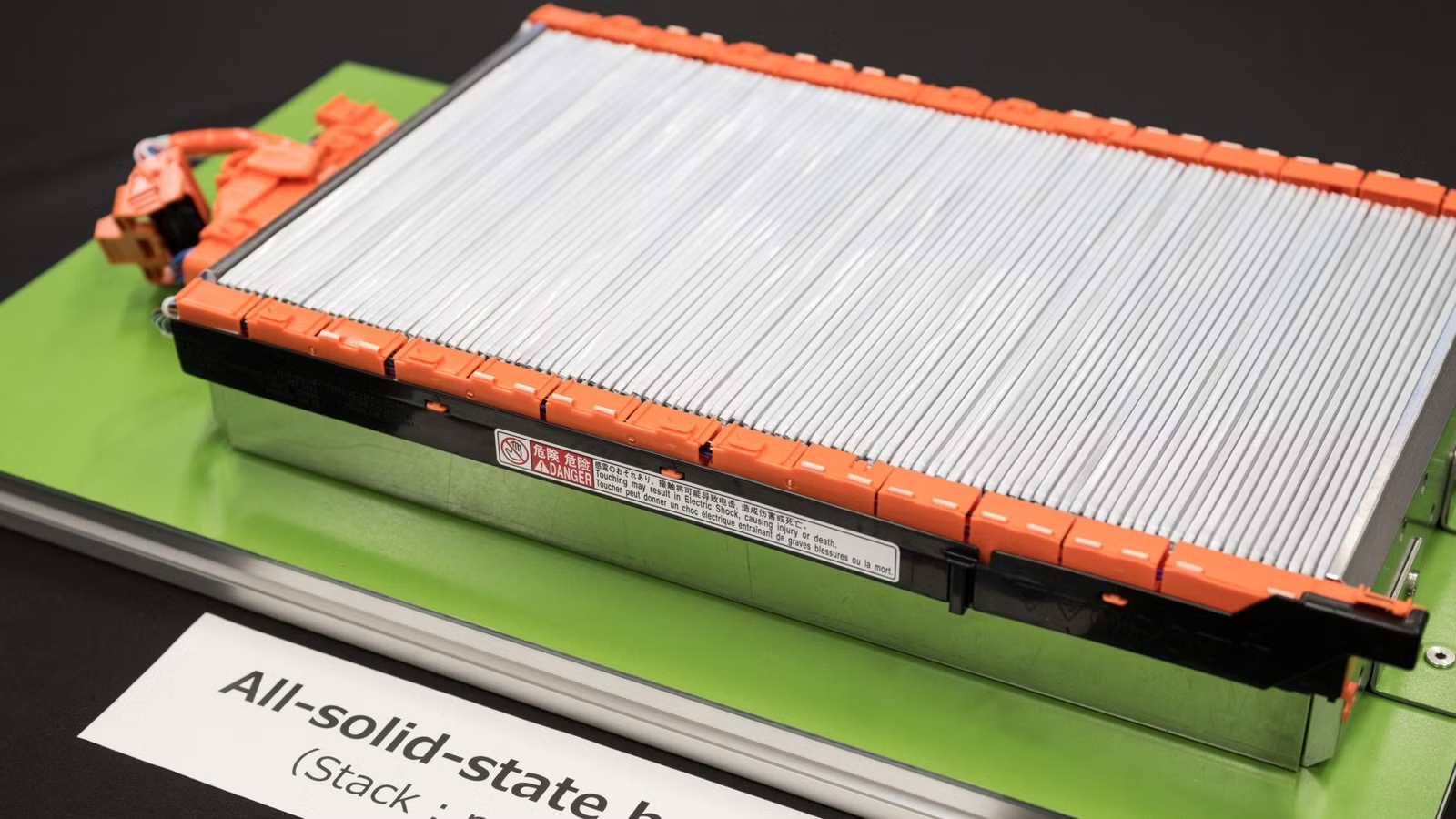
Toyota and Honda have spent decades trading blows in nearly every corner of the automotive market — and now they’re racing each other into the future of energy storage. The Accord and Camry have long sparred in the sensible-sedan segment. The Odyssey and Sienna compete for parents who need a minivan so dependable they can stop thinking about the powertrain entirely. The RAV4 and CR-V go head-to-head for drivers who want a practical SUV without the footprint of a small aircraft carrier. So it’s entirely fitting that these two pillars of mid-priced Japanese reliability are now locked in a rivalry over solid-state batteries — technology that, for all the breathless press releases, still hasn’t reached a single production car.
What We Know About Their Range And Weight
- At various times, Toyota has promised a range between 745 and 932 miles per charge.
- Honda hasn’t released any specific range statistics, but says its solid-state battery will be half the weight of current ones.

It may sound surprising after more than a decade of battery research and development, but the era of solid-state batteries has barely begun. Exuberant press releases are plentiful, but hard specifics remain scarce. Still, a few concrete details have surfaced among the extravagant promises — and what little information has gone public makes clear why solid-state batteries have grabbed the entire EV industry’s attention. The range figures alone would make today’s EVs seem charmingly primitive.
Toyota’s Battery Will Go From 745 To 932 Miles
Range may be solid-state batteries’ biggest selling point. Depending on which press release one reads, Toyota’s battery will deliver between 745 and 932 miles per charge. Even at the low end, that exceeds the range most ICE cars can squeeze from a full tank of gasoline. TopSpeed’s own readers have said that range is the main reason their next car won’t be electric. While it’s easy to imagine that Toyota’s official figures come with some wildly optimistic caveats — think exclusively downhill, tailwind, no climate control — it’s clear that Toyota’s solid-state battery will offer more range than any EV on any dealer lot today.
Honda Had No Official Range Statistics, But Promises Half The Battery Weight

Honda has not offered any official range projections. However, it does offer one concrete number: the company states that its solid-state battery will weigh just half as much as the lithium-ion batteries powering its current EVs. The battery is notoriously the heaviest single component of any EV outside the chassis itself — in fact, most EV battery packs outweigh the combined engine and transmission of a roughly equivalent combustion car.

Most drivers don’t think about vehicle weight unless they’re pushing the car in neutral, but the implications here go well beyond the spec sheet. Cutting battery weight allows automakers to raise passenger and cargo limits without costly frame reinforcement. Removing several hundred pounds from low in the vehicle also gives chassis engineers far more freedom to tune handling. That last point is of particular interest to Honda, a company with a long and ongoing tradition of making its cars just a little sportier than strictly necessary.
Toyota “Found A New Material” (But Won’t Say What)

- Toyota is using petroleum byproducts from Idemitsu, a Japanese oil company, to produce its solid electrolytes.
- Honda has not released any official announcements about what chemicals will be inside its SSBs.
The electrolyte is what puts the “solid” into a solid-state battery — and it has also been the most stubborn obstacle in the entire development process. Solid-state batteries are not a new technology; the battery industry has been making them in very small sizes for decades. Manufacturing SSBs for hearing aids and pacemakers is relatively straightforward, but a great deal of pesky physics gets in the way when someone tries to scale them up to power a car.
In other words, budgets aren’t the reason SSBs aren’t under every electric car today. Science is.
What Toyota’s Partnerships With Idemitsu And Panasonic Tell Us

Toyota hasn’t specified what wonder material turns its 745-mile dream into reality. However, its ongoing partnership with petroleum company Idemitsu offers some clues. Toyota has officially stated that it will produce its solid electrolytes from petroleum refining byproducts — not as a direct fuel source, but as raw feedstock. The various sulfides sourced from Idemitsu serve as starting ingredients for lithium sulfides, which will be a key component of the electrolyte chemistry.
Additionally, Toyota has co-developed over 1,000 SSB-related patents with Japanese electronics manufacturer Panasonic. That depth of collaboration suggests the battery will incorporate complex power management circuitry — a significant step beyond the simple battery management systems found in conventional ICE vehicles.
Honda Hasn’t Disclosed Its Material At All
Honda has not made any major announcements about what its solid electrolytes will be made of. To be fair, doctorate-level battery physics doesn’t translate easily into a press release. But since Honda is already discussing manufacturing processes, it’s reasonable to assume the materials question has been resolved internally.
What can be inferred with some confidence is that Honda’s solid electrolytes will almost certainly rely on substantial amounts of lithium. Solid-state batteries are known to require significant lithium content — potentially more than conventional lithium-ion cells. With that in mind, if Honda had found a way to build lithium-free solid-state batteries, it would almost certainly be trumpeting that breakthrough in every press release it issues.
What We Know About Toyota’s And Honda’s Factory Plans

- Both Honda and Toyota seem to be working on mass-production methods, which suggests that they have already come up with viable battery designs.
- Toyota is building a SSB factory in Liberty, North Carolina.
- Honda has developed a process for pressing its batteries together for better internal electrical contact.
After solving the problems of physics and materials engineering, any automaker pursuing solid-state batteries must also crack the challenge of mass production. It’s not as simple as scaling a recipe. A bakery can multiply its founder’s pound cake to produce a thousand at a time, but there is no equivalent shortcut from a laboratory prototype to a battery production line. Even so, it appears that both Honda and Toyota have made meaningful progress toward manufacturing batteries by the freightload rather than one at a time.
Toyota Is Building A Factory In North Carolina

Toyota is certainly spending money as though it has cracked the code on moving its batteries from the laboratory into a production line. The company is investing billions of dollars in a factory in Liberty, North Carolina.
It’s tempting to speculate that Toyota is simply spending on an empty facility to compensate for decades of slow progress — factory shells are relatively easy to repurpose later. But even though Toyota’s status as one of the world’s top-selling automakers could theoretically afford such a face-saving gesture, that kind of extravagance would be out of character for the company. The more likely reading is that Toyota is genuinely transitioning from battery design to production.
Honda May Have Solved One Of SSBs’ Biggest Problems

Honda hasn’t announced any factory plans yet. However, it has already made several announcements about its production process. Honda’s releases proudly tout its battery-stamping method: the company will press its batteries together under significant force, effectively squishing the solid electrolyte granules so they make better contact with the battery’s electrodes.
Honda has also developed a method to prevent dendrites from forming inside its batteries. Dendrites are small, needle-like crystals that grow when lithium separates from the compounds within aging batteries. As they enlarge, they puncture internal battery structures and bring the cell to the end of its useful life — and they always originate at the electrodes. Honda’s design addresses this by placing a polymer layer across the electrodes. Much like laying a tarp over bare soil to suppress weeds, this barrier prevents lithium from ever contacting the electrodes directly, blocking the conditions that allow those damaging crystals to form.
Toyota Got Into SSBs First, But The Industry Is Catching Up

Toyota essentially launched the solid-state revolution, even if it took the rest of the industry several years to recognize it. When Toyota made its first solid-state announcement in 2010, the concept seemed nearly as far-fetched as mass-produced EVs did before Tesla changed the conversation. However, Toyota no longer holds a monopoly on solid-state battery development.
Practically every major company in the auto industry is now in the solid-state game. Some are developing the technology independently; others are funding battery startups that few had heard of before; and a handful of automakers are forming solid-state partnerships with one another. The competitive pressure means Toyota can no longer casually push back its expected deployment date. The race is tightening.
The Enduring Appeal Of Solid-State Batteries
In theory, solid-state batteries will eliminate every meaningful weakness of EVs. If the hype is to be believed, they will drastically cut battery weight, survive fast-charging without the accelerated degradation that plagues lithium-ion cells, and shrug off extreme heat and cold far more effectively than current battery technology. Many drivers avoid EVs precisely because they don’t want to build multi-hour charging stops into their routines — solid-state batteries promise to make that concern largely irrelevant. Read enough solid-state press releases, and it becomes easy to wonder why anyone bothered with lithium-ion batteries at all.
Why Honda, Toyota, And Everyone Else May Not Get Very Far With Solid-State Batteries

Despite all these extravagant promises, it must be acknowledged that billions of dollars and many years of effort have gone into solid-state batteries without a single production vehicle to show for it. No company in the auto industry has managed to put a solid-state-powered car on the road — there hasn’t even been a credible test mule with a prototype cell bolted in. At some point, one has to ask whether solid-state batteries represent a long but ultimately successful undertaking, or an ever-growing sunk cost.
The threat of a lithium shortage adds another layer of uncertainty. As noted above, solid-state batteries are expected to require more lithium than conventional lithium-ion cells, at precisely the moment when lithium is becoming scarcer and demand is surging. It is entirely possible that all the solid-state research will sputter to an unremarkable end due to material shortages — and even if the batteries do reach factory production, lithium prices could make them too expensive for mainstream buyers.
Even so, the current generation of lithium-ion EV batteries is clearly inadequate for most people — if it weren’t, EVs would have displaced combustion engines long ago. Honda and Toyota are positioned to lead the solid-state era if it arrives. And if solid-state batteries ultimately go nowhere, both companies have the financial depth to absorb the loss and move on.

Related posts




Latest Post


No Comments