Buying a sports sedan used to be simple. If you wanted something practical enough for the daily commute but entertaining enough for a Sunday morning blast, you bought a BMW. For decades, the Bavarian marque perfected the formula, offering models that combine sharp handling, strong engines, and enough refinement to justify the sometimes eye-watering prices.
The market doesn’t quite work like that anymore. Today, spending luxury-car money doesn’t automatically buy you the most rewarding drive, and the badge on the hood means less than it used to.
German vehicles have a reputation for being expensive to own, and unfortunately for some of the best BMW sedans, that reputation is not unfounded. It isn’t just the generally high sticker prices either; according to CarEdge, the average BMW annual insurance premi um is $4,636, the average 10-year maintenance cost is $16,021, and the average depreciation rate is 50 percent over five years. Audi, Mercedes, and Porsche don’t fare much better either.
These are averages for driving normally, let alone if you own something that goes around the track on the weekends as well. Powerful engines can be expensive to fuel and repair; routine maintenance can turn into financial ruin; brakes will likely take a hammering and will need replacing more often; and scrubbing out performance tires is not a cheap hobby.
Side 3/4 action shot of 2025 BMW Alpina B8 Gran Coupe in green driving on roadBMW
This has forced us all to rethink what defines value in the sports sedan segment. Straight-line speed and badge weight are no longer enough to justify the prices. More and more, the best performance cars truly combine engaging handling with sensible running costs, everyday practicality, and a sticker price that actually leaves room in the budget to enjoy driving them.
BMW Sports Sedans Are Popular For Their Superb Driving Balance
Front 3/4 shot of 2026 BMW M340i parked next to wallBMW
BMW didn’t become the benchmark by accident, and long before every brand claimed its sedan was “driver-focused,” BMW built its reputation around cars that actually rewarded enthusiastic driving. Rear-wheel-drive platforms, even weight distribution, responsive steering, and smooth inline-sixes give models like the 3 Series a level of balance that few can truly match.
Whether you are driving through city streets or taking on a windy back road, a BMW always seems to feel lighter and more connected than its rivals. The formula works because BMW never forgot these cars had to work as everyday transport. A 3 Series, especially the newer ones, can carry four adults, return decent-enough fuel economy, and soak up highway miles just as easily as it can attack corners.
Rear 3/4 shot of 2026 BMW 3 Series parkedBMW
BMW has spent a long time creating an image centered around driving pleasure, motorsport heritage, and quality. For many of us, owning a BMW is about more than the performance specs; it is about buying into one of the strongest reputations in the auto world. Even today, that brand recognition is enough to place BMW on almost everysports sedan shortlist. BMW earned this reputation over decades. The question is whether it still deserves it in 2026 — and whether any car priced thousands below it can match the experience that made the brand famous.
The BMW Badge Doesn’t Always Equal The Best Driving Experience
2025 BMW X7 M60i badgeLyndon Conrad Bell | TopSpeed
A strong reputation can set expectations, but it doesn’t guarantee results in any given price bracket. Modern sports sedans have evolved to suit a broader audience than ever before. That means refinement, tech, fuel efficiency, and comfort have, in some cases, taken priority over outright driver engagement.
Adaptive suspension, big touchscreens, more sound insulation, and bigger builds have made performance sedans fancier than their predecessors, but not always more involving to drive. At the same time, the gap between luxury and mainstream brands has narrowed by some margin.
Rear 3/4 action shot of 2026 BMW 5 Series driving on roadBMW
Better chassis engineering, electronically controlled limited-slip diffs, adaptive dampers, small but powerful turbo engines, and performance tires mean brands no longer need years of prestige to create something exceptional to drive. So which car actually closes that gap — and does it do so convincingly enough to make BMW’s premium impossible to justify?
The 2026 Hyundai Elantra N Delivers BMW-Level Driver Engagement For $10,000 Less
A front action shot of a blue 2026 Hyundai Elantra N driving around a trackHyundai
If you were to ask most people what the best sports sedan under $45,000 is, they’d likely say that it is the 2026 BMW 2 Series, which has a starting price of $42,200. However, people tend to forget about the 2026 Hyundai Elantra N.
While the badge on the hood would not fill most sports sedan fans with confidence, the new Elantra N’s starting price of $35,100 just might make them take a look. The manual Elantra N costs the base amount; the DCT-equipped model is an extra $1,500, and the TCR Edition will cost you $40,495 for the automatic and $41,995 for the manual.
High-Performance Formula Built Around Driver Engagement
A set of 2026 Hyundai Elantra N sports sedans parked on the trackHyundai
At the center of the Elantra N’s appeal is its driver-focused build. It measures 185.4 inches long by 71.9 inches wide and rides on a 107.1-inch wheelbase. It also weighs between 3,186 and 3,296 pounds. The Elantra N also gets a rare choice in the sedan market today: a manual transmission option.
You can choose between a short-throw six-speed manual with rev matching or, if you want to let the car do the work for you, an eight-speed DCT with paddle shifters. If you go for the DCT, you get the N Grin Shift (NGS) button on the steering wheel. When engaged, you get an extra 10 horsepower for up to 20 seconds, making overtaking more expensive cars considerably easier.
Rear shot of 2026 Hyundai Elantra NHyundai
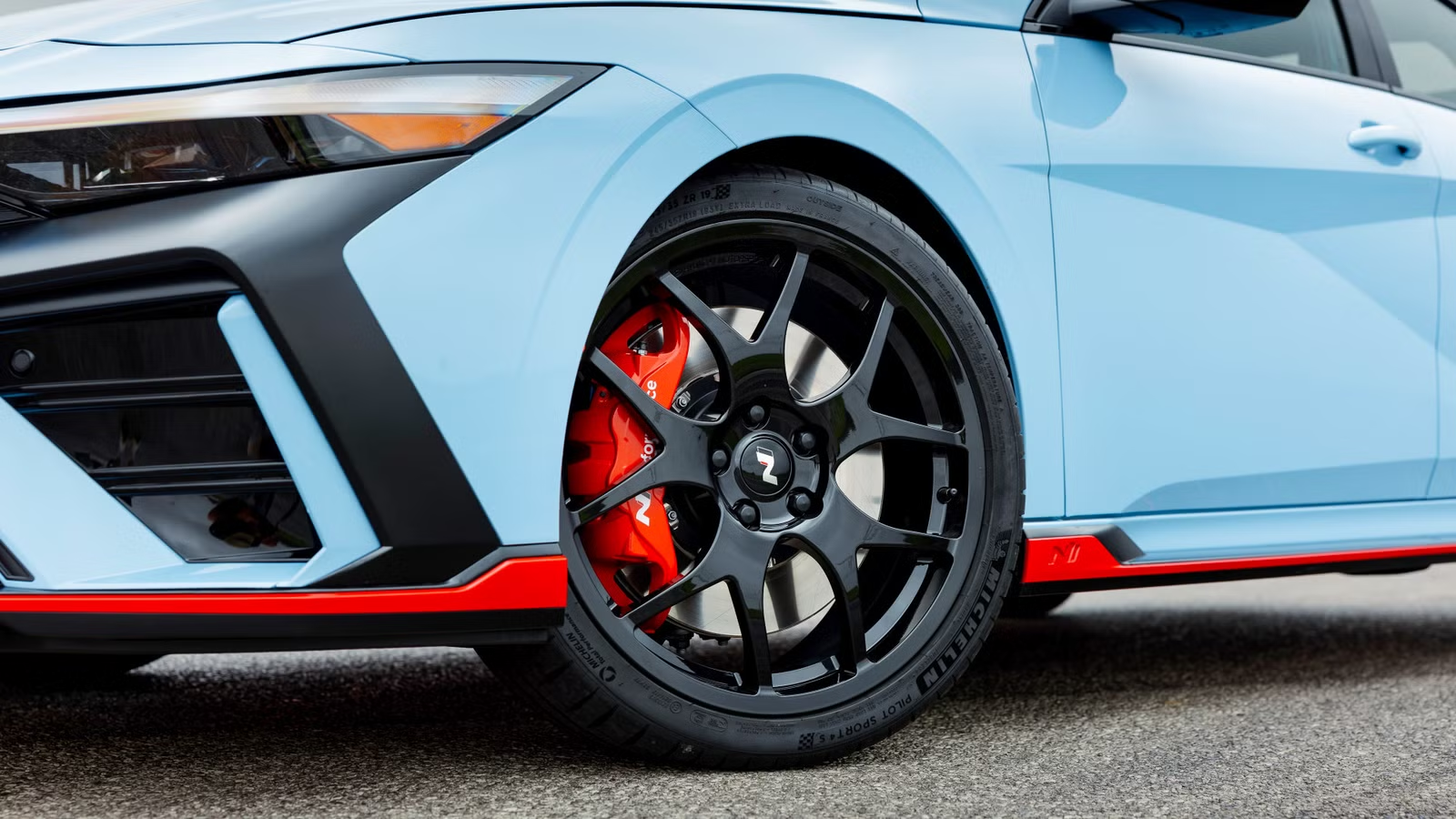
The N is equipped with sport-tuned suspension, adaptive dampers, and the N Corner Carving Differential, which is an eLSD that actively sends torque to the outside front wheel in fast corners, reducing understeer and allowing you to accelerate hard out of corners.
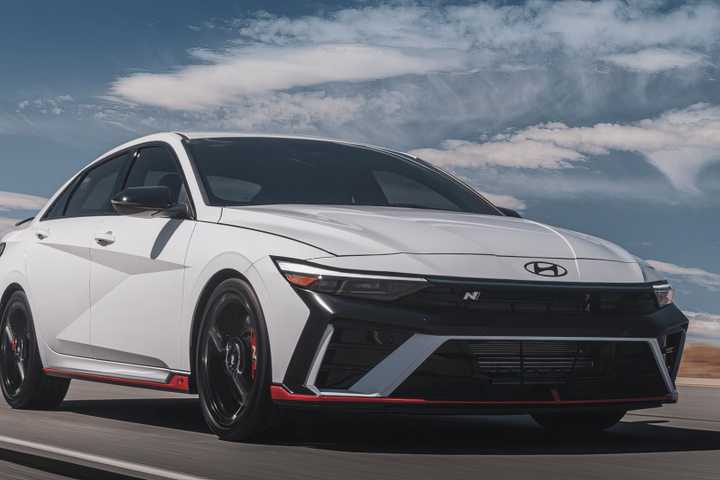
Possibly the most notable piece of sporty equipment the Elantra N gets is the large swan-neck rear wing, which adds significant downforce at speed and improves aerodynamic stability when driving back roads. To benefit from this, you have to opt for the Elantra N TCR Edition. The only downside is that there is no rear-wheel-drive or all-wheel-drive option; the Elantra N is front-wheel drive only.
Usable Turbo Power Without The Unnecessary Upcharge
A 2026 Hyundai Elantra N displays its lights and wing in a closeup rear shotHyundai
Hyundai may not be known for its exceptionally powerful engines, but in the Elantra N, the 2.0-liter turbocharged GDI inline-four producing 276 horsepower at 5,500 rpm (286 when NGS is engaged) and 289 pound-feet of torque at 2,100 rpm does an exceptional job.
0–60 mph times in the manual flavor have been clocked at around 5.2 seconds, and in the DCT-equipped model, around 4.7 to 4.8 seconds, courtesy of the NGS button. The top speed of the Elantra N is limited to 155 mph, so, in other words, the same as a lot of BMW sports sedans in 2026.
Dual 10.25-Inch Screens And Alcántara Trim Give The Cabin Premium Vibes
Shot of 2026 Hyundai Elantra N interior showing front cabinHyundai
While German brands tend to get praise for their blend of athletic and luxury interiors, the Elantra N does not do badly considering its price tag. As standard, dual 10.25-inch screens—one for infotainment and one for the instrument cluster—are fitted, along with N Light Sport bucket seats wrapped in leather and suede, and wireless Apple CarPlay and Android Auto.
The TCR Edition gets even more finery and features that take on BMW. This trim gets an Alcantara steering wheel, Performance Blue seat belts, TCR special badging, TCR puddle lamps, and far more leather touchpoints around the cabin.
How The Elantra N Compares To BMW’s Entry-Level Sports Sedans
A rear 3/4 shot of 2026 Hyundai Elantra N parked on trackHyundai
It looks good inside (there have been some concerns about the exterior design), and it is quick, but where the new Elantra N truly comes into its own is value for money. A 2026 BMW 2 Series Gran Coupe has an MSRP of $40,000 , while a 2026 BMW 3 Series will set you back just under $50,000 for the base-trim 330i.
The 2026 330i is equipped with a 2.0-liter turbo-four good for 255 horsepower and a 0–60 mph time of 5.4 seconds, while the base-trim 2 Series Gran Coupe (the 228) gets a 241-horsepower turbo-four that reaches 60 mph in between 5.8 and 6.1 seconds. Even the base-trim Elantra N challenges both of these times.
Handling Against The New BMW 2 Series And 3 Series
2026 Hyundai Elantra N front shot driving on trackHyundai
When it comes to ratings, J.D. Power rates the new Elantra N 84 out of 100 for driving experience, the new 3 Series 84 out of 100 for driving experience, and the 2 Series 91 out of 100.
Owner reviews on Kelley Blue Book are slightly more complicated: the 3 Series has not been rated, the 2 Series gets 5 out of 5 for performance, and the Elantra N gets 4 out of 5. This rating should be treated with caution, though, as the 2 Series has only received 3 ratings, while the Elantra N has received 70. A recent TopSpeed review of the Elantra N sums up the driving experience.
I think what truly shines through about the Elantra N is that it doesn’t feel like a botched job, but rather like a genuinely thought-out effort by people who are actually interested in making a car fun to drive and genuinely fast. The Elantra N is as athletic, stiff, direct and engaging as any of its established rivals. I love how loud the exhaust pops can be, or how muted the entire experience can become.
The entry-level 228 Gran Coupe isn’t cut from the same cloth as the rest of BMW’s lineup. Built on the UKL2 front-wheel-drive architecture, it shares its platform with the X1 and several Mini models rather than the rear-wheel-drive-based 3 Series. BMW has done a good job of disguising these origins, though, and has incorporated a rigid body structure, nicely tuned suspension, and the Actuator-Related Wheel Slip system, which processes wheel-slip data directly through the ECU for quicker intervention compared to a conventional stability control system.
It is a different layout to usual BMW sports sedans, but you still get good stability and nice traction. However, the standard open front differential means it may not be as eager to rotate through tight corners compared to true-performance-bred sedans. Arguably, it is not as sporty as the Elantra N in the corners, but it is still very refined.
Low-angle front 3/4 shot of 2026 BMW 5 Series drivingBMW
The entry-level 330i is in a very different position. It rides on BMW’s CLAR platform with a longitudinal engine layout and rear-wheel drive. It retains much of the balance that made the 3 Series for decades, with double-pivot front suspension and a five-link rear rig keeping the chassis composed, and near 50:50 weight distribution helping you smoothly ride through corners while still maintaining traction.
Variable Sport Steering is available to sharpen turn-in, and the M Sport Package and Adaptive M Suspension can be added, which firm up body control while still maintaining everyday comfort. The new 330i may not be as “hands-on” as the older models, but it still delivers very well in the modern sports sedan market and in a way few can truly match.
What You Sacrifice By Choosing Value Over Prestige
Front 3/4 shot of two 2026 Hyundai Elantra N modelsHyundai
Whether fully justified or not, the BMW badge does carry a lot of prestige that influences everything from curb appeal to resale value, and for some of us, the roundel is just as important as performance. The Elantra N will certainly turn heads, but maybe not for the same reasons as the 2 or 3 Series, nor does it offer the same premium ownership experience.
BMW still sets the standard for interior quality in the entry-level luxury segment, with softer-touch materials, tighter panel gaps, thicker acoustic glass, and an overall sense of solidity that the Elantra N hasn’t yet earned. The latest iDrive infotainment system is more polished than what is in the Hyundai, and finer details like the switchgear, seat adjustment, and cabin insulation just feel a step above.
The Elantra N Could Be The Better Sports Sedan To Buy In 2026
What you get from an Elantra N is driving enjoyment over luxury, so arguably, it is the more enthusiast-worthy choice. Overall costs will also make a difference; Edmunds estimates that the five-year true cost to own an Elantra N with a manual transmission is $47,206, and $48,536 for the DCT-equipped model.
This includes maintenance costs of up to $5,003, repair costs of $656, depreciation of up to $15,075, and fuel costs of up to $18,762 over five years. In comparison, the new base-trim 2 Series with a manual box will cost you $13,016 to own over the same time, while a new base-trim 3 Series will cost you $65,113 over five years.
The biggest compliment you can pay the new Elantra N is that it forces us to think about what we are actually paying for. For a long time, choosing a sports sedan meant accepting the best driving experience came with a luxury badge and price. That gap has been closed, and while BMW still builds exceptional sports sedans, they no longer have the segment to themselves. If your priority is outright driver engagement rather than premium appointments or brand prestige, there is genuine competition that costs a lot less.
This is the Elantra N’s greatest achievement. It cannot beat BMW sedans for luxury, and it does not try to imitate what the 3 Series offers or compensate with gimmicks. Instead, it proves that smart engineering, good chassis tuning, a capable engine, and a clear enthusiast focus can outweigh decades of reputation. That’s not only good for those of us looking to get the most from a well-priced sedan, but for the sports sedan as a whole.
2025 Hyundai Elantra N Side ProfileGuillaume Fournier | TopSpeed
The basics that make sports sedans enjoyable, such as steering precision, throttle response, chassis balance, and suspension tuning, are no longer exclusive to expensive German brands. For those who prioritize driving engagement over cabin gadgetry, the Elantra N’s example is worth paying attention to.
Base Trim Engine
2L I4 ICE
Base Trim Transmission
6-speed manual
Base Trim Drivetrain
Front-Wheel Drive
Base Trim Horsepower
276 HP @5500 RPM
Base Trim Torque
289 lb.-ft. @ 2100 RPM
Base Trim Fuel Economy (city/highway/combined)
21/29/24 MPG
Make
Hyundai
Model
Elantra N
Segment
Compact Sedan
Sources: Hyundai, BMW, J.D. Power, Kelley Blue Book, and Edmunds.










No Comments