
The Forgotten Two-Stroke Rivalry That Built The 500cc GP Template
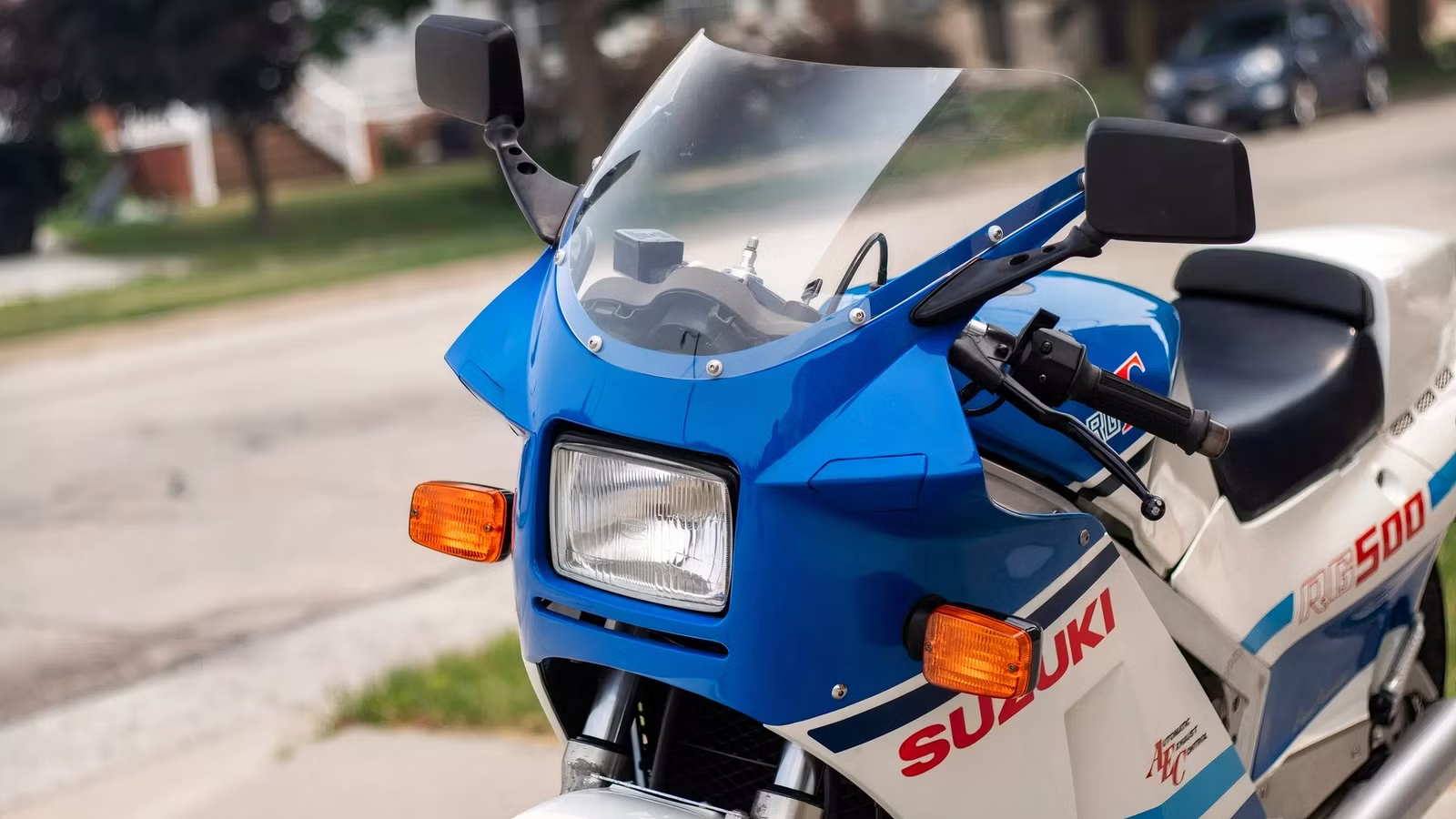
Inside a mid-1970s paddock, two very different two-strokes warmed beneath thin race fairings. One sounded furious even at idle, and promised brutal acceleration, huge speed, and a fair chance of frightening its rider before lunch. The other looked less dramatic; its crew could tune it without a factory engineer guarding the toolbox, and its rider could trust it beyond one heroic lap. The faster motorcycle produced the scarier numbers, yet the calmer design would shape Grand Prix racing for the decades to come.
Two-Stroke Racing Had A Power Problem Nobody Had Solved

By the middle of the 1970s, two-stroke engines had already proved their basic point. They could make enormous power without the size, weight, or mechanical clutter of a large four-stroke. Every revolution produced a power stroke, and carefully shaped expansion chambers helped pull fresh charge through the engine at high speed. A small package could suddenly make yesterday’s premier-class machinery look ready for a museum. The trouble started when engineers tried to make that performance last for an entire race instead of one glorious run down the straight.
Peak output often arrived through a narrow slice of the rev range. Below that zone, the engine might cough, load its spark plugs, or offer very little drive. Inside it, the rear tire could lose its argument with physics. Crankshafts, primary gears, pistons, and bearings lived under severe stress. Rich fuel mixtures reduced seizure risk but could spoil throttle response. Leaner settings improved speed but gave the engine more ways to destroy expensive parts. Bigger fuel loads then hurt handling, while period frames, suspension, brakes, and tires struggled to keep up with the engines.
Japanese manufacturers also began leaving their modified road-bike roots behind. Earlier racers often borrowed engines, layouts, or major parts from production motorcycles. The new generation used specialized engines, dedicated frames, dry clutches, racing gearboxes, and cooling systems built for competition. That shift created a larger question than horsepower alone – a factory could chase maximum speed and acceleration, but it also needed reliability, useful throttle response, and a chassis that riders could understand. Customer teams added one more demand – mechanics without direct factory support had to tune, rebuild, and race the machine. The winner would need more than power.

One Factory Chased 192 MPH; The Other Chased Repeatability

The first factory took the direct route. It created a water-cooled inline-triple of roughly 748cc for Formula 750, national superbike races, the Daytona 200, the Isle of Man TT, and other major open-class events. Later versions produced around 130 hp while weighing close to 300 pounds. The piston-port engine delivered its power with the subtlety of a falling piano. Period accounts compared the hit to a highly tuned motocross bike. When the engine entered its powerband, it could twist the chassis, spin the tire, and turn a small throttle error into a large geography lesson.
Its speed made the pain seem worthwhile. Officials reportedly clocked one at 192 mph during the 1978 Isle of Man TT, an astonishing figure for a motorcycle using the tires, suspension, brakes, and aerodynamics of that period. Early examples paid for that performance with crankshaft life of about 200 miles. That made the crank shorter-lived than some family vacations. The factory improved the design, but it never turned the motorcycle into a common customer racer. Sources commonly place total production at only about 20 examples from 1975 through 1978. The machine became a rare weapon for factory-backed riders and specialist teams rather than a foundation for an entire class.
The second factory followed a different target. Its machine used a compact 498cc rotary-valve square-four designed specifically for the 500cc Grand Prix category. It lacked the triple’s 250cc capacity advantage, but its smaller engine fitted neatly into a focused race chassis. More importantly, the company developed the design as a platform. Engineers could refine it year after year. Importer teams could run it, and private riders could buy versions that sat much closer to works performance than most customer racers of the era.
The Kawasaki KR750 Met The Suzuki RG500, And Refinement Won

The violent triple was the Kawasaki KR750, a water-cooled 748cc piston-port two-stroke. The smaller machine was the Suzuki RG500, which began as the XR14 works racer and developed into the customer motorcycle that transformed 500cc Grand Prix grids. One common mix-up needs clearing here immediately – the KR750 did not use a square-four engine. Kawasaki built it around three cylinders arranged in line. Kawasaki’s square-four 500cc Grand Prix racer arrived later as the KR500 in 1980. The similar names, green paint, and generous clouds of exhaust smoke have confused plenty of memories since. Smoke, as usual, makes a poor filing system.
Still, the KR750 belongs in the RG500 story because their paths crossed in major open-class racing, where capacity rules allowed very different machines to fight on the same track. The 1976 Rothmans Pro Series in Australia offered a vivid example – at Oran Park, Gregg Hansford raced the factory-backed KR750 against Warren Willing’s Yamaha 750 and New Zealander John Woodley’s privately owned RG500. Woodley gave away roughly 250cc yet stayed in the leading battle on the tight circuit. Hansford eventually won, but the Suzuki showed why its design mattered. It let a private entrant fight two larger, highly developed 750s instead of merely decorating the rear of the grid.
The two motorcycles achieved speed through different personalities. The KR750 used capacity, violent cylinder filling, and a hard power hit to produce savage acceleration and huge terminal speed. Riders had to manage wheelspin, chassis movement, short component life, and an engine that rarely forgave hesitation. The RG500 still demanded skill; it hardly behaved like a commuter with numbers on it. Early XR14s suffered seizures, transmission trouble, rich jetting, and weak chassis parts. Suzuki, however, kept solving those faults – by 1975, the works bike produced more than 100 hp at the rear wheel and reached about 175 mph. The factory then revised the engine dimensions, porting, transmission parts, and setup until the package became fast enough to win and consistent enough to reproduce.
Production and championship results settled the argument more clearly than any single race. Suzuki reportedly delivered 58 customer RG500s during 1976. That season’s final 500cc standings featured Suzukis across nearly the entire top group, with customer riders able to challenge factory-backed entries. Suzuki then won seven straight 500cc Manufacturers’ World Championships from 1976 through 1982. Kawasaki built only about 20 KR750s during the model’s full run. The firm had created the more sensational motorcycle, the sort of machine that could produce a headline with one speed-trap figure. Suzuki created a repeatable system, though – riders could buy into it, teams could learn it, and engineers could improve it across many seasons.
Suzuki Turned Factory Speed Into A Grand Prix Ecosystem

The RG500’s engine layout gave Suzuki a strong starting point. Four cylinders sat in a compact square, with two toward the front and two behind them. The arrangement placed the basic masses close together and avoided the width of a conventional inline-four. Early XR14 works engines used four short crankshafts linked by gears, while later versions evolved the concept with different crank and cylinder arrangements. Rotary discs controlled the intake timing and allowed engineers to choose precisely when each cylinder received its charge. That helped the engine breathe at high rpm without using the KR750’s extra displacement as a shortcut. The design still had gears, discs, seals, and crank parts that could fail, but it gave Suzuki a compact technical package with room to develop.
Customer availability turned that package into something larger than one fast works bike. A private rider could purchase an RG500, transport it across Europe or Australia, and enter the same premier class as factory stars. Of course, the customer machine did not always match the newest factory specification, and owners still needed talent, money, spares, and a mechanic willing to forgo sleep. Even so, it gave independent teams a serious tool. More RG500s on the grid also created a broad development network – different tuners tested jetting, pipes, frames, suspension settings, and fixes under real race conditions. Successful ideas spread, while recurring failures became impossible to ignore. Suzuki gained something close to crowdsourced research decades before anyone used that phrase.
That reach changed the economics of Grand Prix racing. A factory victory could advertise engineering strength, but a customer victory sold an entire racing program. Suzuki did not need every leading RG500 to sit inside one official garage. Importers, professional teams, and private owners carried the design into national championships and international events. In the 1976 world standings, RG500 riders occupied 11 of the first 12 positions when accounting for Giacomo Agostini’s mixed Suzuki and MV Agusta season. Barry Sheene took the title on the factory-supported version, while customer and importer-backed riders filled the positions behind him.

Kawasaki’s later KR500 works racer makes the contrast even sharper. Introduced in 1980, it used a 500cc two-stroke square-four with rotary-disc induction, placing Kawasaki much closer to the architecture that Suzuki had already established. Kawasaki paired the engine with a radical aluminum semi-monocoque chassis that incorporated the fuel tank. The company improved the machine and earned podium finishes, but difficult handling, weight, vibration, and limited development time kept it from matching its rivals. Kawasaki withdrew after the 1982 season. The KR500 did not copy the RG500 in every detail, yet the pivot suggests that Kawasaki understood where premier-class design had moved.
The RG500 helped normalize that formula. Premier-class motorcycles would use dedicated 500cc two-stroke engines rather than enlarged production units or old four-stroke layouts. Engineers would package several cylinders tightly to reduce frontal area and improve chassis placement. They would chase greater output while also shaping the power so riders could use it through corners and over race distance. Just as important, factory technology could feed customer racing instead of staying locked inside a small works department.
The RG500 Gamma Proved Which Philosophy Survived

Suzuki delivered the final payoff in 1985 with the road-going RG500 Gamma. The street motorcycle kept a 498cc liquid-cooled square-four, rotary-valve induction, and twin-crank construction that made its racing ancestry easy to spot. It produced about 95 hp in standard form and carried little weight by the standards of the day. Its aluminum frame, cassette-style gearbox, four expansion chambers, and sharp power delivery gave ordinary buyers a taste of premier-class thinking with lights, mirrors, and a license plate. Calling it practical required a strong imagination and a friendly fuel station, but practicality rarely earns bedroom-wall status.
The Gamma also gave the racing concept a cultural life beyond old results sheets. The KR750 survives as a terrifying artifact – rare, brutally fast, and tied to riders who could tame a motorcycle that consumed parts nearly as quickly as fuel. The RG500 left a wider trail – it became a works winner, a customer-racing standard, a seven-time manufacturers’ champion, and one of the most celebrated road-going two-strokes.

Later 500cc Grand Prix motorcycles became lighter, faster, and far more sophisticated. They gained better frames, wider tires, power valves, refined ignition systems, data collection, and engines that eventually approached 200 hp. Yet the winning philosophy had already emerged in the quieter half of this forgotten rivalry – raw speed could win a race and produce a legendary number, but a compact purpose-built engine, manageable performance, steady refinement, and support for more than one factory rider could shape a whole era.
Source: Suzuki, Kawasaki, Motorsport Retro

Related posts

Latest Post


No Comments