
The Most Complete Sport Bike On Sale Today
The modern open-class segment forces riders into two stark functional extremes. Uncompromising track replicas sit on one side of the showroom floor; upright super-nakeds occupy the other. Flagship sportbikes feature low clip-ons, tall first gears, and rock-hard chassis spars that punish wrists and spines over public pavement. Stripped streetfighters offer relaxed handlebars for local commuting, yet they leave your chest completely defenseless against brutal highway wind blast. Riders who want full fairings without crippling joint pain face an unfair choice. Yet one open-class platform refuses to accept this split, delivering elite performance without the usual daily misery.
Road-Going Race Replicas Bring A Flawed Compromise Today

Track-focused superbikes create distinct mechanical headaches on ordinary asphalt. Factories tune these engines purely for high-RPM breathing, leaving combustion chambers hollow and unresponsive below 8,000 RPM. You end up slipping the clutch through intersections, while cooling fans blow trapped engine heat directly onto your shins. Meanwhile, tall first gears designed for high-speed track exits make slow-speed maneuvers clunky and awkward.
Swapping to a naked motorcycle solves the low-speed posture problem, but unfaired ergonomics create severe neck fatigue past legal highway speeds. Attempting to bridge this gap usually forces aftermarket sacrifices, such as bulky handlebar risers or tall touring windshields that ruin front-end stability. The segment lacks a factory-engineered machine that honors high-speed aerodynamics while actively managing physical fatigue across long stints.
Variable Valve Timing And Adaptive Damping Solve Real-World Track Trade-Offs

Resolving this operational conflict requires dynamic engineering solutions rather than static chassis compromises. Engine designers eliminate sluggish low-end response through variable valve timing. Mild intake cam lobes produce thick, usable torque at low engine speeds. Electromagnetic actuators then shift the camshaft to aggressive, high-lift profiles as revs climb.

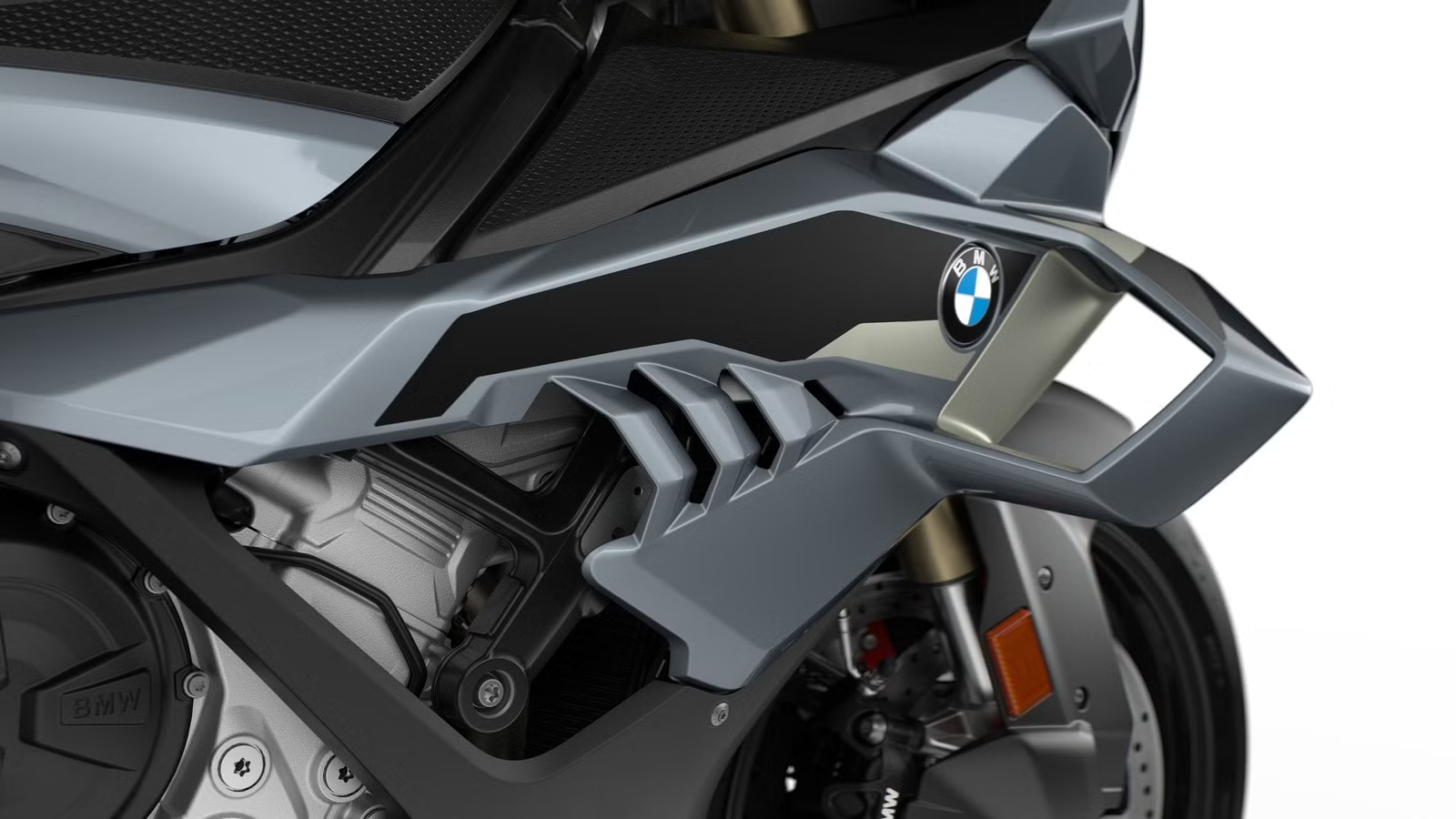
BMW Motorrad perfected this approach across its high-performance inline-four platforms, proving top-end thrust does not require an unrideable, dead midrange. Active chassis hardware handles the remaining physical abuse. Semi-active suspension continuously monitors wheel stroke and chassis pitch. Damping valves soften instantly over cracked, frost-heaved tarmac to isolate the rider, then immediately firm up under heavy braking to keep the bike planted.
The BMW S 1000 RR Offers High Performance Without The Punishment

The BMW S 1000 RR remains the benchmark because it balances comfort and excitement better than its rivals. Its ShiftCam engine pulls cleanly from low revs, ending the need to dance constantly on the gear shifter. Optional cruise control and adaptive electronic suspension manage fatigue across dull highway transfers, while the electronics package stabilizes the chassis over unexpected road surface changes.
The machine combines front-running track pace with functional, street-focused engineering. By refusing to sacrifice everyday road usability for racetrack bravado, the S 1000 RR secures its position as the most complete sportbike on sale today.
A Sub-$20,000 Base MSRP Hides Lucrative Tech Option Packages

The S 1000 RR retails for $19,975, which rivals the Honda Fireblade at a lower price. In terms of price, it sits between the Japanese bikes and the European ones. It includes everything you would want from a racetrack sportbike, including dynamic traction control with slide control, ABS Pro with brake slide assist, launch control, a pit lane limiter, a two-way quickshifter, and a large 6.5-inch TFT display.
It also displays lean angles and has Bluetooth connectivity. However, if you want a more well-rounded machine, you will pay a premium, because the electronic suspension, cruise control, TPMS, and lap trigger are all on the options list.
The 205-Horsepower ShiftCam Inline-Four Delivers Ferocious Mid-RPM Drive

The S 1000 RR’s inline four-cylinder engine is one of the greats; the original is the fastest 15-year-old sportbike. It displaces 999 cc, has a compression ratio of 13.3:1, an extremely short stroke, and variable valve timing on the intake valves. It uses titanium valves for reduced weight, which helps it rev more quickly and to higher RPMs, and it does not use a big-bang firing order, preferring instead the age-old screamer firing order.
The result is 205 horsepower at 13,000 RPM and 83 pound-feet at 11,000 RPM. It needs premium 98 RON fuel, but it will take you to 188 miles per hour with the help of a six-speed gearbox, a clutch, and a two-way quickshifter. Despite its chosen firing order, it has a very strong midrange that not only helps its performance on the racetrack, but makes it extremely rideable on the street.
A Cast Aluminum Bridge Frame Relies On Standard Manual Hardware

The S 1000 RR uses a bridge-type frame made of cast aluminum, and it uses the engine as a stressed member. The swingarm is also made out of aluminum. The suspension on the base model is mechanical, with 45 mm upside-down forks and a monoshock at the rear; both ends are fully adjustable. There is 4.7 inches of travel available at the front, and 4.6 at the rear.
The brakes are what you would expect from the segment: twin 320 mm front discs with four-piston radial fixed calipers at the front and a 220 mm single brake disc at the rear with a single-piston caliper. They are mounted on 17-inch alloy wheels with speed-rated radial tubeless tires. If you opt for the M wheels, the rear tire is 10 mm wider than the base model one at 200 mm. The ride and handling can be tuned for whatever you need; this is the German sportbike that finally gets the balance right.
A 437-Pound Wet Mass And Low 32.7-Inch Saddle Aid Real-World Control
The S 1000 RR is once more par for the course when it comes to dimensions. It is 81.6 inches long and 33.3 inches wide at the mirrors. It has a wheelbase of 57.3 inches. The seat height is 32.7 inches, but there is a higher sports seat available that gives you a more aggressive position and raises the seat to 33.7 inches.
It has a fuel tank that can hold 4.3 gallons of usable fuel, and it has an unladen weight ready to ride of 437 pounds. This makes it a remarkably compact sportbike, accounting for the inline-four width. Still, it is extremely approachable, which is why it is the most anticipated liter-class sportbike of 2027.
Steering Angle Sensors And Drift Aids Contrast With Costly Touring Upgrades

The S 1000 RR is a sportbike for enthusiasts who plan to keep it forever, and as such, it is stuffed to the gills with electronics. It starts with a large 6.5-inch TFT display that has different views; it can show things like lean-angle meters, lap timers, and DTC intervention levels in real time. A six-axis IMU and by-wire throttle are standard, but this BMW also gets a steering angle sensor.
As a result, it gains not just ride modes and cornering capabilities for the ABS, traction control, and engine brake; it also delivers slide control on the brakes while entering corners. It will also allow you to preset drift angles and rear wheel spin while accelerating out of corners. The traction control and wheelie control are multilevel, and it also has more standard features like hill-hold assist, launch control, a pit lane limiter, and a two-way quickshifter.

Mechanically, there are also a lot of very interesting adjustments available. The swingarm allows you to adjust the pivot point and rear ride height, and electronic suspension is an option. This is the semi-active system that you can tune for your preferred racetrack, or you can set it to auto and let it adjust automatically on your preferred route.
Cruise control is another option. The electronic suspension and cruise control, combined with the engine’s great midrange, make this a genuinely usable everyday bike, despite the features here making it sound like a high-strung track-day special. That is a huge part of what makes it the most complete sportbike on sale today.
Exotic Italian V4s And The ZX-10R Challenge BMW Over Road Versatility

There is fierce competition in the liter sportbike segment, but the BMW manages to carve out a niche for itself. At the top of the price range is a motorcycle that makes summer feel too short, the $35,595 Ducati Panigale V4 S. It has all the bells and whistles, including electronic suspension, a counter-rotating V4 engine with Desmodromic valves, rear cylinder bank deactivation, and the pedigree of having beaten all the competition at the highest echelons of road racing, but it costs at least $10,000 more than even the S 1000 RR specced with the electronic suspension.

Another European exotic that costs nearly the same as the BMW — and feels like the Ducati without the price tag — is the $19,699 Aprilia RSV4 1100. Like the BMW, it has cut its teeth in racing, but unlike the BMW, it runs a V4 engine that generates nearly 220 horsepower. Aprilia’s acclaimed APRC electronics suite is present in the base RSV4, but it doesn’t have electronic suspension; for that, you have to step up to the more expensive Factory variant. Still, the Aprilia can give the BMW a run for its money, but it is biased toward the track and merely tolerates street duty.

If you want to be pragmatic about something as illogical as a liter sportbike, you could opt for the smart buy in the class and save a couple of thousand dollars with the $17,999 Kawasaki Ninja ZX-10R ABS. It might be a little down on power compared to the European bikes; however, it is still frighteningly quick and has all the equipment that you need to have fun on track while still making road rides pleasant.
Source: BMW USA

Related posts

Latest Post


No Comments