
The World’s Fastest Diesel Car Is A Quad-Turbo Sleeper Sedan
Diesel power never quite got its moment in the sun. Just as the technology matured enough to produce genuinely quick, refined, and efficient cars, the twin hammers of the Dieselgate scandal and the electric-vehicle revolution knocked the wind out of it. Yet while the world moved on, a handful of engineers kept quietly pushing oil-burner performance to places nobody expected. The result? A quad-turbocharged sleeper sedan that can embarrass sports cars at a stoplight — and it runs on diesel.

Then the wheels seemed to fall off diesels. The technology was there to move them significantly forward from the black-smoke-belching tractors that they once were, but then “Dieselgate” hit, and generally consumers started to realize that they could get many of the same things a diesel offered — including cheap miles and plenty of torque — from an electric car.
But not everyone was convinced. The fact is that diesels still have a fan base, mostly being used in trucks and big SUVs in the US, but also in sedans and wagons across Europe. For a time-poor sales rep who needs to cover long distances in Germany, doing more than 1,000 miles on one tank in a VW Passat still has its benefits. Diesel technology has also been quietly improving too, while nobody was watching. By how much? The fastest oil-burner of them all is a sleeper car that can beat a Toyota Supra in a straight line, put it that way.
HotCars used official manufacturer data to round up the fastest diesel production cars on sale. We used independent reviews and manufacturer’s claims for performance data.

The BMW M550d xDrive Is A Diesel That Is Faster Than A 2000s M3
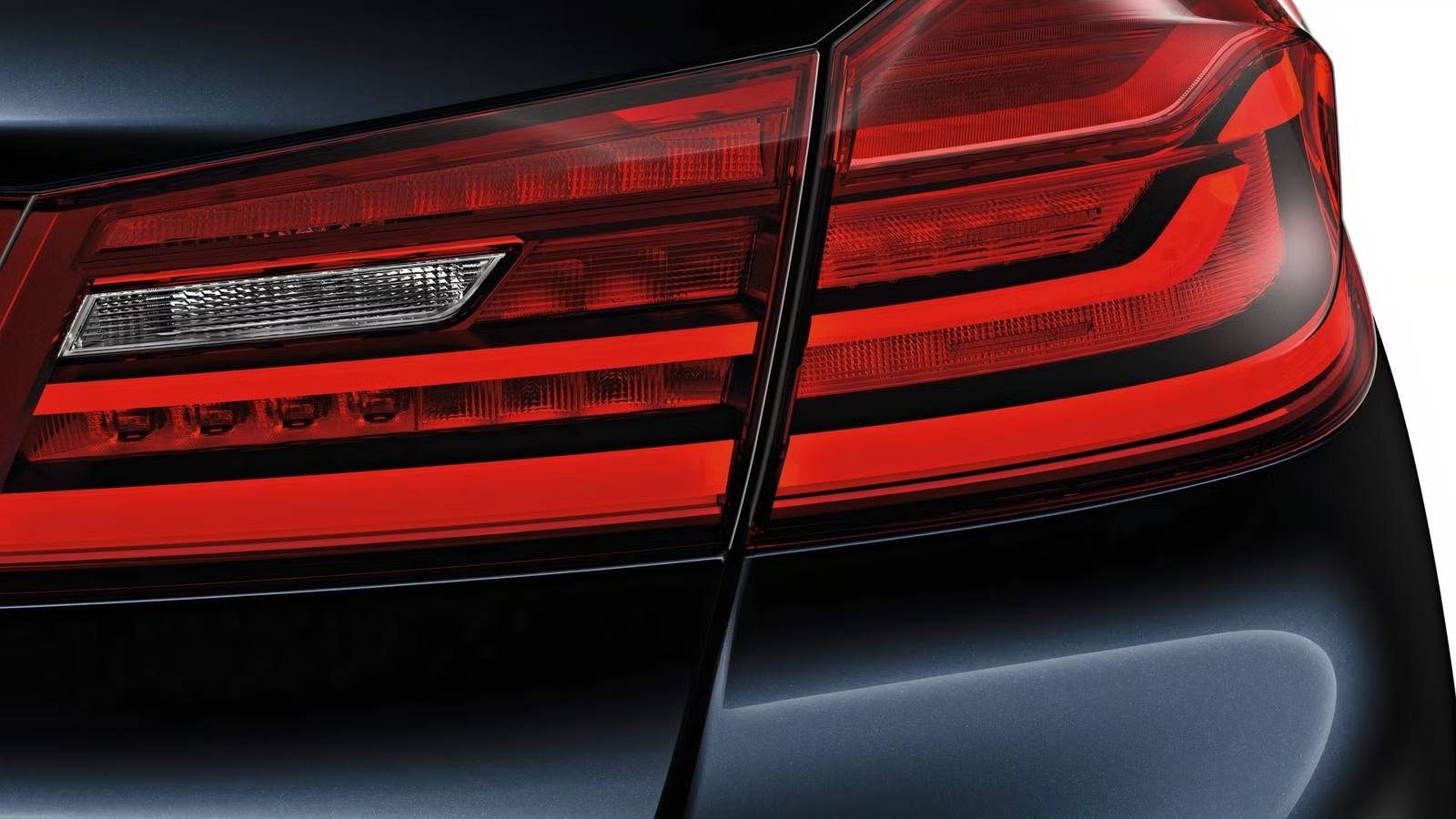
There’s nothing wrong with the look of the G30 BMW M550d xDrive. It’s just that you wouldn’t exactly be concerned if someone pulled up next to your V8 E92 in one. BMW’s 5 Series has grown considerably in recent years, and anything without an ‘M5’ badge on the trunk looks like any other German executive sedan — quietly upmarket, but not remotely showy.
Spot the small ‘d’ at the end of the trunk badge and you’d probably conclude this thing moonlights as an airport taxi. But while diesels had largely fallen out of fashion by the mid-2010s, BMW’s engineers never stopped developing them — quietly refining and improving these units year after year. The M550d xDrive is one of the pinnacles of oil-burning technology. Be afraid — be very afraid.
The BMW M550d xDrive Is Like A Bugatti Veyron… Kind Of

The bottom line is that the M550d xDrive doesn’t feature a twin-turbo diesel lump, as BMWs did at the height of diesel-mania. It has, in fact, four turbochargers — yes, just like a Bugatti Veyron and Chiron hypercars — making the engine under the hood the most powerful six-cylinder diesel ever fitted to a production car. It’s also paired with an intelligent all-wheel drive system with rear-wheel orientation that delivers both characteristic M Performance driving dynamics and tremendous grip off the line. If you want to know what happens to that V8-powered M3 when the lights go green, read on.
A Closer Look At The BMW M550d xDrive’s Powerplant

Before we get there, let’s take a quick look at the B57 engine in the BMW M550d xDrive, which was available as both a Sedan and a Touring model. These G30/G31 5 Series use a 3.0-liter straight-six diesel featuring multi-stage turbocharging with quad turbochargers for high output and strong torque. The system pairs two high-pressure variable-geometry turbos with two low-pressure units that have ultra-low inertia for improved low-end response.
The Diesel 5-Series Has M5 Levels Of Power
The result is 400 horsepower and 560 lb-ft of torque spread between 2,000 and 3,000 rpm from the quad-turbo inline-six. That’s the same horsepower as the E39 BMW M5 that was produced until 2003, and more torque than even a Corvette C8 Z06. The M550d comes with BMW’s 8-speed ZF automatic transmission and can manage 39.9 mpg on the combined cycle in sedan form, which is almost as impressive. Buyers also get M sports suspension as standard, along with Integral Active Steering, an M aerodynamics package, and an exhaust system with M Performance-specific twin tailpipe trims.
So, How Fast Is The BMW M550d xDrive?

The BMW M550d xDrive is a true sleeper, with little on the outside to hint at just how quickly it can accelerate. The advertised figure is zero to 60 mph in 4.3 seconds for the sedan, with the estate arriving 0.2 seconds slower, but experienced BMW fans know this car launches to 60 in the high 3s on dry pavement.
Of course, top speed is limited to 155 mph, so expect that number to climb considerably if you could remove the electronic limiter. To put this performance into perspective, the M550d is faster than the 414-horsepower E92 BMW M3 with its 4.0-liter naturally aspirated V8, which hits 60 mph in 4.4 seconds.
The Big Diesel Bavarian Wagon Can Also Outrun A Cayman
Another way of looking at it is to compare the diesel BMW 5 Series to a Porsche 718 Cayman, whose turbocharged flat-four reaches 60 mph in around 4.5 seconds. Diesels may be going out of fashion, but the BMW M550d xDrive proves there is still life in oil burners.
There Is One Diesel That Can Match The BMW M550d xDrive

The people over at Porsche also know a thing or two about powerful diesel engines. Porsche launched the Panamera 4S Diesel with, for the first time, the option of a permanent all-wheel drive system and an eight-speed Porsche dual-clutch transmission (PDK). The car is fitted with a diesel V8 that produces 422 horsepower and 627 lb-ft of torque. Equipped with the Sport Chrono pack, the Panamera 4S Diesel can hit 60 mph in an M550d xDrive-matching 4.3 seconds.
The Panamera Diesel Has The Fastest Top Speed Out Of All Oil-Burners
The Panamera isn’t restricted at the top end either, so point it at an autobahn and the speedo will climb to 177 mph — making the diesel Panamera the fastest diesel available on the road. There is also the 5 Series’ smaller sibling, the BMW M340d xDrive Sedan, fitted with a six-cylinder inline diesel engine complete with BMW’s TwinPower Turbo and mild-hybrid technologies, producing 340 horsepower and 516 lb-ft of torque. This car will reach 60 mph in roughly 4.6 seconds.
Source: BMW.

Related posts

Latest Post


No Comments