
The 1969 Chevelle Chevy Built By Sneaking A 427 Past Its Own Rulebook
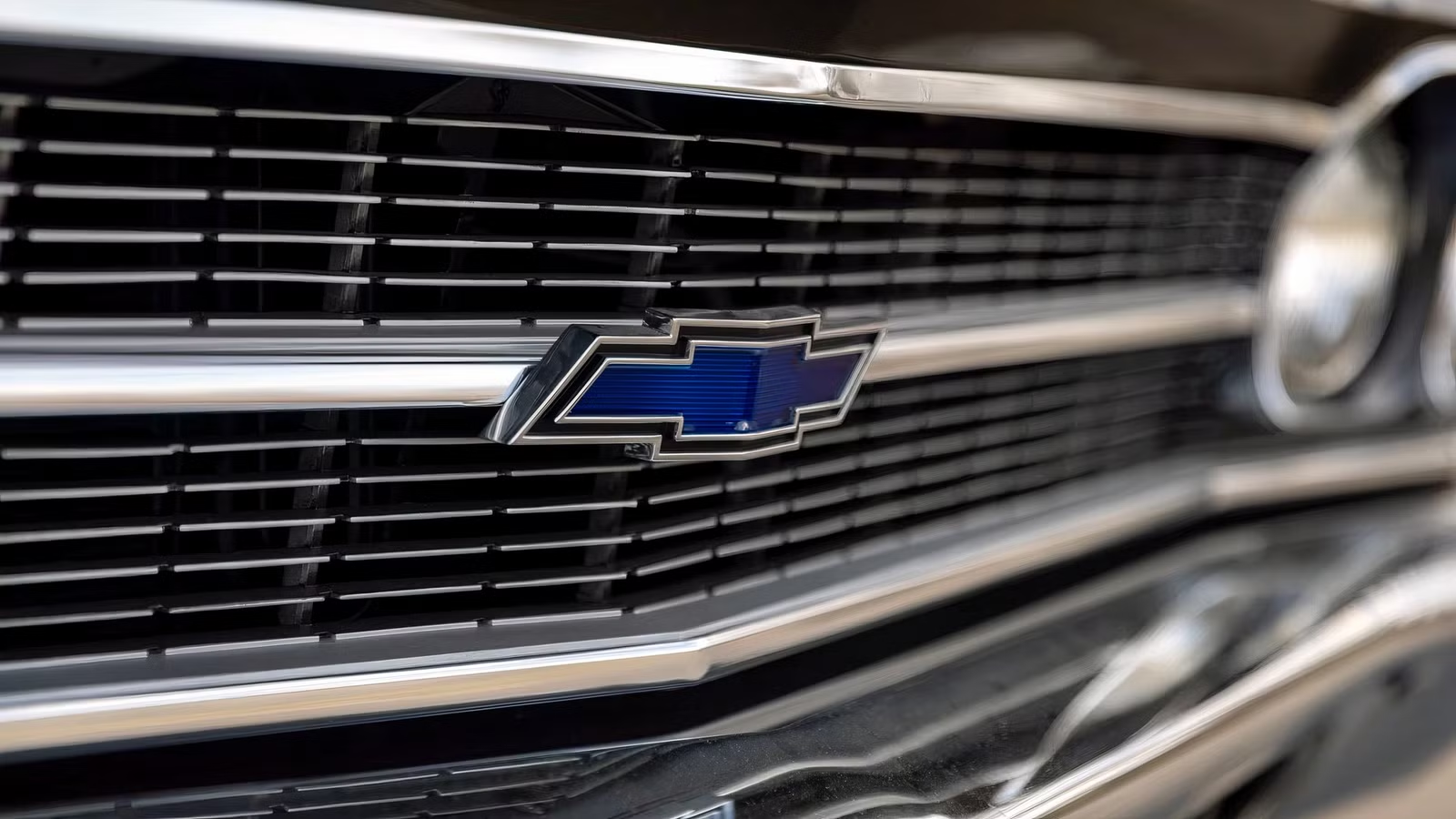
Chevrolet already had the engine and the right midsize chassis. What it didn’t have was permission from upstairs, where a corporate displacement limit kept its biggest V8s away from the cars that could use them potently.

In the end, the answer came through paperwork (of all things!) rather than an engineering skunkworks. A few people who understood Chevy’s ordering system found a side door in the rulebook and used the right sequence of letters and numbers to open it. In essence, it was a performance breakthrough disguised as clerical work.
General Motors had placed a 400ci ceiling on engines installed in anything smaller than a full-size car, with the Chevrolet Corvette standing as the useful exception. That decision left Chevy’s intermediate Muscle Cars capped at 396 cubic inches while Ford and Chrysler could reach for larger engines when the fight moved to the drag strip.

Keep in mind that the top L78 version of Chevy’s 396 was hardly a weakling. It made 375 hp, used an 11.0:1 compression ratio, and breathed through rectangular-port heads with a Holley four-barrel. Despite that, a serious 396 could look slightly underprepped when rival cars arrived with 426, 427, 428, or 429 cubic inches on their sheets.
And as we’re well accustomed to by now, this was important because Detroit’s muscle car battle played out in public. Performance dealers knew customers wanted more than a respectable SS 396. Chevy already had a 427ci big-block rated at 425 hp, yet corporate policy kept it out of the midsize body where it could do the most damage.
Vince Piggins Found A Back Door In The Fleet-Order Department

The Central Office Production Order (COPO) system wasn’t created to build street bruisers. Boiled down to its basics, Chevy used COPO requests to handle fleet buyers that needed equipment outside the regular option catalog, including police departments and taxi operators. Somewhere along the way, the people reading those forms realized the system didn’t care whether its next customer carried a badge or a drag racing helmet.
Vince Piggins, who led Chevrolet’s Product Promotion operation, became the key figure in turning that administrative route into a performance program. Fred Gibb and racer Dick Harrell had already pushed Chevy toward special 427-powered Camaros, giving Piggins proof that the ordering machinery could be used for far more fun work.
Legitimately Illegitimate

Don Yenko then saw a way to remove the costly engine-swap work from his dealership. He’d already built a reputation selling 427-powered Chevrolets, but factory installation would save time and make the finished car a genuine production build. Yenko committed to 99 examples, enough volume to make the proposal difficult for Chevrolet to ignore.
That’s how a system intended for unusual fleet equipment became Chevrolet’s internal hot rod menu. The combination stayed out of ordinary brochures, so only informed dealers and buyers knew it existed. The car moved down the assembly line with the prohibited combination already installed and documented by factory codes. Take note: bureaucracy had finally done something fun.
COPO 9562 Made The ’69 Chevelle A 427-Powered Factory Sleeper

With all that said, what you got was the ’69 Chevrolet Chevelle COPO 9562, based on the Malibu sport coupe rather than the flashier SS 396. It wore an SS-style hood with a blacked-out grille and rear panel, but there were no 427 badges announcing what lived underneath. Anyone unfamiliar with the code could mistake it for a dressed-up Malibu with unusually serious exhaust pipes.
Under the hood sat the L72 427 V8, rated at 425 hp at 5,600 rpm and 460 lb-ft of torque at 4,000 rpm. Its hardware included a four-bolt-main block, forged internals, an 11.0:1 compression ratio, and a 780-cfm Holley carb. Chevrolet had installed one of its angriest production big-blocks in a car that still carried a Malibu interior and an AM radio (the radio was optimistic).
You could pair the 427 with a heavy-duty Muncie four-speed, including the M22 Rock Crusher, or a strengthened TH400 three-speed automatic. A KQ-code 12-bolt rear axle used 4.10:1 gearing and Positraction. Heavy-duty cooling and suspension parts helped the rest of the car survive the engine’s enthusiasm, while power front disc brakes handled the less glamorous job of slowing it down.
The paperwork showed exactly how each car was configured. COPO 9562AA identified a four-speed car with Positraction, while 9562BA specified the TH400 automatic. Other suffixes added bucket seats or different wheel packages. The related 9566AA code covered a four-speed arrangement with power brakes and Super Sport wheels. Quarter-mile testing ranged from 13.85 to 14.10 seconds on bias-ply tires, a scorching pace for an ordinary-looking coupe in ’69.
The Other 224 Cars Escaped Yenko’s Shadow

Don Yenko’s 99 cars became the celebrities. His dealership added bold graphics, 427 badging, extra instruments, and its own tuning touches, creating the Yenko Super Chevelle that now dominates most conversations about the factory 427 Chevelle. Yenko understood promotion nearly as well as horsepower, and a striped car naturally photographs better than an anonymous one.
Chevrolet built 323 accepted COPO Chevelles for 1969, which means 224 weren’t part of Yenko’s allocation. Those cars filtered through other performance-minded dealers, including Fred Gibb, Berger, Landers, and Grossman. An estimated 17 to 22 also went to Canada, extending a paper trail that was never especially easy to follow.
Wherefore Art Thou?

Many non-Yenko cars stayed close to the original sleeper brief. Without dealership stripes or 427 callouts, they looked like unusually well-equipped Malibus rather than factory drag specials. That anonymity was handy when they were new and became a headache decades later, once an ordinary Chevelle could be restored or cloned to resemble something much rarer. The overlooked 224 turn the story into a nationwide hunt rather than another Yenko retrospective. They’re also harder to trace because many lived without the visual clues that made Yenko’s cars instantly recognizable.
The Paper Trail Matters As Much As The Horsepower

Roughly 66 documented survivors are believed to remain, so authenticity carries enormous weight. A genuine 1969 Chevelle COPO 9562 needs more than the correct engine and a convincing paint job. Collectors look for build sheets, original driveline stamps, dealership records, and a history that makes sense from assembly plant to first owner.
The engine pad is one place the investigation begins. MP identifies an automatic-equipped L72, while MQ points to a four-speed version. The KQ stamp on the 12-bolt axle is another key clue. Sequence numbers and stamp styles must align with the car’s assembly history, because on a machine this valuable, a slightly wrong font can cost more than a nicely restored small-block Chevelle.
Interconnected Past

Survivors with intact paperwork also show how varied the program was. Some have bench seats and 14-inch Super Sport wheels, while others carried buckets or 15-inch Rally wheels through specific COPO suffixes. Those differences may look minor, but they’re the fingerprints that connect a particular car to Chevrolet’s central office.
The ’69 Chevrolet Chevelle COPO 9562 was fast, scarce, and easy to miss, which is why the appeal’s easy to see. More than half a century later, the engine still gets the attention, but proving the legend ultimately comes down to the paperwork.
Sources: Supercars.net, StreetMuscle Magazine, USA Car World, Chevelle Stuff, Hemmings.

Related posts



Latest Post


No Comments