
The Most Aggressive-Looking Harley-Davidson V-Twin Cruiser
Few motorcycle brands carry as much visual weight as Harley-Davidson, and nowhere is that more apparent than in the cruiser segment. The Motor Company has built its identity on big, bold, chrome-laden machines — and the current lineup reflects that, with a total of 10 cruisers spanning seven Softails and three Sportsters. Most lean heavily on retro styling, staying well within the brand’s established design language. But a handful push things further, trading classic elegance for something rawer and more confrontational. We dug through the entire lineup to find the most aggressive-looking of the bunch — here’s what we found.
The Breakout Is The Most Aggressive-Looking Harley-Davidson V-Twin Cruiser
Starting Price: $22,999

Out of our three picks, it’s the Breakout that takes the cake by a mile. Why, you ask? Because of its aggressive dragster-style chopper look. The 21-inch front wheel is a rare sight for cruisers in general, and the same can be said for the beefy 240-section rear. Add to that the uber-long wheelbase, and what you have is a certified head-turner. We also dig the available color options, including Centerline Yellow, Brilliant Red, and our favorite, Midnight Firestorm with flame graphics.

In second place is the Low Rider S. It’s always been an aggressive cruiser in the H-D lineup, thanks to its chopper-esque design and burly overall stature. There are some nice design touches here, such as a small headlight cowl, blacked-out mechanicals, a sporty front fender, and alloy wheels. But the closer you look, the more the Breakout edges ahead. For instance, the air filter assembly and fuel tank both have much less visual drama on the Low Rider. The Breakout’s two-into-two exhaust is also our preference over the Low Rider S’s single exhaust.

Last but not least is the Sportster S. It’s an entirely different design from the Softails, drawing inspiration from old-school flat track bikes. The balloon-type tires, minimalistic body panels, and a distinct headlight give it a unique identity that many new-age riders appreciate. The upswept exhaust is a genuinely cool design element, even if it’s not the most practical choice when carrying a pillion. For us, though, the Low Rider S and Breakout both feel more true to the H-D formula. That said, design is deeply subjective — feel free to disagree with us in the comments.

The Breakout Blends Retro Chopper Flavor With Modern-Day Features
All Your Fancy Electronic Aids Come Standard

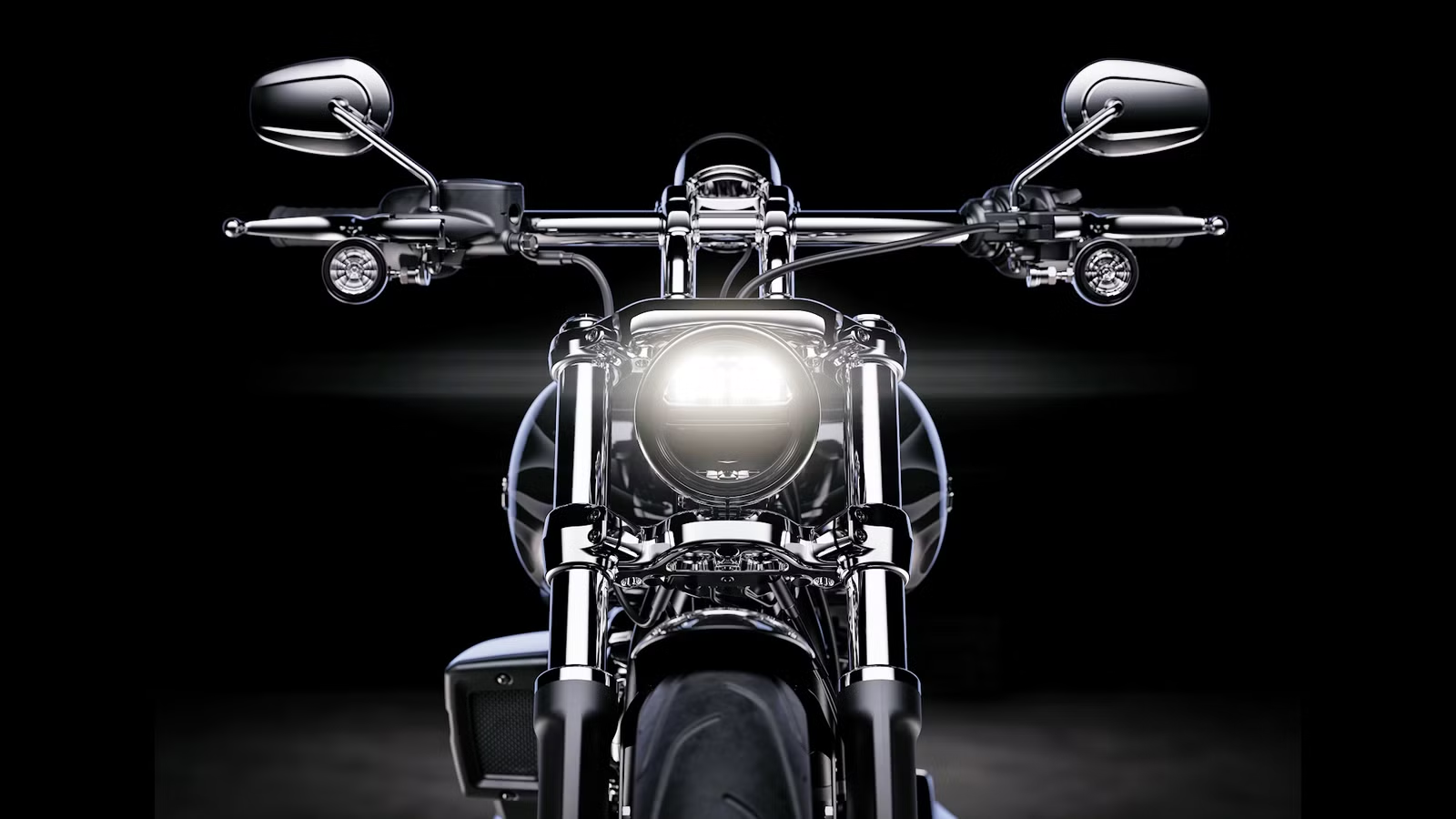
Let’s dive deep into the design of the Breakout. Up top, it features a sleek LED headlight and nacelle — more minimalistic than the previous-generation model. A closer look also reveals LED turn signals and chrome triple-trees to hold the forks. In the middle, the air cleaner sports a larger, more integrated shape. The tank, tail, and saddle carry over from the prior generation.

Despite its retro chopper roots, the Breakout is a thoroughly modern machine. Harley has equipped it with a full rider-aid suite comprising cornering traction control, cornering ABS, drag-torque slip control, and ride modes. Practical extras like TPMS, cruise control, a USB Type-C port, and updated switchgear round out the package. Our only gripe remains the basic semi-digital instrument cluster, which looks identical to Harley’s more affordable Nightster. For a bike at this price point, we’d expect something more premium.
2025 Breakout 117 Key Features
- Cornering traction control
- Cornering ABS
- Drag-torque slip control
- Ride modes
- Type-C port
- TPMS
- LED lights
- Cruise control
Harley-Davidson’s Mighty Milwaukee-Eight Powers The Breakout 117
Peak Power: 104 HP

All those electronics exist for good reason: there’s a serious powerplant beneath the skin. The Breakout runs the Milwaukee-Eight 117 Custom engine, producing 104 horsepower and 126 pound-feet of torque — figures that represent meaningful gains over the previous iteration. All that power reaches the rear wheel through a six-speed transmission and belt drive.
Milwaukee-Eight 117 Custom Highlights
- 6 percent more power and 5 percent more torque
- 50 percent greater touring-style intake airbox volume
- Intake noise is significantly reduced
- More desirable, rumbling exhaust tone
Key Engine Specs
|
Engine |
Milwaukee-Eight 117 Custom |
|
Bore X Stroke |
4.075 X 4.5 inches |
|
Power |
104 HP @ 4,800 RPM |
|
Torque |
126 LB-FT @ 3,000 RPM |
|
Transmission |
Six-speed |
|
Claimed efficiency |
49 MPG |
Showa Suspension And Laidback Ergonomics Round Off The Package
Seat Height: 25.6 inches

Turning to the underpinnings, the Breakout is built around a steel double-cradle chassis. Suspension duties are handled by Showa 49 mm dual-bending telescopic forks up front and a Showa monoshock at the rear — only the latter offers adjustment, via hydraulic preload. Braking comes courtesy of a single disc at each end, which feels modest given the bike’s fully fueled weight of nearly 700 pounds. On the plus side, that massive 240-section rear tire remains one of the widest fitted to any production cruiser, and it pairs with the chopper-inspired 21-inch front wheel to striking visual effect.

Harley has worked hard to make sure you don’t feel all that mass on the move. The seat sits just 25.6 inches off the ground, the footpegs are forward-set, and the tubular handlebar is wide and relaxed. The two-piece saddle looks genuinely spacious, with a dedicated section for a pillion passenger. The trade-off for that low, stretched-out stance is limited cornering clearance — lean angle tops out at under 27 degrees in either direction.
2025 Breakout 117 Key Dimensions
- Wheelbase: 66.7 inches
- Ground clearance: 4.5 inches
- Rake: 34 degrees
- Seat height: 25.6 inches
- Tank capacity: 5 gallons
- Tire size: 130-section front and 240-section rear
- Weight: 681 pounds

Related posts
Latest Post


No Comments