
The ADV That Can Handle A Long Highway Day Before Heading Off-Road
Long-distance riders do not have it easy. To truly conquer high-speed interstate miles and then go exploring technical backcountry trails has always required two entirely different motorcycles. For the highway, dedicated sport-tourers deliver confidence-inspiring stability at triple-digit speeds, protection from the wind, and fuel tanks that do not require you to stop for fuel often. However, all this high-speed ability comes with low ground clearance, fragile fairings, and street-biased geometry. This means that the first foray off tarmac turns into a white-knuckle experience.
Lightweight Dual-Sports Sacrifice Interstate Comfort For Trail Agility

Dirt-oriented middleweight motorcycles have similar problems, but in reverse. When you head off into the great unknown, they glide over whatever surface you put them on, but on the highway, they offer hand-numbing vibrations, fuel tanks that are simply not big enough, and nonexistent aerodynamics. There has to be a compromise, and many manufacturers have tried, but there is one flagship that has been engineered specifically to erase the need for that compromise. It proves the same motorcycle can handle a 500-mile day on tarmac and then head into the dirt without hesitation.
Contradictory Ergonomics Force Compromise Between Highway And Dirt

The reason there are not many motorcycles that can do both competently is because what dual-sport bikes and sport-tourers do requires contradictory engineering. Highway touring requires a low center of gravity, good aerodynamics, and great wind protection to prevent rider fatigue. On the other hand, off-road capability demands ground clearance, a narrow midsection for control while standing on the pegs, and long-travel suspension. Adventure bikes have been engineered to bridge the gap, but most fail to reconcile these requirements, choosing instead to land on one side of the fence or the other.
Bologna’s Racing Electronics Bridge The Chasm Between Tarmac And Dirt

Solving this dilemma cannot be done with purely mechanical solutions; the costs would be too high. A more palatable solution involves electronics. What you need is a multi-cylinder powerplant that offers enough power for highway cruising, yet with low enough weight and a torque spread that is useful off-road. For the suspension, a semi-active suspension system will help change the chassis response in milliseconds.

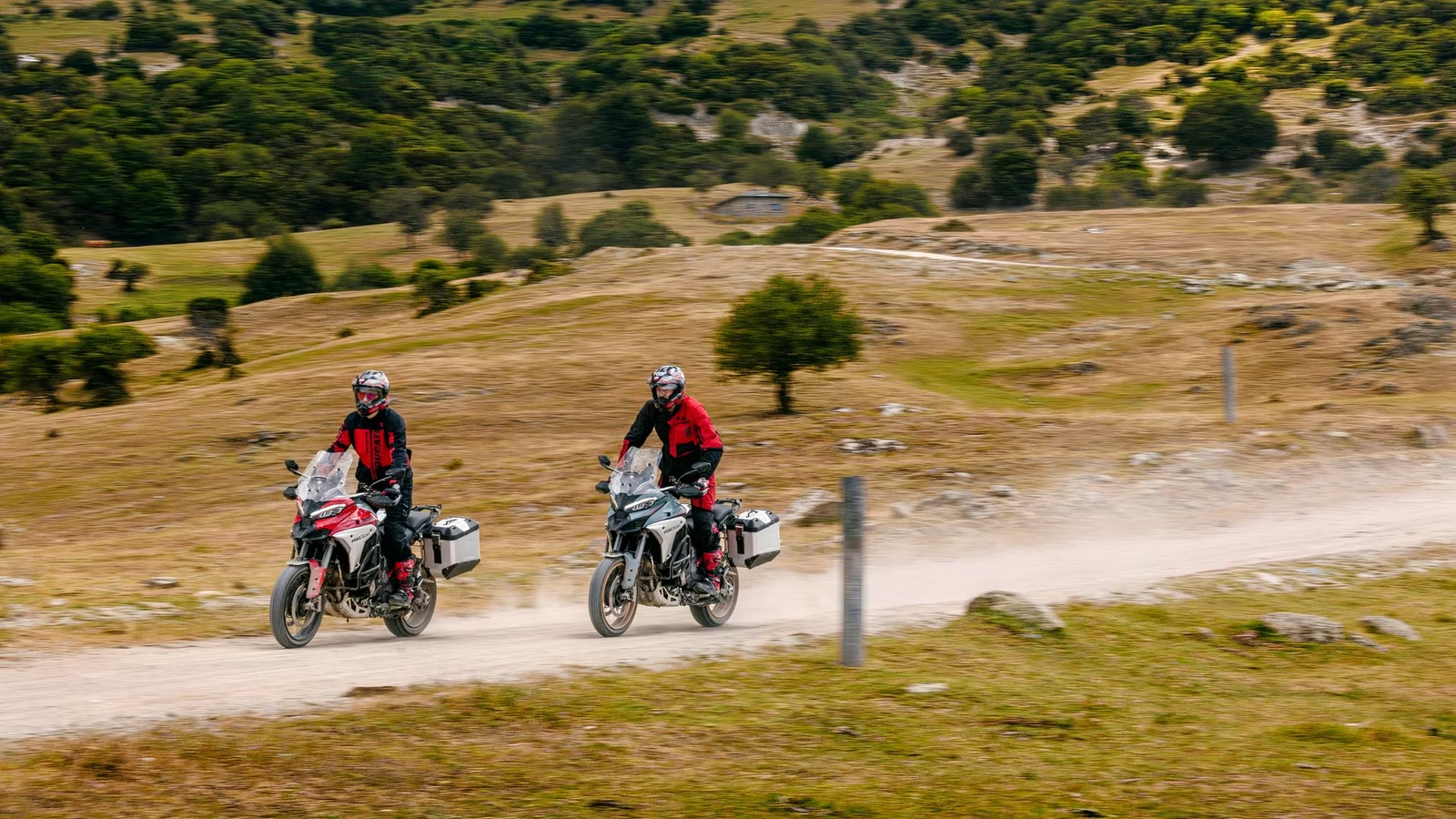
Ducati is a manufacturer intimate with electronic control on two wheels, having demonstrated its mastery in road racing. It has now started foraying into off-road racing, and with success there has shown that its expertise is not bound to the blacktop. It has managed to unite a high-speed tarmac tourer with an agile dual-sport off-roader to produce the ADV that can handle a long highway day before heading off-road.
The Multistrada V4 Rally Unifies Superbike Velocity With Trail Demands

The Ducati Multistrada V4 Rally is, on the face of it, Ducati’s flagship off-road adventure motorcycle, but zoom in, and you realize that it is equally a ferocious, high-speed, long-distance tourer that is capable of rendering every other motorcycle in your garage pointless. It is supported by its 170-horsepower V4 engine, massive 7.9-gallon fuel tank, semi-active suspension, and radar-guided cruise control. The magic dust on top is Ducati’s extensive experience with electronics that ties all of it together with a by-wire throttle and six-axis IMU, thus converting it into whatever kind of touring machine you choose depending on the situation and the ride mode.
The $31,995 Base Price Commands An Uncompromising Exclusivity Tax

The Multistrada V4 Rally sits near the top of Ducati’s adventure tourer range and as such has a base price of $31,995. This base price includes pretty much all the features that you would otherwise tick from an options list; however, it also makes it far more expensive than its competition, even with options loaded onto them. This is an exotic motorcycle, and this is the price you pay for the ultimate adventure bike. At this price, every dollar needs to justify itself — so let’s start with the engine Ducati chose to anchor this entire platform
The Spring-Valved V4 Granturismo Prioritizes Durability Over Desmo Tradition

Ducati moved to a four-cylinder engine from its signature V-twin a few years ago for the extra performance it offers. The Multistrada has also moved to one of these engines, called the Granturismo. It is a 90-degree V4 with a counter-rotating crankshaft and a ‘twin pulse’ firing order. The biggest shift is to conventional valve springs. This, coupled with the fact that it weighs less than the V-twin it replaced, means it has an extremely broad spread of torque and more power without a weight penalty. It has a semi-dry sump that makes it more compact, and Ducati’s intentions to make it compatible with both interstates and dirt are obvious with the dual side-mounted radiators.

It displaces 1,158 cc with a short-stroke design and an extremely high compression ratio of 14.0:1, but it also manages to generate 170 horsepower at 10,750 RPM and 91 pound-feet at 9,000 RPM. You do have to rev it quite high to extract the maximum performance from it, but it is something the rider will get used to. The engine is mated to a six-speed manual transmission with a two-way quickshifter and hydraulic assist for the assist-and-slipper clutch. Despite this being a long-distance adventure touring motorcycle, Ducati has chosen to stick with a chain to drive the wheel. This might be a negative compared to a bike with a driveshaft if you cover serious miles on a trip.
Cast Aluminum Backbone And Skyhook Damping Bridge The Dirt-Tarmac Divide

The Multistrada V4 range uses an aluminum monocoque frame with the engine as a stressed member to reduce weight. This is the same reason the swingarm is a double-sided unit. The subframe is a trellis unit as well. The V4 Rally has electronically adjustable suspension at both ends: at the front are beefy 50 mm inverted forks, and at the rear is a monoshock. Both ends are fully adjustable and offer 7.9 inches of travel.

The brakes are equally impressive, with two 330 mm semi-floating discs from Brembo with radial Stylema four-piston monobloc calipers and a radial master cylinder. At the rear, a 265 mm disc has a Brembo two-piston floating caliper. It opts for a 19-inch front and 17-inch rear tubeless spoked wheel combination, and it is fitted with tubeless radial tires. The V4 Rally specs give it all-around ability, whether for high-speed tarmac touring or riding in the dirt. One has to remember that this is a tall, heavy adventure motorcycle, so it has limits. But within those extremely high limits, it balances off-road fun and comfort perfectly.
A 7.9-Gallon Fuel Reservoir Extends Highway Range Past 300 Miles
Ducati does not release all the dimensions of the Multistrada V4, but we do have a couple of important figures. The wheelbase is 61.9 inches, which should ensure stability on the highway and off-road. The standard Multistrada V4 has 8.6 inches of ground clearance, so we know the V4 Rally will have at least that much going for it. It has a high seat height at 34.3 inches, and this is the standard seat in the lower position, so it only gets higher from there.
It weighs 525 pounds wet without fuel, which is on par with similar bikes in the segment. It has a huge 7.9-gallon fuel tank, which ensures you rarely need to stop for fuel. However, the fuel tank can also make a difference to the way it handles because it holds the fuel up high on the motorcycle, so you need to be wary at low speeds with a full tank.
Factory Radar And Extended Cylinder Deactivation Tame Long Miles

The Multistrada V4 Rally is one of the flagship variants of the range, and as such, Ducati has thrown so much tech at it that it makes GS riders reconsider their choices. It has the larger 6.5-inch TFT display with Bluetooth and navigation, which is not a standard feature on most Ducatis. Also on the standard features list are cornering headlamps, heated grips, and a heated seat. The lack of Desmodromic valves has pushed valve clearance checks to 37,000 miles, an industry-leading interval.
There is a by-wire throttle and six-axis IMU, of course, which means you get cornering functions for the ABS, traction control, and engine brake control. Since it is the V4 Rally, you also get specialized off-road riding modes. In addition, the Granturismo V4 engine gets extended rear cylinder bank deactivation, which means it shuts off the rear bank even when the engine is under light load, not just when idling at a stoplight.

The electronic suspension lowers the motorcycle at walking speeds, while an ‘Easy Lift’ function helps when taking it off the stand. There is radar-based adaptive cruise control and blind-spot monitoring. There is really nothing else left to add to a motorcycle like this, but you can select different seats and luggage from the options list.
European And Japanese Heavyweights Challenge Ducati On Value And Dirt Prowess

The full-size adventure tourer segment has an incredible range of machines, all of which can handle a long highway day before heading off-road with varying degrees of competence. Every single one of them has more ability than the average rider who will buy one, so there is no bad choice.
The adventure bike benchmark is the BMW R 1300 GS Adventure. Its twin-cylinder boxer engine carries its mass down low and has a broader torque spread than the Ducati, even though the power figure is lower at 145 horsepower. Its driveshaft means it does not need chain maintenance on a trip. It can even be specced with an automated transmission, and with all these features, it will still cost less than the Multistrada, but not by much.

Better value is offered by the Triumph Tiger 1200 Rally Explorer. Its inline three-cylinder engine now has a T-plane crank, which offers better torque throughout the rev range, and Triumph has worked hard to bring weight down to the level of its twin-cylinder competitors. It is also the only one here to offer a full-size 21-inch front rim coupled with an 18-inch rear rim, which means if you truly want to take it off-road, you can get the right tires for it. It offers slightly more value than the Ducati and BMW at $24,895.

The KTM 1390 Super Adventure S Evo is even more affordable at roughly $22,700, and for that price, it could replace every other motorcycle you own. This being a KTM, you know it is going to handle off-road work, even though this is not the hardcore dirt variant of this motorcycle. It has all the amenities you could want. Standout features include the automated manual transmission, the portrait-style TFT screen, and the fact that despite having just a twin-cylinder engine, it still makes 173 horsepower.

However, if you are considering a chassis fit for off-road work, the cradle frame of the Honda Africa Twin Adventure Sports stands out among all of these. For less than $19,000, you can get electronic suspension, a six-speed dual-clutch automatic transmission, a 6.5-inch TFT touchscreen with Apple CarPlay, and a dependable driveline. It might be the most practical adventure bike you can buy, but it falls short on performance, with a maximum power output of 100 horsepower.
Source: Ducati USA

Related posts





Latest Post



No Comments