
The Cruiser That Delivers Big-Bike Confidence Without The Big-Bike Drama
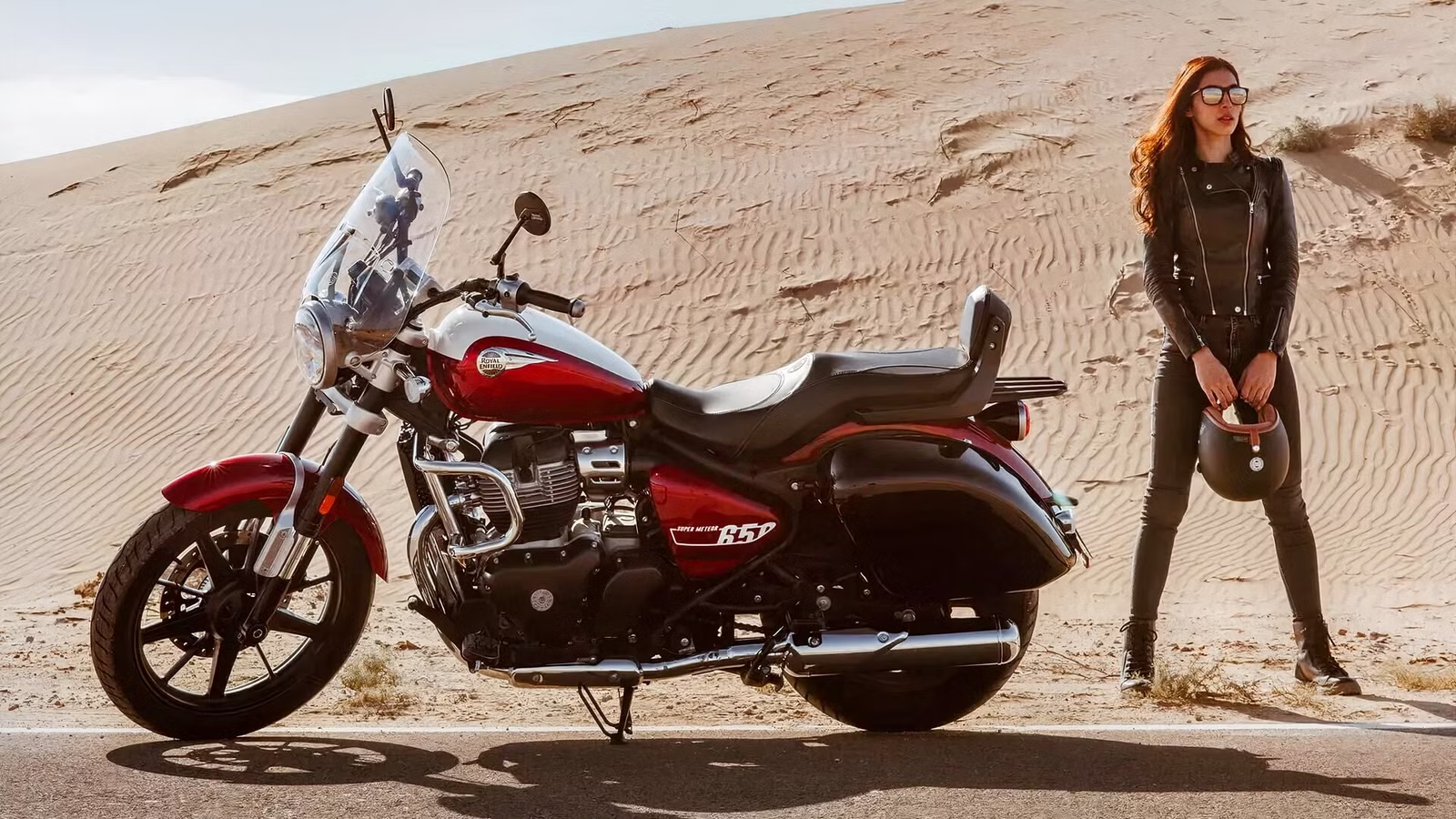
The middleweight cruiser segment today has a number of options, but getting something for a reasonable price, say under $8,000, can be quite frustrating because you need to compromise. The choices you have are between small, light products that are engineered to be great commuters, or there are middleweight cruisers that have quite a bit of a weight penalty, which means they’re good on the highway but not in the city. If you want something that bridges the gap between these two extremes, there is a surprising lack of choice in the market at this point in time. That’s the niche a certain Royal Enfield wants to exploit.
You Need The Right Machine To Enjoy It Fully

The appeal of a cruiser isn’t just in its ability to deal with the highway. First, it needs to look the part. A long, low look with a planted stance that turns heads wherever it goes, followed by an engine that sounds and feels the part. Then, it needs to have the performance to back up those looks. A bonus is good ownership experience with lots of reliability and very little ownership costs thrown in. If you manage to get all of these in a single machine, you’ve pretty much got yourself the Holy Grail of middleweight cruisers.
Many Products Use Electronics As A Crutch – But Nothing Replaces Great Engineering

Electronics have come to rule our lives; this is an undeniable truth, but motorcycles are primarily mechanical devices. The electronics are supposed to lend a helping hand, but as with any good thing, too much of it is not a good thing. Getting yourself an analog machine that feels good even without the electronic nannies means that you’ve got a fundamentally well-engineered product. It also allows you to focus on the important bits, namely the road, the horizon, and your experiences, without any high-tech distractions.
Can You Really Get Big-Bike Benefits Without A Big Bike?

The short answer is yes. As manufacturers develop new technologies, new and wonderful products constantly get put on sale, so even in a segment such as the middleweight cruiser segment, there is the possibility of getting that Holy Grail of cruisers – a middleweight cruiser that feels like a big bike when you ride it on the highway, but otherwise shrinks around you in traffic and allows you to back it up easily in a parking lot. This product comes from a most unexpected direction, Royal Enfield, but it is well deserving of all the praise it gets.

The Royal Enfield Super Meteor 650 Delivers Big-Bike Confidence Without The Big-Bike Drama

Royal Enfield has been a legacy manufacturer with not much progress for most of its century-long history; however, in the last 35 years, it has grown by leaps and bounds. The current set of products it has can compete with any global manufacturer, and the pinnacle of this development was its twin-cylinder platform. Here is where we will find the cruiser that delivers big-bike confidence without the big-bike drama, because the Super Meteor 650 is everything that we look for in a middleweight cruiser: simplicity of engineering combined with a very engaging chassis and an engine with loads of character. It delivers big road presence without high costs, which is a win.
It Is Priced At The Low End Of The Midsize Segment

At $7,899, the Super Meteor 650 is one of the rare products that you don’t have to overpay for. In fact, it is only Chinese manufacturers that can better such a price when you look at the size of the motorcycle and the displacement it offers. We also have to bear in mind that this is not a liquid-cooled engine, but the Super Meteor doesn’t depend on specs to make you have a good time. Royal Enfield now has a single price for both versions of the Super Meteor, including the touring-biased version with the more comfortable seat, pillion backrest, and windshield.
Royal Enfield’s First Twin Cylinder Engine Is A Gem

This is the first multi-cylinder engine in recent years. So it is understandably an important milestone for Royal Enfield. This is a parallel-twin engine with air and oil cooling, but it opts for a 270-degree crank and an SOHC head with four valves per cylinder. The brand has also chosen a very relaxed compression ratio of 9.5:1.

The result is 47 horsepower at 7,250 RPM and 38.6 pound-feet of torque at 5,650 RPM. This is controlled by a cable throttle. It does have an assist and slipper clutch that links it to a 6-speed gearbox, and a chain drives the rear wheel. There are no electronics here beyond the ignition and injection, and it doesn’t need any, to be honest. This is a big part of why this is an affordable cruiser that still feels premium.
The Traditional Chassis Is Engaging

The Super Meteor chooses a traditional downtube cradle frame, which adds to its weight, but it bodes well for longevity and customization. This also feels like a relaxed bike for riders who refuse to rush, which is why the inverted front forks are a surprise. At the rear, there are twin piggyback shocks with preload adjustment.

The brakes are par for the class with a single 320 mm front disc paired with a two-piston floating caliper, and at the rear, there is a slightly smaller 300 mm disc with an identical caliper. A 19-inch front and 16-inch alloy wheel are used with tubeless tires, and spoke rims are not an option even at the dealer level.
This Is A Long And Low Cruiser
This is a mid-size cruiser, and the proportions are such that it makes bigger bikes feel unnecessary. It is 89 inches long and 35 inches wide, with a 59-inch wheelbase. The seat height stands at 29.1 inches and the ground clearance at 5.3 inches. It can hold 4.15 gallons of fuel in its tank, and the wet weight is a little high for the class at 531.3 pounds with its fluids almost topped up.
The Features Are Good Enough For The Price

The Super Meteor 650 looks like a retro motorcycle, and its feature set matches that vibe. Still, you do get more than you bargained for. It has an offset circular instrument cluster with an analog speedometer that has a floating needle around the circumference. In the middle is an LCD that shows information like the fuel level, gear selected, the odometer, trip meters, clock, and the warning lamps at the bottom. Additionally, there is the smaller circular Tripper pod, which is a TFT display. This syncs up with Google Maps via an app on your phone and gives you navigation alerts.

There are distinct variants of the Super Meteor 650, although they are not priced differently. The regular variants have single-tone colors, whereas the Celestial versions have two-tone paint jobs, a much more comfortable touring seat, a pillion backrest, and a bolt-on windshield. You also get a center stand as standard with all variants, which is nice. Accessories include soft luggage, engine guards, and sump guards. Dual-channel ABS is the only safety feature available, and it is not switchable.
There’s An Interesting Mix Of Alternatives To The Super Meteor

The Super Meteor 650’s price has been essentially unchanged since its launch in the US market in 2023, but looking at the options for middleweight cruisers throws up some very interesting alternatives. The obvious one is the Kawasaki Vulcan S, which is one of the parallel-twin cruisers that riders keep longer than any other bike. It has a similar displacement as the RE but goes about doing things in pretty much the opposite way with a liquid-cooled, high-revving parallel twin with a 180° firing order. This is one of the cruisers that loves corners. You do have to pay a little bit more for it at $8,149 for the ABS-equipped Vulcan S.

It’s a similar story with the Honda Rebel 500 — this is a budget cruiser that riders end up keeping for years. Like the Kawasaki, it has its roots in a modern street bike and therefore shares its chassis and driveline with that bike. Both these models do not offer TFT screens for instrumentation, but it is easier to digest with the Honda’s $6,799 retail price.

If you don’t mind spending a little more money for an honest-to-goodness V-twin cruiser, the Honda Shadow Phantom is an option at $8,699. It now offers dual-channel ABS and has a driveshaft, which means zero maintenance between services but retains its legendary reliability that makes high mileage feel routine. Finally, there are the Chinese options, both of which come in at under $6,000. The Moto Morini Calibro 700 is incredible value, whereas the CFMoto 450CL-C offers light weight, which will be better for city runs. Both these models use a belt final drive and run liquid-cooled parallel twin engines with 270-degree firing orders.
Source: Royal Enfield USA

Related posts


Latest Post



No Comments