The Luxury Sedan That Loses $36,000 In Five Years And Becomes A Used Bargain
13 minutes reading
Friday, 24 Jul 2026 13:30 0 60 autotech
A luxury sedan can offer the best kind of combination: powerful engines, top-tier tech, badge prestige, and classy interiors. However, new luxury sedans from traditional luxury marques are generally not cheap, and for most of us, we are outpriced when they are first released.
We can now get sedans from more “mainstream” brands that offer a lot of luxury appointments and some decent power—take the new Mazda3, for example—but hanging on for a couple of years before buying a BMW, Mercedes, or Audi makes a lot of sense if you want real-deal luxury at a low price.
Why Luxury Sedans Become Financial Disasters New And Bargains Used
Front 3/4 shot of 2018 Lexus ES 300h parked in front of cityscapeLexus
Luxury sedans face some of the highest rates of depreciation in the auto world. Unlike collectible sports cars or in-demand SUVs, they’re typically bought new by those of us who prioritize technology, warranty coverage, and prestige over long-term resale value. The moment a new generation arrives with updated infotainment, better driver tech, or a more efficient powertrain, yesterday’s flagship suddenly feels old, even if it still drives better than most new mainstream cars.
Rear 3/4 action shot of 2025 Audi A6 Sportback e-Tron driving on roadAudi
There is also the reality that a lot of luxury sedans are expensive to own once the warranty expires, and the used market knows it. If you are buying a luxury sedan, you’ll likely need to factor in the possibility of adaptive suspension repairs, sophisticated electronics, turbocharged engines, and high-end components that cost far more to replace than the mainstream equivalent.
Why Expensive Sedans Lose Value Faster Than Almost Any Other Vehicle
Front 3/4 action shot of 2022 Mercedes-Benz E-Class driving on roadMercedes-Benz
The luxury segment has repeatedly proven that high MSRP rarely translates to strong long-term value retention. Flagship German models that once approached or exceeded five or six figures can often be found for less than that amount within five or six years. This trend has affected everything from the Mercedes-Benz S-Class and Audi A8 to the Maserati Quattroporte, each losing enormous chunks of value despite still being technically impressive.
Technology is a major reason for this depreciation. Features that justify paying a premium when new, such as massaging seats or cutting-edge infotainment, become expected rather than exclusive in just a few years. Meanwhile, the market’s shift toward SUVs and generally high maintenance and running costs have only accelerated the decline and shrunk the demand for traditional executive sedans.
The Five-Year Depreciation Cliff Is Where Used Buyers Win
Low-angle front 3/4 shot of 2020 Cadillac CT6-V in black posing on country roadCadillac
We tend to measure depreciation by how models perform around the five-year mark, and for good reason: in the luxury segment, it is where economics tend to flip completely. Most depreciation has already occurred, certified pre-owned examples begin appearing in greater numbers, and many vehicles have complete maintenance histories that remove some of the uncertainty with high-end ownership. For savvy buyers, this is often the sweet spot where luxury becomes surprisingly affordable.
Instead of paying a premium for that unmistakable new-car smell, we can get genuine executive-car comfort, effortless highway performance, premium materials, and a lot of badge appeal for the same price as a well-equipped new mainstream crossover.
A front-facing shot of a Cadillac CT4-V Blackwing on the trackCadillac
It is probably one of the biggest pricing imbalances in today’s used market: first owners pay for exclusivity, while second owners enjoy nearly all the same experience after someone else has already absorbed most of the costs. However, if you are in the market for a used luxury sedan, you can find a lot of premium options for your money.
The BMW 5 Series Turns A $36,000 Loss Into A Luxury Sedan Bargain
Front 3/4 action shot of 2021 BMW 5 Series sedan driving on roadBMW
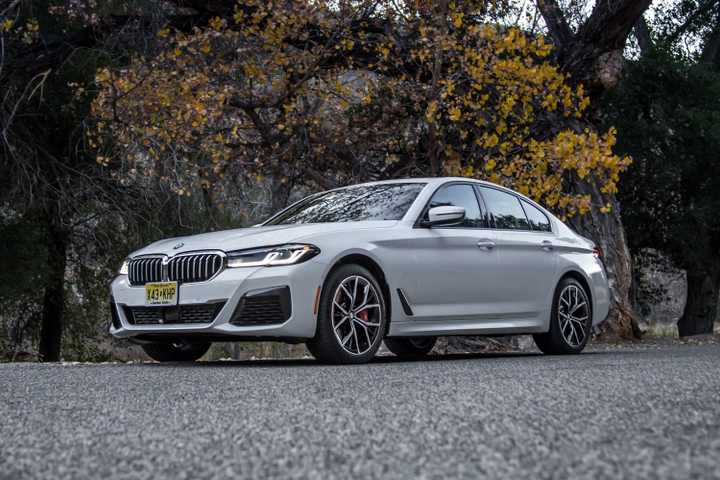
This is where the BMW 5 Series comes in: it can lose up to $36,000 in just five years. As the German marque’s plush midsize sedan, new 2026 5 Series prices are steep at between $60,500 and $68,000 (before moving to “M” territory). Steep, but arguably justified, as you get a choice between a 255-horsepower turbo-four, a 375-horsepower inline-six, or a 483-horsepower plug-in inline-six, lots of track-worthy wizardry, oodles of space inside, an athletic yet comfortable cabin, and the BMW-esque aggressive look.
However, that is a lot of money any way you look at it. If you look at buying a five-year-old 2021 BMW 5 Series sedan instead, though, used prices have dropped to very affordable levels. The 2021 5 Series had an original MSRP range of between $55,195 for the 530i and $77,795 for the M550i xDrive. Today, used prices sit between $25,100 and $40,500.
The BMW 5 Series Loses 49 Percent Of Its Value In Five Years
Profile shot of 2021 BMW 5 Series sedan parked on roadBMW
According to data on CarEdge, a BMW 5 Series loses, on average, 49 percent of its original value in the first five years. That puts it in line with a lot of other sedans of the same ilk, but that also equates to an average one-year value loss of $19,356, a two-year loss of $22,660, a three-year loss of $24,281, a four-year loss of $27,063, and a five-year loss of $30,157. These are average predictions; however, the used market tells a slightly different story. The 2021 5 Series lineup had the following original prices and has the 2026 used prices:
2021 BMW 530i. Original MSRP: $55,195 / Average Used Price: $25,200
2021 BMW 530i xDrive. Original MSRP: $57,495 / Average Used Price: $25,100
2021 BMW 530e. Original MSRP: $58,195 / Average Used Price: $23,700
2021 BMW 540i. Original MSRP: $60,445 / Average Used Price: $32,200
2021 BMW 530e xDrive. Original MSRP: $60,495 / Average Used Price: $23,600
2021 BMW 540i xDrive. Original MSRP: $62,745 / Average Used Price: $32,500
2021 BMW M550i xDrive. Original MSRP: $77,795 / Average Used Price: $40,500
What You Get After Someone Else Pays For Depreciation
Close-up shot of 2021 BMW 5 Series sedan engine bayBMW
That may be a fair chunk of money off, but you aren’t actually giving up much by buying a 2021 model. At the center of the lineup are the engine options. Under the hood of the 530i models is a 248-horsepower/258-pound-foot turbo-four good for 5.9-second sprint times. The 530e models get a 288-horsepower/310-pound-foot turbo-four mated to a plug-in rig that gets you to 60 mph in 5.7 seconds, and provides a 21-mile all-electric range.
Shot of 2021 BMW 5 Series interior showing front cabinBMW
Shot of 2021 BMW 5 Series interior showing front cabinBMW
The 540i is equipped with a turbocharged inline-six mild-hybrid good for 335 horsepower and 332 pound-feet of torque, while the M550i is the most raucous. It is equipped with a 4.4-liter twin-turbo V8 that kicks out 523 horsepower and 553 pound-feet, and gets you to 60 in 3.6 seconds. xDrive models are equipped with BMW’s AWD rig, while the M550i gets it as standard.
Material options inside are top-end, with soft-touch materials covering the dashboard and doors, supportive power-adjustable seats, crisp switchgear, and an overall fit that has aged very nicely. Unlike some of its similarly aged rivals, the cabin still strikes a nice balance between traditional ergonomics and modern tech. Tech is also why it is still worth a look five years on.
Close-up shot of 2021 BMW 530i central console and rotary dialBMW
Every facelifted 2021 5 Series model is equipped with a 12.3-inch digital instrument cluster paired with BMW’s 12.3-inch central touchscreen running the iDrive 7 system. Wireless Apple CarPlay and Android Auto were fitted as standard, as were navigation, multiple USB ports, voice control, and OTA updates. You also get BMW’s iDrive controller, so not everything has to be controlled by the touchscreen.
Then there are the safety features; you get forward collision warning, auto emergency braking, blind-spot detection, lane departure warning, and rear-cross traffic alert, and optional extras originally included Adaptive Cruise Control with Stop & Go, a HUD, surround-view cameras, and Parking Assistant Plus. It may be five years old, but it’s nowhere near outdated.
The Luxury Sedans That Lose Even More Value Than The BMW 5 Series
Rear 3/4 action shot of 2021 BMW 5 Series sedan driving on roadBMW
When it comes to luxury car brand depreciation, Lexus loses the least, on average, over five years. CarEdge estimates that Lexus models hold on to 61.6 percent of their value, while the likes of Mercedes hold on to 53.8 percent; Acura, 53.2 percent; Audi, 52.3 percent; and BMW, 50.1 percent. While BMW tends to lose more, brand-wide, than its closest German competitors (Audi and Mercedes), depreciation is very model dependent, and the 5 Series is not the only one that faces heavy losses.
The Audi A6 And Maserati Ghibli Also Become Depreciation Victims
Front 3/4 shot of 2021 Audi A6 parkedAudi
According to average used prices recorded by Kelley Blue Book, the 2021 Audi A6 has lost a huge amount of value. Original starting prices ranged from $55,945 for the 45 TFSI Premium to $70,545 for the 55 TFSI Prestige; today, average used prices range from $21,700 to $26,700. This makes for a value loss of between $34,245 and $43,845 in just five years, or between 61.2 percent and 62.2 percent in depreciation.
The 2021 model still offers a good range of engines (a 248-horsepower turbo-four mild-hybrid, a turbocharged V6 good for 335 horsepower, and a 444-horsepower turbocharged V6 mild-hybrid); the interior is still plush, and 0–60 mph times in the most powerful flavor have been clocked at 4.4 seconds.
Front 3/4 action shot of 2026 Audi A6 driving on roadAudi
However, what has accelerated the usually relatively in-line-with-BMW depreciation is the fact that the A6 underwent a major update in 2022 and another update this year, which brought a bolder exterior look, the return of more physical controls to the cabin, a new MMI update that improves the infotainment layout, a better reversing camera, and an optional integrated 4K HDR dashcam. The 2021 A6 may not seem that outdated in the grand scheme of things, but new 2026 A6 buyers are certainly going to follow the familiar pattern of buying for the newest tech.
Front 3/4 action shot of 2021 Maserati Ghibli driving on roadMaserati
Then there is the Maserati Ghibli; it is one of the finest luxury Italian sedans on the market, but it is a money pit. It had an original MSRP range of between $76,235 and $111,735; today, used prices range from $23,200 to $42,700. That makes for a depreciation of between $50,035 and $68,035, or between 61.8 percent and 69.6 percent in just five years.
Things look equally damning for the 2024 Ghibli. Original prices were exceptionally high at between $110,995 for the Modena Ultima and $168,195 for the Trofeo 334 Ultima, while used prices today range from $59,900 to $95,000. In just two years, that makes for a value loss of between $51,095 and $73,195, or between 43.5 percent and 46 percent.
Rear 3/4 action shot of 2024 Maserati Ghibli in silver driving on roadMaserati
The reason the seemingly impressive Ghibli has taken such a hit is a combination of pricing, perception, and timing. Despite its exotic badge, Maserati was seen to struggle to justify the six-figure prices against the likes of the 5 Series and E-Class, which both offer stronger tech, generally better dealer support, and, on average, better resale volumes.
The 2024 Ultima models were also built as farewell editions for a platform dating back to 2013, so owners felt it was outdated from the outset. Add in concerns over long-term costs, which CarEdge says are very high, costing you $177,982 over five years, low reliability ratings (iSeeCars rates it 6.9 out of 10 and says it has a lifespan of just 89,462 miles), and the market shift toward bigger vehicles that offer better value for money, and it was almost inevitable that the Ghibli would lose a lot of money, quickly.
Which Depreciated Luxury Sedan Is Actually The Smartest Used Buy?
Profile action shot of 2021 BMW 5 Series sedan driving on roadBMW
It’s an age-old question in the luxury sedan market: do you go for very low prices and the headaches that follow, or higher prices with better long-term value? Depending on how much you drive and what you want the car for, both are equally weighted choices.
If you don’t mind having a five- or ten-year-old model that could be prone to some gremlins, models from the likes of BMW, Maserati, Mercedes, and Audi all offer something interesting at a low cost. However, if you are looking for a more substantial build that is likely to be less of a headache in years to come and retains a reasonable amount of value, it is wiser to choose something that hasn’t depreciated as much yet but still has decent long-term appeal (cabin tech aside).
Front 3/4 shot of 2021 BMW 5 Series in blue parkedBMW
This is where something like a used 5 Series can be seen as a wise choice. iSeeCars estimates that it has a lifespan of 101,768 miles with maintenance. The A6 does considerably better in this department, with a lifespan estimate of 121,122 miles, but you should take into consideration the steep depreciation of used models, driven by this year’s updated version, meaning you are likely to lose even more money in the coming years.
The Ghibli makes for a sultry-looking sedan full of Italian drama, and it is a shame we can’t get it new anymore, but with the huge amount of money it will cost to own one, plus the low lifespan estimate, financially speaking, it doesn’t look like the best used buy.
Is A Five-Year-Old BMW 5 Series The Smartest Luxury Sedan You Can Buy?
Front 3/4 shot of 2021 BMW 5 Series sedan parked on roadBMW
On balance, a five-year-old 5 Series does look like the smartest used buy. Now that prices are lower, it doesn’t take away from the fact that you still get a good helping of powertrain options and BMW-like fun; it almost makes sense to wait and scour the used market.
You get a decent amount of legroom in the front and second rows, at 41.4 inches and 36.5 inches, respectively; 0–60 mph times are healthy for its output; a fast-shifting eight-speed automatic is standard across all trims; adaptive suspension smooths things out during normal driving and tightens up for spirited driving; the drag coefficient is exceptional for its class, at 0.23 Cd; and maximum cargo capacity is good at 14 cubic feet.
Shot of 2021 BMW 5 Series sedan interior showing cockpitBMW
Pricing today sits between the value-leaking A6 and the value-losing Ghibli, and while it wasn’t as expensive at the base level as the Ghibli or A6, its used prices are holding at just about the right level to inspire some confidence.
You should note that RepairPal estimates it will cost you $620 a year to maintain, and 10-year depreciation will mean it will only hold around 38 percent of its original value, but that is a lot better than the Audi A6, which is estimated to cost $913 a year to maintain and only hold on to 22 percent of its value after a decade.
Shot of 2021 BMW 5 Series sedan center console and storage cubbyBMW
As it stands, the 2021 BMW 5 Series is priced on the used market at the sweet spot where someone else has paid for the harsh depreciation that typically hits in the first five years, at a point where you can still enjoy the not-so-outdated tech and capable powertrain. You still get BMW aggression, a comfy cabin, lots of space, an executive ride, and on-road kudos, but you only have to pay for a fraction of it compared to its closest rivals.
Base Trim Engine
2.0L Turbo Inline-4 Gas
Base Trim Transmission
8-Speed Automatic
Base Trim Drivetrain
Rear-Wheel Drive
Base Trim Horsepower
248 hp
Base Trim Torque
258 lb-ft @ 1450 rpm
Fuel Economy
25/33 MPG
Make
BMW
Model
5 Series Sedan
Segment
Midsize Luxury Sedan
Infotainment & Features
10 /10
Sources: BMW, iSeeCars, CarEdge, RepairPal, Kelley Blue Book, and J.D. Power.












No Comments