
Insanely Fast Cars That Have Depreciated Into Affordable Bargains
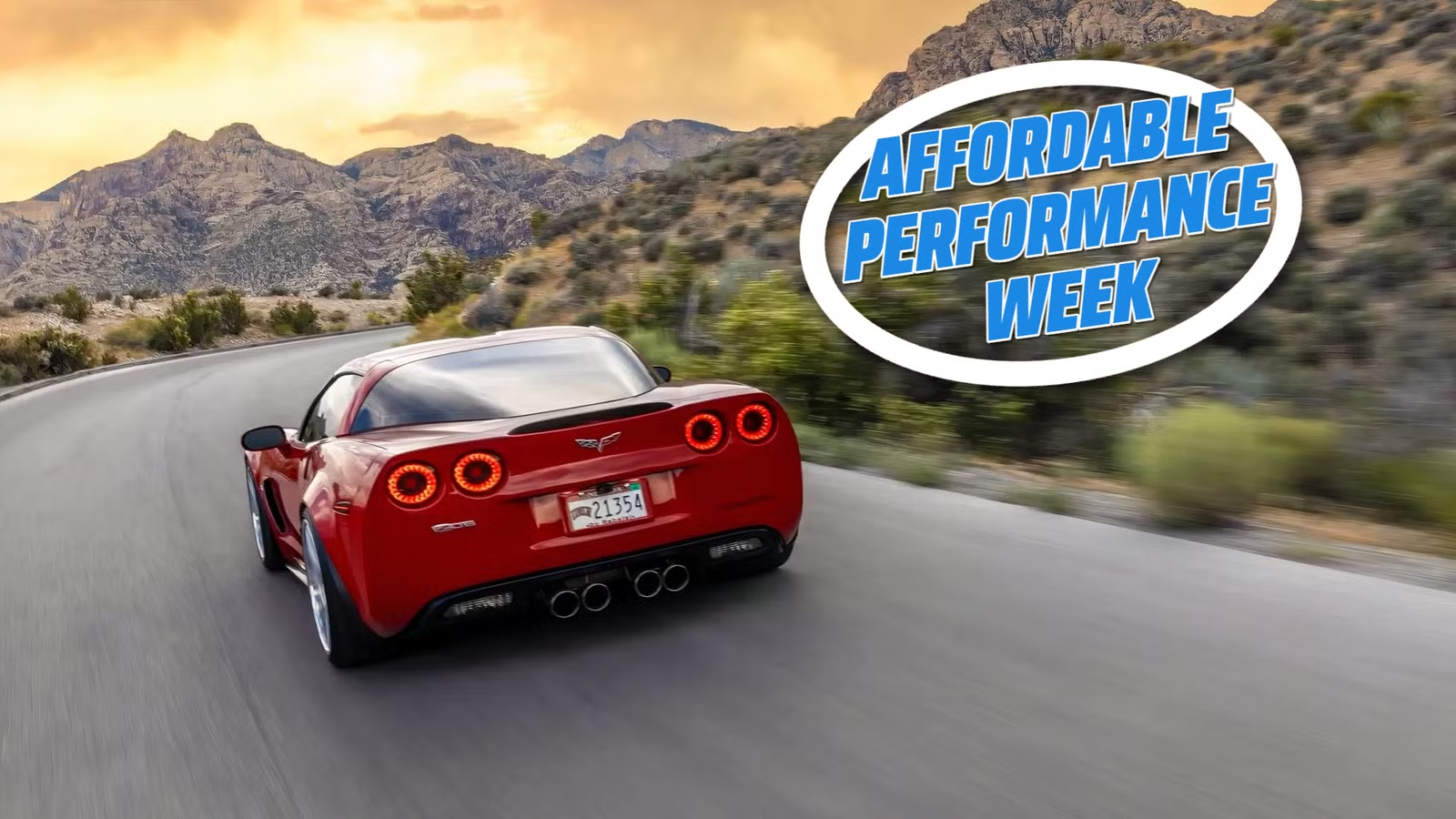
Fast sports cars and fast supercars can be “affordable”, but we tend to see the highest prices placed next to the models that post the best 0–60 mph times and highest top speeds. Take models like the Koenigsegg Jesko Absolut; it has a claimed top speed of 330 mph; it can sprint to 60 mph in 2.5 to 2.8 seconds, and it costs upwards of $2.8 million.

Bang-for-your-buck sports cars like the 2026 Chevrolet Corvette offer a 6.2-liter V8 and sub-three-second sprint times for $70,000, and while that is good value for money for the price, $70,000 is still $70,000. These exceptionally fast sports cars and supercars from yesteryear have gone down in value so much that they are now affordable bargains.
Performance Cars Can Lose Value Fast
The harder they come, the harder they fall… well, sometimes. In the performance car market, thanks to typically dedicated maintenance needs, expensive parts, high fuel costs, and general usability, we tend to see prices for sports cars and supercars plummet in price after a few years.

There are, of course, exceptions, with the likes of the most collectible and legendary sports cars still costing a fortune at auction. The 930 Porsche 911 “Widowmaker” Turbo takes 4.9 seconds to get to 60 mph, but holds a potentially dangerous yet endearing quality for collectors, and costs, on average, over $200,000 at auction. The legendary Ferrari F40 was the late ’80s poster boy supercar; it can sprint to 60 in around four seconds, and today is worth over $3 million.

But then we have models like the 2021 McLaren 570S Spider; it can reach 60 mph in as little as 3.1 seconds, and had an original starting price of $214,000. Today, it has an average auction price of just under $120,000.
The same goes for the Maserati Ghibli; it is one of the market’s most misunderstood performance cars. In 2024, the starting price of the Trofeo 334 Ultima was $170,000. On the used market today, you can pick them up for around $95,000, despite their sumptuous looks and four-second sprint times.
Yesterday’s Dream Cars Are Today’s Hidden Deals

If you look in the right places and at the right models, you can find some real gems of affordable performance cars. As a general rule of thumb, the least collectible and maybe the “less iconic” models that don’t have an association with movies, totally mind-blowing performance specs, limited-run builds, racing history, or celebrity drivers tend to cost less on the used market.
Japanese performance cars are generally a safe bet when it comes to blending speed with affordable pricing. Models like the admittedly expensive Nissan GT-R can hit 60 mph in 2.5 to 3.1 seconds and cost, on average, $110,000 at auction, but compared to something like the Ferrari 296 GTB, which posts similar times but costs over $300,000 at auction, it is positively a bargain.

When the Audi R8 was released in 2008, there weren’t many speed freaks who didn’t sit up and take notice. However, when it was released, the base-model V8-equipped R8 would have set you back around $109,000, and the final model released in 2023 with a V10 under the hood would have cost you just shy of $214,000.
On the used market today, the latest models still command a high price, but you can pick up a 2008 R8 for the average auction price of $50,000. Real performance prowess that was once out of reach can be much closer to being reasonable today.
5 Performance Cars That Deliver Supercar Energy Without Supercar Costs
You don’t have to spend two-story home money to get big supercar energy.
These Sports Cars Hit 60 MPH In Close To Five Seconds

In the modern market, it is not unusual to see family sedans that act like track warriors, SUVs that can outrun sports cars, and mainstream cars that can hit 60 mph in five to six seconds, like the 2026 Kia K5 GT, which hits 60 in around 5.2 seconds, but they don’t always have that supercar/performance car quality that will earn you super bragging rights and a lot of looks in the street.
Some older performance cars used to set the benchmark for speed, hitting 60 in around five seconds. That may be a tad pedestrian for some today, but models like used Ford Mustangs, used Maseratis, and used Porsches all still provide wide-grin fun and speed, crucially, at a low price.
The 2004 Ford Mustang Mach 1 And 2008 Maserati GranTurismo Deliver Serious Pace

According to Classic.com, the average auction price for a 2004 Ford Mustang Mach 1 is just $21,178. The lowest recent sale was for $16,000, while the highest was for $26,000. To put that into perspective, a new Honda Civic has a starting price of just shy of $25,000 and takes a good eight to 10 seconds at base level to get up to speed.
The ’04 Mustang Mach 1 has been clocked sprinting to 60 in 5 to 5.3 seconds, has a top speed of 155 mph, and can run the quarter mile in the high 13-second range at around 106 mph. There is just one engine option, but for those who enjoy the pure side of pony cars, it doesn’t disappoint, with the following specifications.
|
Spec |
2004 Ford Mustang Mach 1 |
|---|---|
|
Engine |
4.6-Liter NA V8 |
|
Transmission |
Five-Speed Manual or Four-Speed Automatic |
|
Horsepower |
305 hp |
|
Torque |
328 lb-ft |

Alongside the best engine configuration, you get an old-school “Shaker” hood scoop, a smooth and responsive feel underfoot, classic Mustang stylings, a thunderous racket from the tail, a redline from the 32-valve DOHC V8 of 6,800 rpm (with the manual box), and a lot of scope to juice up the engine, with a lot of owners fitting a turbo.
If you are looking for something more classy with Italian flair, the 2008 Maserati GranTurismo combines an exceptional body design, GT comfort, luxe cabin, and low auction prices. Under the hood is a Ferrari-derived V8 with its power sent through a six-speed ZF automatic transmission; it has the following specifications.
|
Spec |
2008 Maserati GranTurismo |
|---|---|
|
Engine |
4.2-Liter V8 |
|
Transmission |
Six-Speed Automatic |
|
Horsepower |
405 hp @ 7,100 rpm |
|
Torque |
339 lb-ft @ 4,750 rpm |
This translates to 0–60 mph times of 5.1 seconds and a top speed of 177 mph. You actually get usable seating space for four people, ventilated Brembo brakes handling the stopping power, seven-spoke alloys on all four corners, and all sorts of European good looks. What makes it even more appealing is that Classic.com says auction prices range from just $8,800 to $30,422, giving it an average auction price of $29,700.
The 996 Porsche 911 Carrera Remains An Affordable Performance Benchmark

The Porsche 911 has for a long time been the European sports car to beat, and we can see why. Some of the best 911 models can be worth a fortune, but earn it for their track-ready DNA, legendary nameplate, comfortable cabins, and all-round performance guts. However, if your budget has never stretched the lofty heights of the Turbo models or the GT models, then the “entry-level” Carrera has always been the more affordable way into 911 ownership.
If there is a generation of 911 Carrera models that perfectly balance performance and more affordable costs, it is the 996 Generation, which originally ran from 1998 to 2005. Over its lineage, there were two engine options, both water-cooled M96 flat-sixes; they have the following specifications.
|
Spec |
Porsche 911 Carrera 996.1 (1998 – 2001) |
Porsche 911 Carrera 996.2 (2002 – 2005) |
|---|---|---|
|
Engine |
3.4-Liter NA Flat-Six |
3.4-Liter NA Flat-Six |
|
Transmission |
Six-Speed Manual or Five-Speed Tiptronic S Automatic |
Six-Speed Manual or Five-Speed Tiptronic S Automatic |
|
Horsepower |
296 hp |
320 hp |
|
Torque |
258 lb-ft |
273 lb-ft |
996.1 Carrera models fitted with the six-speed manual can reach 60 mph in 4.6 to five seconds; 996.1 models with the five-speed Tiptronic transmission are slower, at 5.6 to 6 seconds; the 996.2 model fitted with the Tiptronic box hits 60 mph in 5.2 to 5.4 seconds, and the 996.2 Carrera with the same six-speed manual does it in 4.6 to 4.8 seconds.

Today, Classic.com says the whole 996-gen 911 Carrera has an average auction price of $47,592. It is not as affordable as some other cheap performance cars, but this is Porsche engineering at some of its purest, as long as you ignore the water-cooled engine, thanks to the rear engine, RWD layout, and analog feel.
If you are happy with the less-powerful engine in the 996.1 models, it is the cheaper option, with an average auction price of $27,193. The 996.2 generation has a separate average auction price of $31,730, so it is still not out of the realm of affordability for its prowess.
5 Practical Performance Cars Faster Than A C8 Corvette Z06
Five seats, grocery space, and launch control that bends reality. These practical rockets hit 60 faster than a screaming C8 Z06.
Supercar Performance No Longer Requires A Supercar Budget

When you hear the word “supercar,” thoughts of massive price tags, expensive gas bills, huge insurance premiums, pricey parts, and a lot of time in the garage come to mind. Generally, you’d be correct in thinking that.
It is reported that a Lamborghini Murcielago will cost you anywhere between $5,000 and $10,000+ a year for servicing, before even taking into consideration the average auction price of $377,000. Yes, you get a top speed of 213 mph and rest-to-60 times of 3.1 seconds, but it is a massive investment to drive one. In short, you need very deep pockets.
The C4 Corvette ZR-1 And 2006 Corvette Z06 Still Feel Ferociously Fast

This is where two American sports/supercars come in handy; you don’t need to have hugely deep pockets to buy them. Today, you can buy a C4 Corvette ZR-1 and a 2006 Corvette Z06 for between $36,382 and $44,840. While that is more expensive than some Japanese sports cars, here you get real American brute force, massive V8s, and rapid sprint times.
The 1990–1995 C4 ZR1 is the more affordable of the two, with the lowest average auction price as per above, and under the hood, there are two naturally aspirated V8s available, depending on what model year you choose. They have the following specs.
|
Spec |
1990–1992 Chevrolet Corvette ZR-1 (C4) |
1993–1995 Chevrolet Corvette ZR-1 (C4) |
|---|---|---|
|
Engine |
5.7-Liter LT5 V8 |
5.7-Liter LT5 V8 |
|
Transmission |
Six-Speed ZF Manual |
Six-Speed ZF Manual |
|
Horsepower |
375 hp @ 5,800 rpm |
405 hp @ 5,800 rpm |
|
Torque |
370 lb-ft @ 4,000 rpm |
385 lb-ft @ 5,200 rpm |

The earlier iterations are powerful, with an engine that has a DOHC, 32 valves, and a high compression ratio of 11.0:1, while the latter half of the C4 ZR-1 lineage gets a far more powerful engine, with the same compression ratio and valve setup, but with a redesigned intake, a tweaked camshaft, and improved cylinder head castings. 0–60 mph times of the 1990–1992 ZR-1 have been clocked at 4.5 seconds, while the 1993–1995 models can hit speed in 4.2 to 4.4 seconds.
Then there is the newer 2006 Chevrolet Corvette Z06. Under the hood is a bigger V8. You get more horsepower than the C4 ZR-1 models, and you get oodles of track-worthy DNA like a dry-sump oiling system, an aluminum hydroformed frame, carbon-fiber fenders and door panels, and a low curb weight of around 3,130 pounds. The ’06 Z06 has the following engine specs.
|
Spec |
2006 Chevrolet Corvette Z06 (C6) |
|---|---|
|
Engine |
7.0-Liter LS7 V8 |
|
Transmission |
Six-Speed Tremec T56 Manual |
|
Horsepower |
505 hp @ 6,300 rpm |
|
Torque |
470 lb-ft @ 4,800 rpm |
The LS7 V8 is an old-school pushrod beast with a redline of 7,000 rpm, so you get a great feel underfoot. Speed-wise, 0–60 mph times have been recorded in 3.4 to 3.7 seconds, while quarter-mile times have been clocked at 11.5 seconds at 127 mph. For under $50,000, the 2006 Corvette Z06 is a truly affordable American supercar.
The 1999 Dodge Viper RT/10 Delivers Supercar Speed For Less

Classic.com reports that the 1999 Dodge Viper RT/10 has an average auction price of $48,375. The lowest sale in recent years was $40,250, while the highest was $56,500. This may sound like a lot when you compare it to cheap cars that can hit 60 mph in under five seconds, like the new $40,000 Toyota GR Corolla, but with the RT/10, you get something alongside the speed that is seldom seen today: a naturally aspirated V10. Its engine specifications are as follows.
|
Spec |
1999 Dodge Viper RT/10 |
|---|---|
|
Engine |
8.0-Liter OHV V10 |
|
Transmission |
Six-Speed Tremec T56 Manual |
|
Horsepower |
450 hp @ 5,200 rpm |
|
Torque |
490 lb-ft @ 3,700 rpm |

The RT/10 is effectively a muscle car mated with a supercar. It has a front-mid-engine layout, rear-wheel drive, a manual stick only, a naturally aspirated engine, exceptionally aggressive looks, and near-perfect weight distribution. You also benefit from a limited-slip differential, a 3.08 final drive ratio, and a totally raw, analog feel behind the wheel devoid of electronic nannies.
It may be slightly slower to 60 mph than the Z06 Corvette above, at around 4.3 seconds, and comparable to the ZR-1 above, but it is still not slow. Plus, a top speed of around 170 mph and true American auto heritage to accompany the noise of a NA V10 thundering through side-exit exhausts is worth the money for any sports car fan.
10 Used Performance Cars That Continue To Turn Heads
These machines offer more than speed—they bring design, character, and heritage to the table.
These High-Performance Cars Are The Bargains We’ve Been Waiting For

What makes these kinds of models so appealing isn’t just the performance they offer; it is the fact they’ve become more attainable without losing what made them special when they were first released. You still get the same speed, drama, fun, and excitement from them today, just not the ridiculous price tags. Plus, a lot of these affordable sports cars and affordable supercars were also built before screens and drive modes took over.

They’re not simply fast for the money, but they bring a long heritage, a connected feel, head-turning looks, and legendary status. Yes, you could buy a 2026 BMW M5 or a 2026 Kia EV6 GT, which both post 0–60 mph times of between 3.2 and 3.4 seconds and 3.2 and 3.5 seconds, respectively, while still carrying a week’s worth of shopping around with you, but these cars are something beyond the spec sheet.
They were the performance benchmark for their day, and today, speed can be added relatively easily. When these were built, they were built as icons for enthusiasts who appreciated what went into making an OHV V10 capable of shooting you to 60 in less than 5 seconds. These are the kinds of models that a lot of us probably thought would never be affordable enough to get behind the wheel of, but now are.
Sources: OEMs, Classic.com, and Bring A Trailer

Related posts
Latest Post


No Comments