
The Hybrid SUV That Gets Better Fuel Economy Than Most Compact Sedans
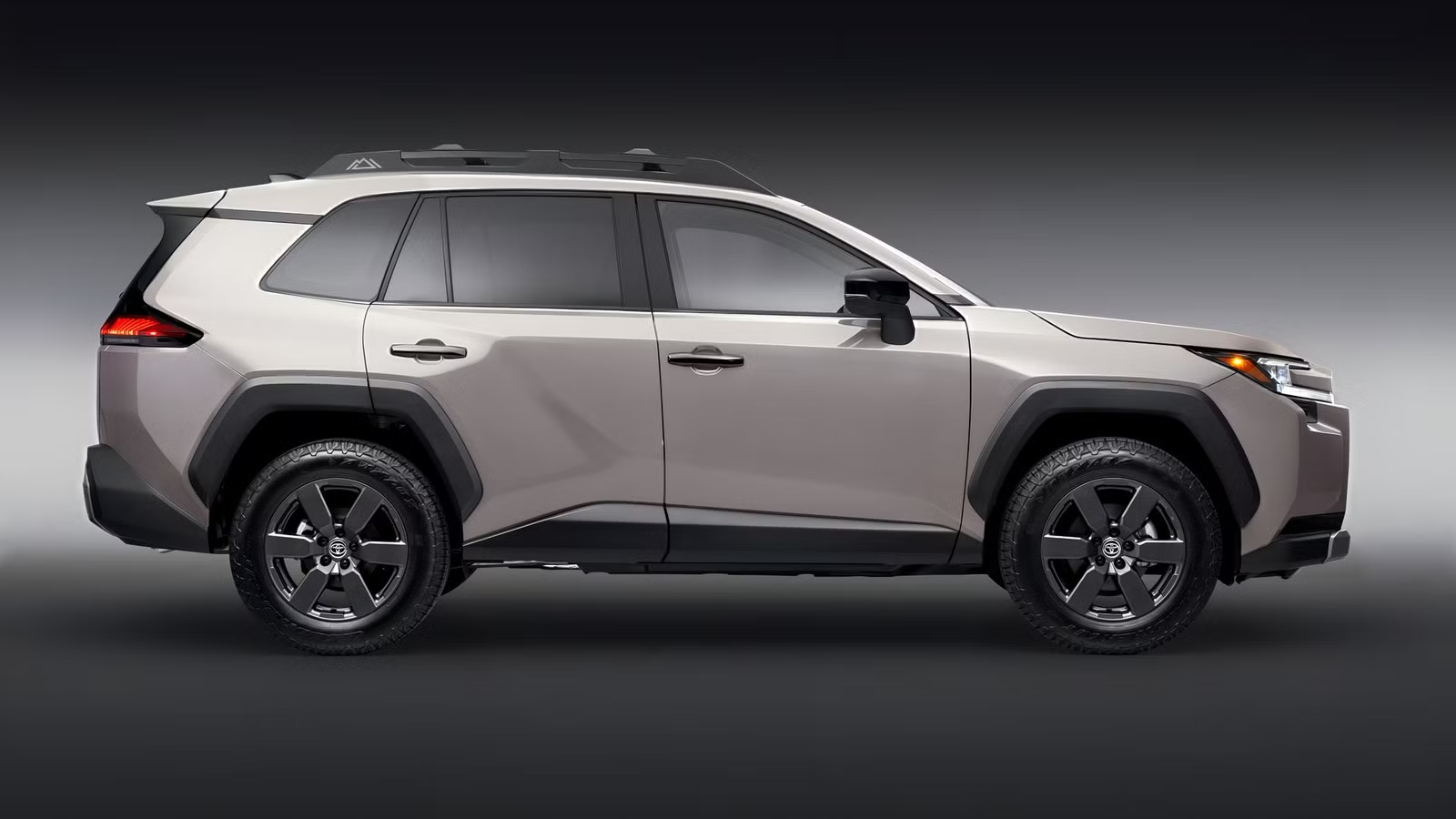
For years, choosing an SUV meant accepting higher fuel bills as the price of extra space, a higher seating position, and all-weather confidence. That tradeoff is quickly disappearing. Thanks to advances in hybrid technology, one midsize SUV now delivers fuel economy that rivals, and in many cases surpasses, many popular compact sedans, all while offering far greater versatility. It’s a reminder that efficiency is no longer reserved for small commuter cars, and that today’s smartest family vehicle might also be one of the least frequent visitors to the gas pump.
Why Some SUVs Now Rival Economy Cars At The Pump
The Technology Behind The Efficiency

Traditionally, SUVs don’t achieve the same fuel economy as sedans, but modern technology has changed that. Instead of matching trucks for fuel mileage, which was often the case with much older body-on-frame SUVs, modern unibody models with hybrid powertrains can easily achieve the same or better fuel mileage than some cars.
Hybrid systems use regenerative braking, which returns captured energy to the electric system to improve overall fuel economy. Additionally, the use of the Atkinson cycle also improves fuel mileage, allowing some small SUVs to reach figures that weren’t possible several years ago. This means shoppers no longer need to choose between an SUV and a sedan based solely on fuel mileage, but can consider other factors as well.
Why Fuel Economy Matters More Than Ever

The cost of everything has gone up, so saving money wherever you can is very important. Owning a vehicle is much more expensive than it was several years ago, before the widespread inclusion of advanced technology. The push to add technology wherever possible enables hybrid powertrains, improving fuel efficiency in many SUVs, but it also makes buying and owning modern vehicles more expensive than ever before.

An SUV with good fuel economy reduces your annual expenses. For example, a Kia Sorento Hybrid achieves 37 city/36 highway mpg, which translates to an estimated annual fuel cost of $1,700. By comparison, a Nissan Pathfinder with its naturally aspirated V6 engine costs an estimated $2,700. That’s $1,000 more per year in fuel costs alone.
2026 Toyota RAV4: The Hybrid SUV That Embarrasses Compact Sedans
43 MPG Combined Without A Plug

The Toyota RAV4 is one of the most popular compact SUVs on the market, and it has now followed the Camry. Saying “RAV4 Hybrid” is a bit redundant since every model has a hybrid powertrain. The standard model delivers fuel mileage that many compact sedans can’t achieve, delivering 47 City/40 Highway/43 Combined MPG. The AWD version of the RAV4 still delivers excellent fuel efficiency, reaching 46 city/39 highway mpg, giving you power on all four wheels and the desired fuel savings in one great package.
The Kia K4 can’t come close to this, giving drivers 29 city/39 highway mpg, while the non-hybrid Toyota Corolla only achieves 32 city/41 highway mpg, which is matched by the non-hybrid Honda Civic. Although the K4 comes close to the RAV4’s highway fuel mileage, in the city, the RAV4 tops the charts, offering much more space and versatility than any of these compact sedans.
Efficiency Without Sacrificing Everyday Practicality

The Toyota RAV4 compact SUV’s size makes it stand out as one of the most practical vehicles to drive, especially when compared to compact sedans. You’ll have acres more passenger room, a larger cargo hold, much higher ground clearance, and an AWD option to handle tough weather. This combination delivers impressive everyday family usefulness that you won’t find in a Nissan Sentra, Volkswagen Jetta, Kia K4, or Hyundai Elantra.
Putting some numbers to the claim, the RAV4 has 37.8 cubic feet of cargo capacity behind the rear seats, which expands to 70.4 cubic feet. None of the compact sedans come close, and hatchback versions fall short as well. The Corolla Hatchback offers 17.8 cubic feet behind the rear seats, the most space among them, but not nearly as much as the RAV4.

In addition to the cargo room, the RAV4 is a family-sized vehicle, offering plenty of space for four adults and a small child across two rows of seats. While compact sedans also offer this seating configuration, the RAV4’s rear seat measurements of 39.5 inches of headroom, 37.8 inches of legroom, and 56.4 inches of shoulder room can’t be matched by any compact car.
How It Compares With Other Hybrid SUVs

Although it comes close, the Honda CR-V Hybrid only reaches 43 city/36 highway mpg, which falls short of the RAV4 in both city and highway driving. The 2026 Toyota RAV4 LE starts at $33,350, while the 2026 Honda CR-V Hybrid Sport starts at $37,080. The CR-V has 36.3 cubic feet of cargo space behind the rear seats, which is less than the RAV4, but when the seats are folded, the Honda has 76.5 cubic feet of space, beating the Toyota SUV. Finally, the Honda CR-V Hybrid can tow up to 1,000 pounds, which is much less than the RAV4’s 3,500 pounds. In most cases, the Toyota RAV4 is much more practical than the Honda CR-V Hybrid, making it an easy choice over its chief rival.
Versus The Hyundai Tucson Hybrid And Kia Sportage Hybrid

Looking at the same qualities for the 2026 Hyundai Tucson Hybrid and 2026 Kia Sportage Hybrid, we find the hybrid compact SUV class taking shape. The Tucson Hybrid can achieve 38 city/38 highway mpg while the Sportage Hybrid reaches 41 city/44 highway mpg. This means the Kia Sportage returns better fuel economy figures than the RAV4 on the highway.
The Hyundai Tucson Hybrid Blue SE trim starts at $33,695, while the Kia Sportage Hybrid LX begins at $31,985, making the Kia the most affordable compact hybrid SUV in this comparison. The Tucson Hybrid has 38.7 cubic feet of cargo room behind the rear seats, which expands to 74.5 cubic feet. It also tows up to 2,000 pounds. The Sportage Hybrid gives you 39.5 cubic feet of room behind the rear seat and 73.7 cubic feet when the seats are folded down. It also tows up to 2,000 pounds.

Compared with the Tucson and Sportage hybrid models, the RAV4 doesn’t fare as well as it does against the CR-V. It still has the best overall fuel efficiency, but falls short of the Sportage Hybrid in highway efficiency and price. It also doesn’t have as much cargo room or towing capacity as the Tucson and Sportage hybrid SUVs.
One area where the Toyota RAV4 stands out among hybrid SUVs is its battery warranty coverage. While most hybrids adhere to the industry standard of eight years/100,000 miles for hybrid batteries, Toyota extends this to 10 years/150,000 miles.
Why Owners Save More Than Just Fuel
Lower Ownership Costs Over Time

Fuel savings can add up over time and with each mile driven. If you drive your vehicle more than average, you’ll enjoy much greater savings than someone who only drives their vehicle occasionally. Of course, fuel savings are only one part of the ownership cost equation.
Toyota has a long history of hybrid excellence, which should give RAV4 owners additional confidence. The hybrid-only lineup is new for this Toyota SUV, so there is not enough data to determine annual maintenance costs and total cost of ownership. Still, the RAV4 is historically one of the most affordable vehicles to maintain, costing an average of $429 per year according to RepairPal.
Strong Resale Helps Offset Purchase Price

Resale value is based on depreciation and is often the second-most expensive component of a vehicle’s total cost of ownership, after the purchase price. The RAV4 has a typical five-year depreciation of only 28 percent, leading to a high resale value. This is expected to continue with the hybrid-only lineup. Toyota’s reputation for hybrid excellence and impressive resale value gives these projected figures weight for the new compact SUV lineup. Additionally, there’s often a strong demand for pre-owned RAV4 SUVs, and that demand could increase as many drivers look for hybrid SUVs to save money at the gas pump.
By comparison, the Hyundai Tucson depreciates 47 percent on average, while the Kia Sportage depreciates 49.6 percent over the first five years. The Honda CR-V comes closest to the RAV4, with only 29 percent depreciation over the first five years of ownership.
Is The RAV4 The Smartest Efficiency Buy In America?
Who Will Benefit Most From This Hybrid SUV

The impressive fuel efficiency, value-oriented packaging, affordable pricing, and practicality of the 2026 Toyota RAV4 make it a well-rounded SUV that can meet the needs of many drivers. If you still want to drive a compact sedan, the RAV4 isn’t for you, but if you’re ready to replace your sedan, it could be the smart choice, especially with the fuel savings you’ll enjoy over time.
The RAV4 makes sense as a daily driver, achieving excellent fuel mileage on every road. It also works well for those who want to retire and travel the country or who still put a lot of miles on their vehicle. It doesn’t make sense as an SUV that’s parked in your driveway and only driven occasionally. The impressive hybrid warranty makes it an easy choice for drivers who plan to keep the RAV4 for 150,000 miles or more, and the AWD system is excellent for handling tough weather in snowy climates or when you want to take this SUV on some light off-road trails.
Final Verdict: An SUV That Changes Expectations
The 2026 Toyota RAV4 proves that drivers no longer have to choose between fuel efficiency and everyday practicality. By delivering fuel economy that beats many compact sedans while providing the cargo space, passenger room, and confidence of an SUV, it redefines what buyers should expect from a family vehicle. Add Toyota’s long-standing reputation for reliability, strong resale value, and low ownership costs, and the RAV4 Hybrid becomes more than just an efficient SUV—it becomes one of the smartest long-term purchases on the market. For anyone who wants to spend less time and money at the gas station without giving up versatility, it’s hard to find a more compelling choice.
Sources: Toyota, EPA, Edmunds, Kelley Blue Book, CarEdge

Related posts






Latest Post


No Comments