
Million-Mile Engines Beyond Toyota: Volvo, Dodge & Mercedes
Capitalizing on the 1970s oil crisis, Toyota’s foothold in the US market proved to be a valuable one. In a market that was hit by rising costs, the brand offered highly efficient and reliable motoring that the US domestic brands were struggling to match. It didn’t take long before the Corolla took the title of the best-selling Japanese car in the US. By over-engineering vehicles and continuously refining them as well as adopting quality control measures for manufacturing through the Toyota Production System, the quality of the products soon started to show and the cars (along with others from Japan) soon gained a reputation for reliability and longevity.

Thanks to this, owners kept coming back to the brand. Victor Sheppard was one example whose 2007 Tundra hit one million miles. The Tundra’s 2UZ-FE 4.7-liter V8 was torn-down by Toyota engineers after they acquired the truck. They found it had the original transmission and engine, with the cylinder walls and internals showing little-to-no signs of wear, despite having nothing more than routine dealership oil changes. Victor later went on to put another million miles on a 2014 Tundra SR5. But it’s not just Toyota’s engines that are capable of a million miles — these three companies have shown the world that ‘longevity’ is built into their engine DNA.
Million-Mile Heroes Worthy Of Your Attention
Volvo B230 Redblock
Launched in 1985, as an evolution of the earlier B23 engine, Volvo’s B230 Redblock became an instant hit due to its unkillable status, thanks to an over-engineered design. A clever piston head and valve design were arranged in such a way that they wouldn’t collide if the timing belt broke, which would otherwise lead to engine failure. Also, the thicker cast-iron block design made it resistant to cracking/warping under intense heat. And the over-engineered crankshaft and connecting rods were capable of handling significantly more than their factory output. B230 engines had lower-compression ratios and lower horsepower figures, so components also weren’t pushed near their physical limits.

As a result, the B230 engine in Volvo’s 240, 700, and 900 series was loved and praised by its owners, allowing them to surpass 300,000 miles without the need for major maintenance or rebuilds — an engine they could always depend on. Owners like Selden Cooper entered Volvo’s High Mileage Club, reaching over a million miles in his red 240 sedan thanks to his commitment to a diligent routine maintenance schedule throughout the car’s life.
“I never contemplated that I’d reach one million miles. I’ve never had any trepidation about taking my Volvo on long trips.” — Selden Cooper
Dodge 5.9L Cummins 12-valve

Introduced in Ram 2500 and 3500 models from 1989 through early 1998, the 12V 5.9L Cummins’ mechanical simplicity, robust forged connecting rods, and Bosch’s P7100 fuel injection pump on later variants transformed Dodge trucks into heavy-duty workhorses. Built to haul agricultural and industrial equipment, its durability, low-end torque, and simple mechanics meant this straight-six provided the solid foundations for heavy-duty towing while also offering tuning potential, and earned the engine a place in the million-mile club. Dan Edelman’s 1996 Ram 2500 recorded over one million miles which he used for hauling goods, stating it was a very reliable design – crude but effective.
Mercedes OM606

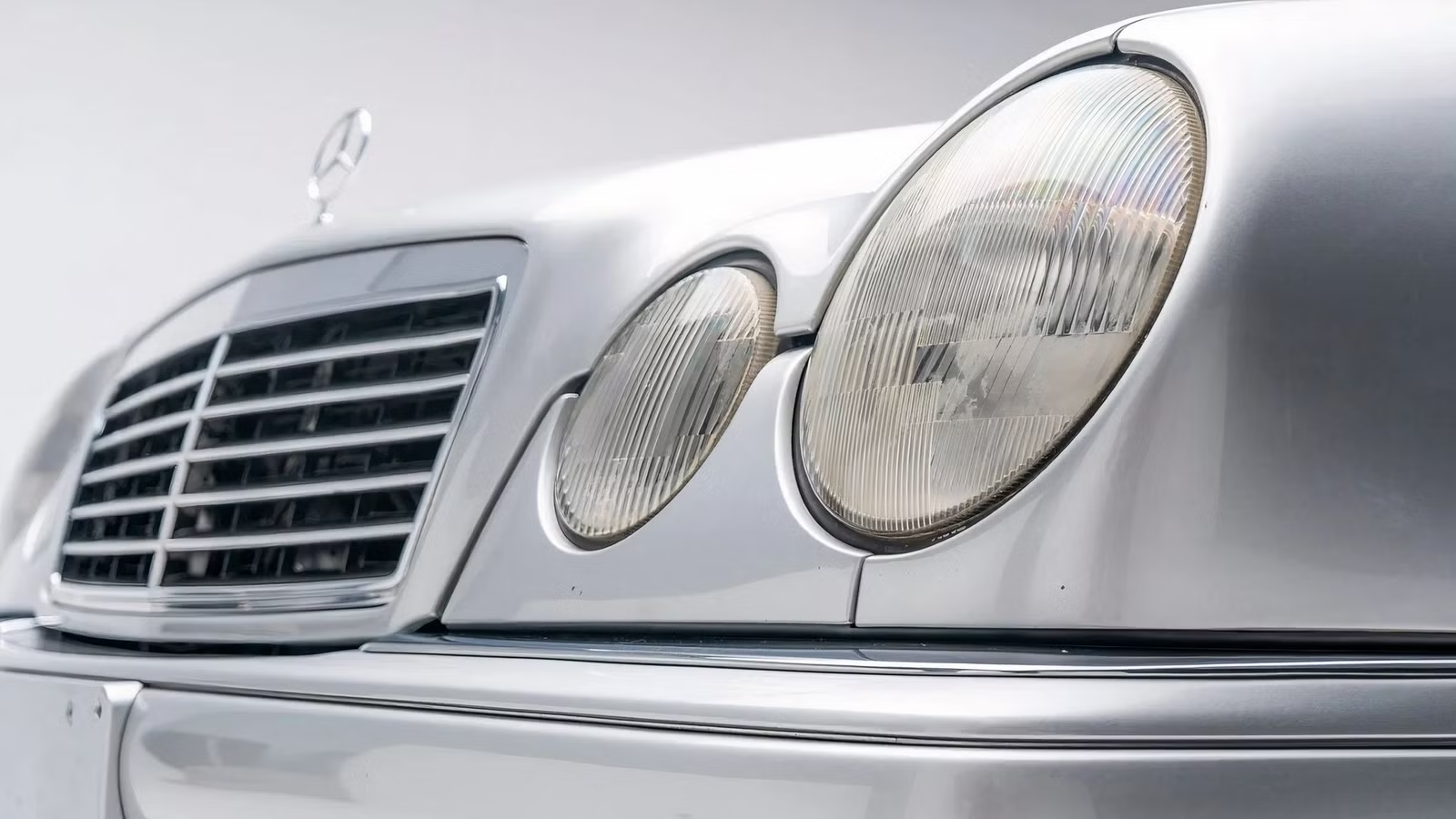
Despite their lax attitude toward over-engineering, which sparked negative criticism of the brand, Mercedes was on a roll in the ’90s with cars like the W163 ML, which starred in Jurassic Park, and the cleverly packaged W168 A-Class. More important than any of these, perhaps, was their over-engineered achievement in the form of the 3.0-liter inline-six OM606 diesel engine found in the W124 E-Class, along with its ’95 replacement, the W210, and the W140 S-Class and G-Class. What made the engine a byword for million-mile bulletproof durability was its legendary cast-iron block with robust forged internals that could withstand the high compression and pressures needed for diesel engines, making it loved and praised by owners all over the world.
Many of these include taxi drivers in some of the most remote parts of the world, who depend on old Mercs for their taxi business, favoring their ability to run like clockwork with rugged suspension and only basic maintenance — perfect for traveling large distances on rough roads. W124 taxis (along with W201s and other Mercs) have been used across North Africa, most notably in Morocco and Mauritania, where many of them are still going strong despite their battered, worn exteriors. Albania, too, was in love with the W124, with the model often becoming a fixture of the city’s transport links. One owner of a ’93 W124 clocked over 930,000 miles on the original engine.
So Are They Still Being Used Today?
Today, all three makers have dropped their million-mile hero record-breakers in favor of new, more powerful, more efficient, and eco-friendly electrified designs. Volvo has phased out the unkillable Redblock and all stand-alone gasoline and diesel engines in favor of hybrid technology and fully electric power. Dodge, meanwhile, replaced the 5.9L Cummins with the larger, more powerful 6.7L unit in 2007 to meet stricter regulations. While Mercedes also dropped the OM606 engine in favor of newer versions of the OM family, those W124 diesel taxis still in active service are keeping the ‘606’ lump alive today.
Why They Haven’t Got The Recognition They Deserve

While all three engines were dependable workhorses, as proved by their colossal mileage figures, and have gained legendary status among enthusiasts through their cult followings, the cars they were featured in contributed in one way or another to each engine’s fade from glory. While Volvo’s B230 is hailed as an all-time great, the 240, 700, and 900 series were viewed as safe and sensible vehicles for those with family-oriented priorities. They were some of the company’s best offerings, but they lacked the image of sportier, faster performance cars, or bigger, rugged trucks.
The Cummins motor, meanwhile, outshone the Dodge Ram it was placed in for the second generation. Trucks were plagued with interior quality problems, electrical issues and weak automatic transmissions which were prone to failing. Steering issues and front suspension problems also hindered the truck’s reputation.
Most of the Mercs which featured the OM606 unit were well-engineered, pioneering products. However, due to the company’s relaxed attitude toward over-engineering cars launched in the second half of the ’90s and into the early 2000s, the W210 fell victim to build quality problems — not something that should have been seen on a Mercedes-Benz.

Rust was one of the car’s biggest weaknesses, which resulted from the introduction of thinner, eco-friendly, water-based paints (to comply with stricter EU environmental regulations) and reduced anti-corrosion protection. As a result, this affected areas like the fenders, doors, and trunk lid, which became prone to rust in even moderate climates. Aside from the rust, W210s also lacked the interior build quality of the earlier W124 models, with owners reporting failed digital instrument displays, peeling lacquer, and squeaky dashboards.
These engines not only proved that Toyota was not the only maker building dependable, reliable engines, but they’ve also shown how far we’ve come with engine development to ensure (with regular maintenance) the longevity of a car can be upheld.
Sources: BBC, King Rose Archives, Volvo

Related posts




Latest Post


No Comments