
The Adventure Bike That Was Years Ahead Of Everyone Else
The adventure bike segment has gained some serious ground in recent years, and that shouldn’t come as much of a surprise. Such machines are incredibly versatile, doing a fantastic job at both long-distance touring and mild off-roading, while also serving as decent (albeit bulky) commuters and boasting enough power to feel at least somewhat sporty. What’s more, they practically decimated the popularity of dedicated tourers, as a huge chunk of buyers ended up turning to ADVs for their mile-munching needs. Whereas demand for adventure bikes has only really exploded during the 2020s, the formula had been established about four decades prior at the dawn of the eighties.
The Motorcycle World Before ADVs

Before the first true adventure bike landed, dual-sports were the closest things to it you could get your hands on. Yamaha’s two-stroke DT-1 is widely regarded as the world’s first dual-sport motorcycle, released in 1968 with a mixture of road-going equipment and dirt bike genetics. It gave people the ability to effectively ride on and off the tarmac, but it lacked the touring capability and comfort of later ADVs. Things stayed pretty much the same during the seventies, when models like the Honda XL250 rose up to try beating Yamaha at its own game. It wasn’t until 1980 that another manufacturer really upped the ante, taking the dual-sport recipe and refining it further to ensure suitability for traveling long distances. Extra comfort, luggage-carrying capacity, and enough off-roading prowess to take you off the beaten path — these were all essential ingredients to what became the adventure blueprint.
Where It All Began

While Japanese manufacturers were the ones to kick off the whole dual-sport movement, it was the Germans who had the bright idea of building a similar bike that would also be suitable for longer rides. We are, of course, referring to BMW Motorrad here, whose plan was to take things to an entirely new level instead of simply creating a typical dual-sport machine of its own. Engineer Rüdiger Gutsche and renowned designer Hans Muth were put in charge of development, and their groundbreaking masterpiece was ready to be unleashed by 1980. Little did they know, it would also go on to become a legend of the Paris-Dakar rally’s early days, further enhancing its reputation as an extremely capable off-roader. That being said, let us now dive in and see what the motorcycle in question was all about.

BMW’s R 80 G/S Shook The Off-Roading Scene To Its Core

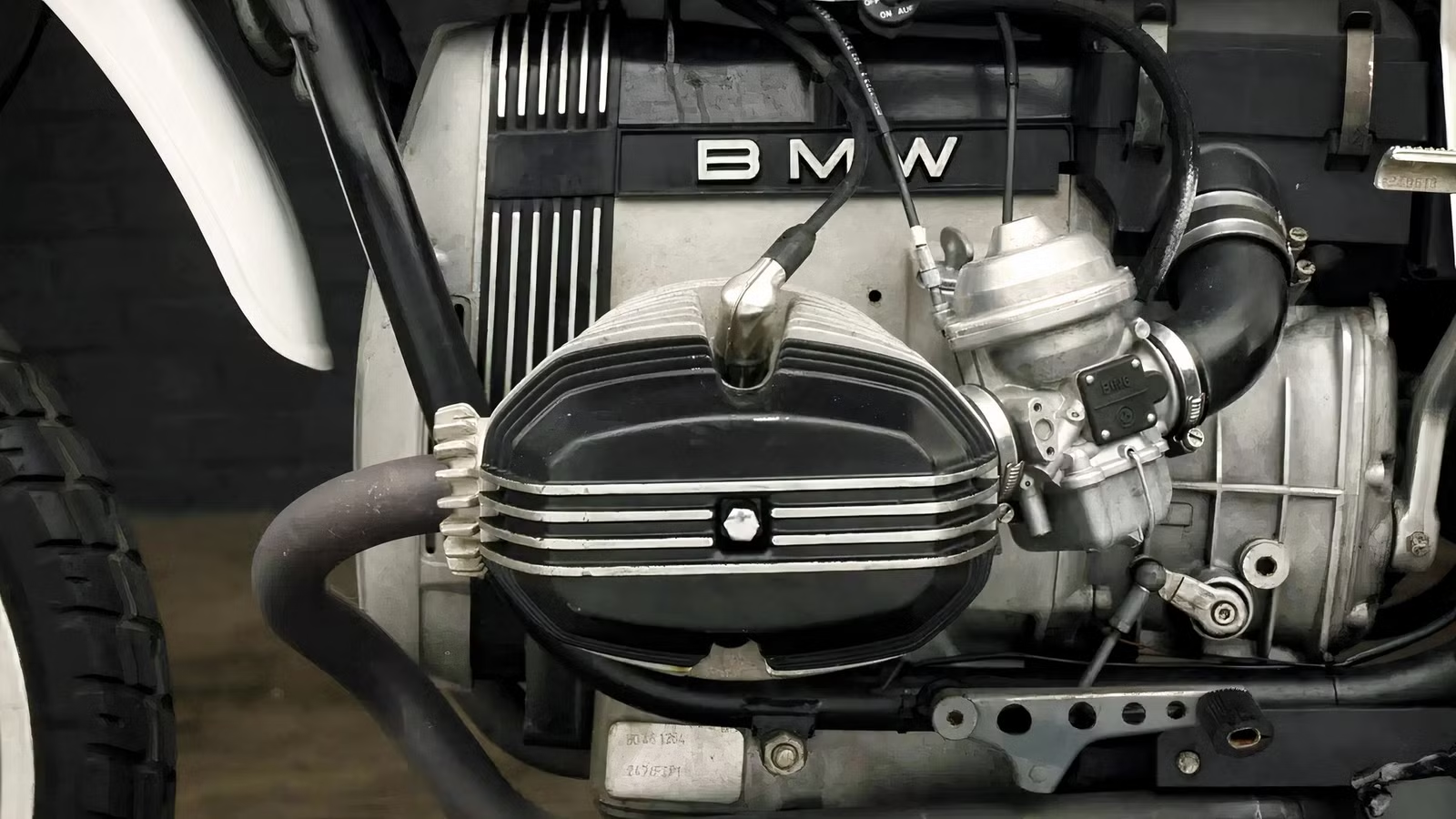
The R 80 G/S was first shown to the public at the Cologne Motorcycle Show in 1980, but people weren’t really sure what to make of it initially. BMW was proverbially playing chess while others played checkers, though, so the press and everyday riders did warm up to the idea after some time. In essence, Gutsche and Muth combined the boxer-twin engine of an R80/7 with the R65’s frame, both of which were cleverly adapted for the G/S. It was, in broad terms, a fusion of that solid airhead reliability with a chassis capable of handling rough terrain, and it came together exactly how BMW had intended. Starting with the motorcycle’s powerplant, it was an air-cooled 797cc boxer breathing through dual Bing carburetors and a two-into-one exhaust system with its muffler routed up high on the left-hand side.
It featured two pushrod-operated valves per cylinder and a compression ratio of 8.2:1, while routing its power to the rear wheel by means of a five-speed transmission and a driveshaft. The mill was good for up to 50 horsepower at 6,500 rpm and about 41 lb-ft of torque at 5,000 revs — enough for it to handle off-roading duties with confidence. Riders frequently noted how the engine offered plenty of usable low-end twisting force, and its architecture facilitated a low center of gravity to keep the R 80 G/S nice and stable. The layout was far smoother than the alternatives, too, minimizing vibration to bring about a more comfortable ride. Top speed was fairly modest at 104 mph, though this was never going to be an issue given the Beemer’s intended purpose.
A Chassis Fit For Any Terrain

Having treated the R 80 G/S to a very capable powerhouse, BMW needed a chassis to match. The basis was that R65-derived double cradle frame, whose front section was fitted with long telescopic forks with almost eight inches of travel. Things were even more interesting at the back, with Bavaria’s proprietary Monolever arrangement taking care of suspension duties. It comprised a single offset shock absorber mounted on the right, together with a single-sided swingarm whose construction housed an integrated driveshaft. Additionally, a 21-inch front wheel allowed the G/S to ride off the pavement and over obstacles with ease, but the bike’s modest weight played a key role in that, too. It tipped the scales at just 410 pounds with the necessary fluids added, which was very much on the lighter side for a motorcycle its size back in the eighties.
Attending The Paris-Dakar Rally With Something To Prove

The R 80 G/S isn’t remembered solely for establishing the adventure bike segment, but also thanks to its outstanding performance at the Paris-Dakar Rally in the early 1980s. It managed to win its class no fewer than four times, the first of them being with Frenchman Hubert Auriol in 1981. History repeated itself just two years later, with Auriol finishing in first place yet again despite riding a bigger and heavier machine than the enduros used by other competitors. Then, it came time for Belgian motocross racer Gaston Rahier to take over from there, achieving two back-to-back wins in 1984 and ‘85. This was the best kind of marketing BMW could’ve hoped for, demonstrating what the R 80 G/S was capable of beyond any shadow of a doubt and turning it into an off-roading icon whose name has been echoed into eternity. Race wins have always been a fantastic proof of concept and promotional tool for manufacturers, especially when they’re achieved in such a grueling event as Dakar.
Evolution And Cult Classic Status

Although the original R 80 G/S was only produced until 1987, the lineup as a whole lives on to this very day sans the slash. BMW introduced the R 100 GS once the initial model was ready for retirement, and many more iterations have followed all the way up to the R 1250 GS we have today. Soon to celebrate its 50th anniversary, the GS family doesn’t seem to plan on hanging up the gloves for the foreseeable future, being one of the most solid candidates on the adventure bike scene. And every ADV in existence today, from the Yamaha Tenere to Ducati’s Multistrada, owes a little something to the original G/S, as that’s where it all began nearly half a century ago. So, naturally, the Dakar-conquering Beemer is held in high regard by collectors and off-roading enthusiasts.
This is especially true for the beefier R 80 G/S Paris-Dakar edition, which will often exceed $20,000 when changing hands at auction. Back in 2021, one particular example commanded a very generous $36,000 on Bring a Trailer, but regular G/S models can also rake in a pretty penny. Heck, we saw a 1981 specimen with low mileage fetching north of 40 grand in April 2023, and that should give you a clear idea of how much people value these vintage off-roading legends. There will probably never be an adventure bike more iconic than the one which started it all more than four decades ago, thus making the G/S an extremely desirable collector’s item and one of the most revered old-school BMWs you can ever get your hands on.
Sources: BMW Motorrad, Bring a Trailer

Related posts


Latest Post


No Comments