
The Rare Rotary Dirt Bike Nobody Wanted
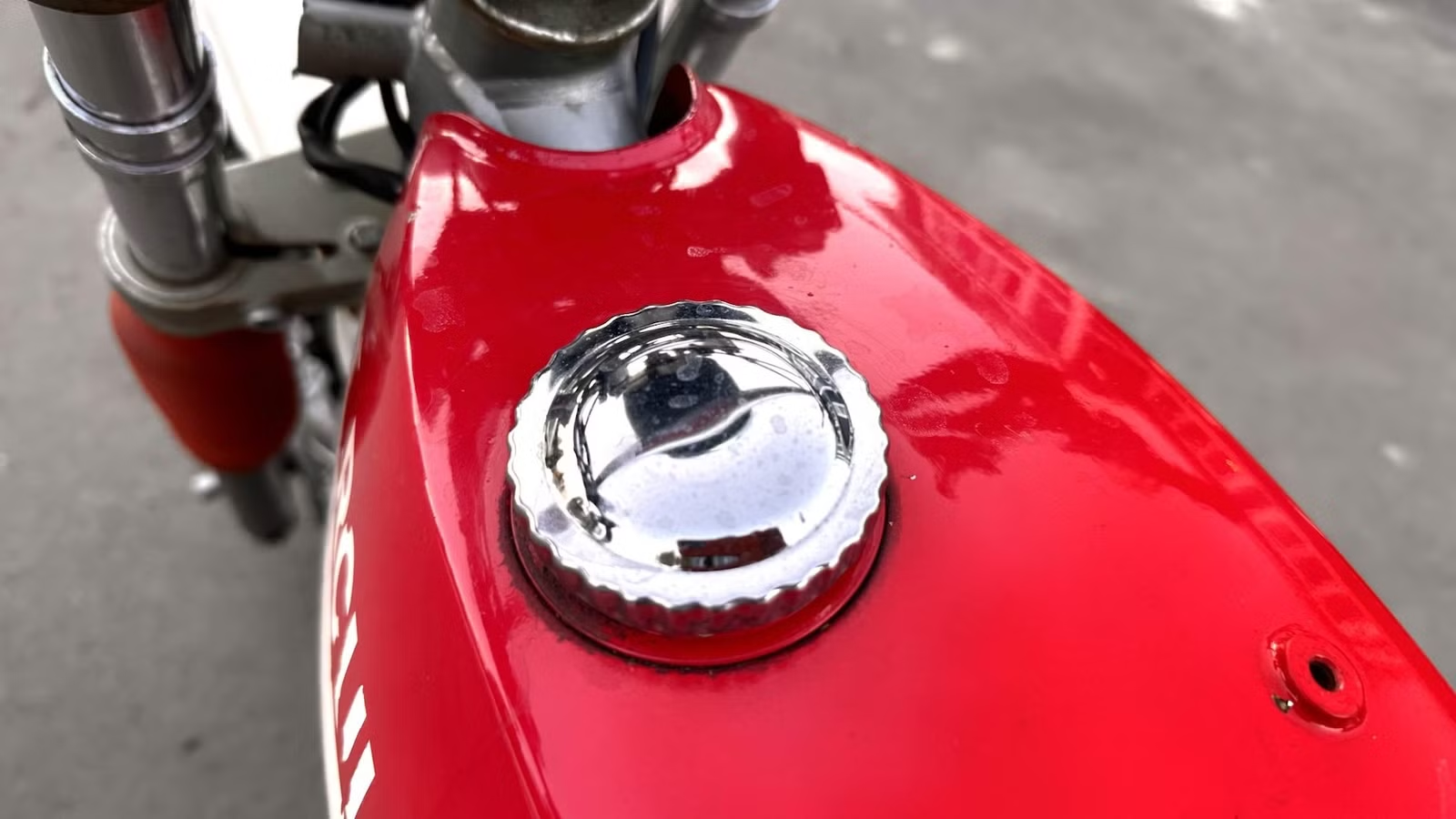
Imagine you’re relaxing on a mountaintop in 1974 when you hear a distant engine growing nearer. It revs so high, it sounds like an approaching helicopter. Or perhaps a tiny, high-pitched jet. Finally, a dirt bike winds its way up the trail—with no visible engine cylinders. You’re looking at the world’s first production motorcycle with a rotary (Wankel) engine.

The many “quirks” of a rotary engine would theoretically make it a perfect fit for a motorcycle. And six major motorcycle manufacturers were also exploring Wankels. But then the first rotary dirt bike hit the market, and no one wanted it.
What Makes The Wankel Engine Perfect For Motorcycles
Your first question might be, “What in the horsepower is a Wankel engine?” And that’s a fair question. In 1924, inventor Felix Wankel began dreaming of a “rotary” internal combustion engine. He patented the technology in 1929. Each of the engine’s “rotors” is a triangular piece of metal attached to the main crankshaft. Each rotor has its own oval chamber in the engine block. As the crankshaft spins, each triangular opening between the rotor and the engine block changes shape due to the oval shape of the chamber.

As with a regular piston engine, a valve fills these openings with a fuel-air mixture. Then, as the crankshaft spins, the rotor compresses this mixture, and a spark plug ignites it. The mixture explodes, and the expanding gases drive the rotation of the rotor, and thus the entire crankshaft.
Without reciprocating pistons, this rotary engine operates with almost no vibration. And if you’ve ever sat on an idling motorcycle, you know what a huge plus that is. It increases rideability while reducing wear and tear.

Without making room for piston travel, a Wankel engine can produce incredible power in a small overall package. This threatened to revolutionize how motorcycles were designed, increasing gas tank size, increasing ground clearance, and improving balance.
Rotary engines are mechanically simple: they have no cams, pushrods, rocker arms, or timing chains. This means they could potentially require far less maintenance. There’s a second benefit to fewer moving parts: an engine that excels at tremendously high rpm. Motorcycle riders, who are already used to shifting near redline, might love such an engine.
The Rotary Revolution That Never Happened

By the 1970s, six motorcycle manufacturers were developing rotary-powered bikes. Production models included the Suzuki RE5 (1975-76), the Van Veen OCR1000, two bikes from Germany-based Hercules, and five separate models from Norton. That’s right, you could order a Wankel Norton F1, F1 Sport, Commander, Classic, or Interpol 2. Some of these models were targeted at police departments. Norton also developed a twin-rotary factory race bike, the RC588.
Other major manufacturers were worried they were about to miss the rotary revolution. Prototypes in advanced stages included the Yamaha RZ201 and Kawasaki X99. Honda and BSA were also developing rotary concept bikes. By the 1970s, even experts were unsure what the future held for the motorcycle industry. Then the first rotary-powered bike hit the market.
The Hercules Wankel Was A Rare Bike Nobody Wanted

Hercules had been building motorcycles for 70 years when it launched 1974’s W-2000. This earned it the distinction of selling the first Wankel-powered motorcycle to the public.
One major strength of the W-2000 was that Hercules didn’t try to reinvent the wheel—or the motorcycle. Most components of the W-2000 were relatively normal among 1970s sport bikes. It had a 54.5-inch wheelbase, 18-inch spoked wire wheels, disc brakes in the front, and drum brakes in the rear. Up front, it had a telescopic fork. Out back: a regular old swing arm.
The W-2000 even had a traditional, six-speed manual transmission with a wet clutch that spun the rear wheel via a chain drive. The rider position, gas tank height, and front fairing were all what riders in 1974 had come to expect. But there was one huge difference from a regular 1974 bike: A rotary engine sitting in the W-2000’s frame.
Hercules’s parent company, Fichtel & Sachs, was among the first licensed manufacturers of the Wankel engine. It had developed the single-rotor Sachs KM-914 rotary engine in hopes of selling it to snowmobile companies.
So Hercules dropped the ready-made Sachs engine into a motorcycle. The resulting bike launched with just 27 horsepower at 6,500 rpm and 24.5 lb-ft at 4,500 rpm. So despite its sprightly 390-pound weight, shifting wasn’t exactly optional.
In North America, the 1974 W-2000 would set you back about $1,900. Early reviewers found that it could consume so much fuel that its efficiency could fall as low as 28 mpg. Sales floundered. But Hercules had one more trick up its sleeve: Hitting the dirt.
The Hercules KC-30 GS Enduro Took The Rotary Off-Road

The W-2000 failed to capture the full potential of a rotary-powered motorcycle. A single-rotor Wankel is such a compact engine that it could easily be mounted sideways in a motorcycle frame, spinning in the same direction as the wheels. Just like an inline four-cylinder sport bike or a Harley-Davidson V-twin does. This would allow it to directly drive the transmission, which could in turn drive the wheel with a chain. But Sachs’ Wankel engine spun in the other direction. It had the same axis as the engine in a BMW or Moto Guzzi.
The Hercules W-2000 prototype solved this “sideways Wankel” issue with a BMW 250 gearbox that spun in the same direction as the engine, powering a driveshaft that then drove the rear wheel. But the production bike had a more traditional gearbox and thus required a bevel gear between the engine and the wheel to turn the power 90 degrees. So much for a rotary engine’s inherent “minimal moving parts” advantage. Or a short, compact powertrain allowing for a longer swing arm.

Most contemporary motorcycles had carburetors set behind or between the cylinders. The W-2000 had a single 32 mm Bing carburetor in the traditional location, directly below the gas tank. But because the engine was a single unit, the entire thing needed to fit below this carb.
The Wankel’s location, below where a regular engine’s sump would be, meant it was so low that Cycle World warned the W-2000 couldn’t corner like a sports bike. Meanwhile, the rest of the space between the high gas tank and the low engine was left completely empty. A fuel injection system, or a gas tank designed to fit around the single carburetor, would have allowed much more efficient packaging.
The intake was designed by Sachs for multiple applications. The bizarre route it took severely limited the engine’s output, though later tuning increased it from 27 hp to 32.
Finally, Sachs had designed the rotary engine with no oiling system. Their logic: you could mount it upside down or any which way. But this meant the owner needed to mix oil in with every tank of fuel—just like with a two-stroke engine.
The Hercules Wankel Gets Dirty

Hercules was making half as many sales as it needed to break even on the W-2000. So it decided to take its dog and pony show off-road. In May 1975, the company launched the KC-30 GS Enduro, a dirt bike version of the W-2000.
The logic seemed sound: Dirt bike riders were already used to riding two-stroke machines and mixing oil in with their fuel. They were also used to lighter engines with a lower power output that required constant shifting. Off-road, the bike’s lower weight would be even more of an advantage. With taller suspension, the absurdly low engine placement would be less crippling. Hercules even took the opportunity to shift the motor’s positioning, improving the bike’s approach angle dramatically.
Hercules did make one major mistake: It set the KC-30 GS Enduro’s price at $2,900. That was the price of an entire Toyota Corolla two-door. The Enduro was pretty much dead on arrival.
The Wankel Engine Winds Down

Cycle World concluded, “Less performance for more money takes this rotary out of the realm of practicality.” But the truth is that the W-2000 didn’t need to be practical to win buyers; it just needed to sell the dream of the future. You see, in the mid 1970s, the rotary engine felt like the future. To some engineering-first buyers, it even felt inevitable. You might compare them to the early EV adopters who picked up a Nissan Leaf in the early 2000-teens. And the W-2000 actually proved there were a surprising number of them.
Hercules sold 1,800 W-2000 motorcycles across various markets. It pulled the plug in 1977, calculating it would have needed to sell about twice as many to remain profitable. But 1,800 is not too shabby for “less performance for more money.” The Wankel obviously had some die-hard fans willing to overlook the W-2000’s many flaws. And not all of them were even Hercules’ fault.
For example, in some markets, officials calculated all three sides of the single rotor toward the bike’s displacement. This meant it cost as much to insure as a huge 850 cc sport bike.

Eventually, Hercules even fixed the oiling problem, integrating automatic lubrication in 1976. Just 199 units received this tech before the entire model was killed.
Overall, the problem likely wasn’t that the W-2000 was too extreme. On the contrary, a clean-sheet design from a company with a real R&D budget might have developed a true winner. Such a motorcycle could have had a short, light, and compact powertrain. The result could be a high-revving sports bike with a longer swing arm, improved handling, quicker braking, a higher engine placement, and a lower tank for more flexibility in rider position.
Such a company did come along. After Hercules pulled the plug, Norton Motorcycles bought all its tooling. Norton would go on to sell six separate rotary motorcycle models. But even Norton never overcame the “less performance for more money” problem with Wankel motorcycles. It nixed its final rotary model in 1994. Today, with electric motorcycles dominating the “forward-looking” and “engineering first” segments, we’re unlikely to ever see a mass market Wankel motorcycle again.
Sources: Hercules, Norton Motorcycles

Related posts



Latest Post



No Comments