
The Honda Motorcycle That Deserves A Massive Comeback
Honda has built its reputation on its engineering prowess that far exceeded the rest of the industry ever since the company’s inception. The motorcycles and the tech Honda employed in them have been nothing short of extraordinary. Take the NR750, for instance, running a V4 format with oval pistons to squeeze V8-levels of breathing out of four cylinders.

This was a feat so complex it earned Honda over 200 patents. Then, the CB750 brought the world’s first disc brake and electric start in the 70s and 80s to a mass-produced motorcycle, and reliability arrived standard with them. That same appetite for engineering firsts produced the first dual-clutch transmission (DCT) on two wheels years before any other manufacturer tried it.
Tech That Was Ahead Of Time And A Sport-Touring Gap That It Left Behind
The Honda DCT is a sophisticated piece of engineering. The transmission works by pre-selecting the next gear on a second clutch while the first stays engaged, so the shift happens without a torque interruption. It wasn’t entirely new technology, as cars and racing applications had already proven the concept before Honda adapted it for two wheels.

And being an automatic transmission, it suited best to a sport-tourer, again, a genre of motorcycling that was only lukewarm at the time compared to today, where they easily outclass their rivals for all kinds of motorcycling needs. But Honda brought it to market anyway, despite being roughly a decade and a half before most riders were ready to trust a computer with their gear changes.

That early swing set the tone for a segment that, strangely, Honda still hasn’t properly replaced in America. Yes, the NT1100 exists and fills the slot today, running the Africa Twin’s parallel-twin engine. And then there is the CB1000GT, which debuted last year in other parts of the world, as a proper liter-class sport-tourer using an inline-four, but Honda hasn’t even hinted at its launch for the American market yet.
Was the tech and the fully-faired sport-touring flagship that used it more than 15 years ago so ahead of its time that Honda has forgotten it? Or was the disappointment from its struggling sales too much to risk again? Because the current market could see the kind of uptake that Honda may have wished for back in 2010.
The Honda VFR1200F Deserves A Comeback In 2026

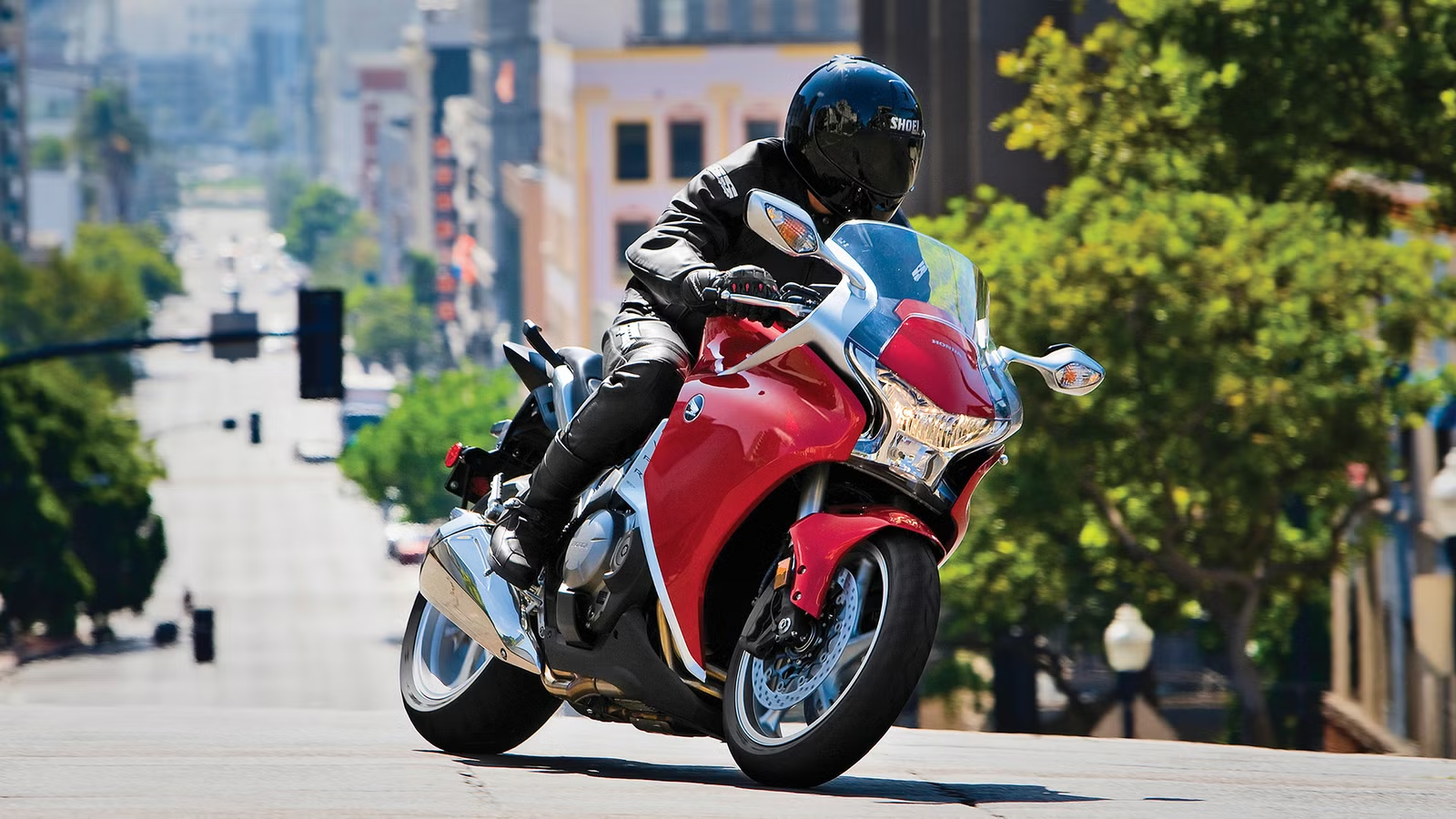
The VFR1200F was the flagship that pushed the sport-touring segment forward in 2010, and then simply vanished from Honda’s lineup by 2015, with remaining units being sold right up till 2016. Unveiled as a concept at Intermot in 2008, it landed in U.S. showrooms for the 2010 model year. As many believed, it wasn’t a refresh of the old VFR800; rather, it was Honda starting from a blank sheet.
Powered by a narrow-angle V4, a single-sided shaft drive, and eventually offering that DCT gearbox as an option, the base manual trim carried a $15,999 MSRP, with the DCT version priced at $17,499. Today, that flagship pricing has collapsed to about half. Pre-owned listings currently run from under $6,000 to almost $9,000 depending on the mileage and trim.
The V4 Masterpiece And A Future-Forward DCT

In the past, Honda had continually developed its V4 engines to be among the most powerful ones. For the VFR1200F, Honda re-engineered a plethora of components to get to its final form. The rear cylinders’ rod journals (or crankpins) sit paired between the front cylinders’ journals rather than beside them, narrowing the engine between the rider’s knees and canceling out the rocking vibration that plagues a conventional V4 layout. The SOHC heads borrow their compact architecture from the CRF450R motocrosser, and Honda paired all of it with a dual-clutch gearbox that took a couple of software revisions to actually deliver on its promise.
Built To Sound Like Nothing Else On The Road

The VFR1200F’s 76-degree V4 with 28-degree offset crankpins produced a flat, almost-360-degree crank exhaust note that was very distinct. Honda’s claimed output sat at 167 horsepower at the crank at 10,000 rpm and 95.1 lb-ft of torque at 8,750 rpm, with 90 percent of that torque already on tap by 4,000 rpm. That usability of low-down grunt coming in that early in the rev range was matched by no bike in the sport-touring class back then, and it still holds up against most of it today.
The DCT That Honda Kept Refining

At launch, the DCT had complaints from riders about the regular Drive mode’s eagerness to hit sixth gear almost as soon as the bike got rolling, killing low-speed throttle response. The Sport mode wasn’t any better either, as it held gears way too long, in a supposed wait to hit the rev limiter irrespective of the throttle position. Honda took notice and revised the control software in 2012. It also added traction control, a slight bump in low-rpm output, and shift logic that went by a rider’s throttle habits. By 2013, the gearbox held gears longer under aggressive riding and launched from a stop with noticeably more shove, even if the downshift action still clattered through the gears.
A Unique Shaft Drive And Aero Fairing That Still Look Good

Honda didn’t settle for a conventional shaft final drive either. The VFR1200F’s single-sided Pro-Arm swingarm carried an offset shaft with a sliding CV joint specifically engineered to cancel the jacking and lash that normally comes with a shaft drive. Honda also developed the Combined ABS, pioneered in the CBR600RR and CBR1000RR, working with six-piston calipers gripping dual 320mm front discs paired with a 276mm rear disc. The bodywork used Honda’s layer-concept fairing that channels air between two shells rather than one, cooling the engine and routing hot air around the rider’s legs while looking futuristic enough to hold its own even today.
The Modern Sport-Tourers The VFR1200F Would Have To Beat

A modern comeback for the VFR1200F today would need to beat two very different flagships that inherited this space. BMW has shadowed this segment since the VFR1200F launched against the K1300S in 2010. The K1600 GT and GTL now field a shaft-driven inline-six that competes as much with Honda’s own Gold Wing as with any sport-tourer, a flagship statement the way the V4 once was.

But for an all-round rival today, the R 1300 RT would be a worthy opponent. Powered by a 1,300cc boxer twin making 145 horsepower at 7,750 rpm and 110 lb-ft at 6,500 rpm, shaft-driven through a single-sided swingarm, it starts at $22,495. At 619.5 pounds wet, it sits within striking distance of the VFR1200F’s 614 pounds. And inflation-adjusted, the VFR1200F DCT would cost about $27,000 this year, with the transmission tech and convenience justifying the added cost over the RT.

The VFR’s true arch nemesis, however, could be found today in a Kawasaki. The Ninja H2 SX SE, with its supercharged 998cc inline-four, makes roughly 200 horsepower and 101 lb-ft of torque, backed by semi-active KECS suspension and radar-based adaptive cruise control, costs $29,999. It inherited the VFR1200F’s old job of embarrassing sport bikes while still carrying luggage, plus the exclusivity in modern engineering that Kawasaki is now the only one still willing to sell in America. A Honda V4 sport-tourer today would be just the kind of uniqueness that this segment enjoys, bringing flagship-grade motorcycling to enthusiasts. Though, if only Honda made it a reality.
Sources: Honda Powersports, Cycle Trader, KBB

Related posts


Latest Post


No Comments