
Slate Truck Gets A Different Battery And Different Range
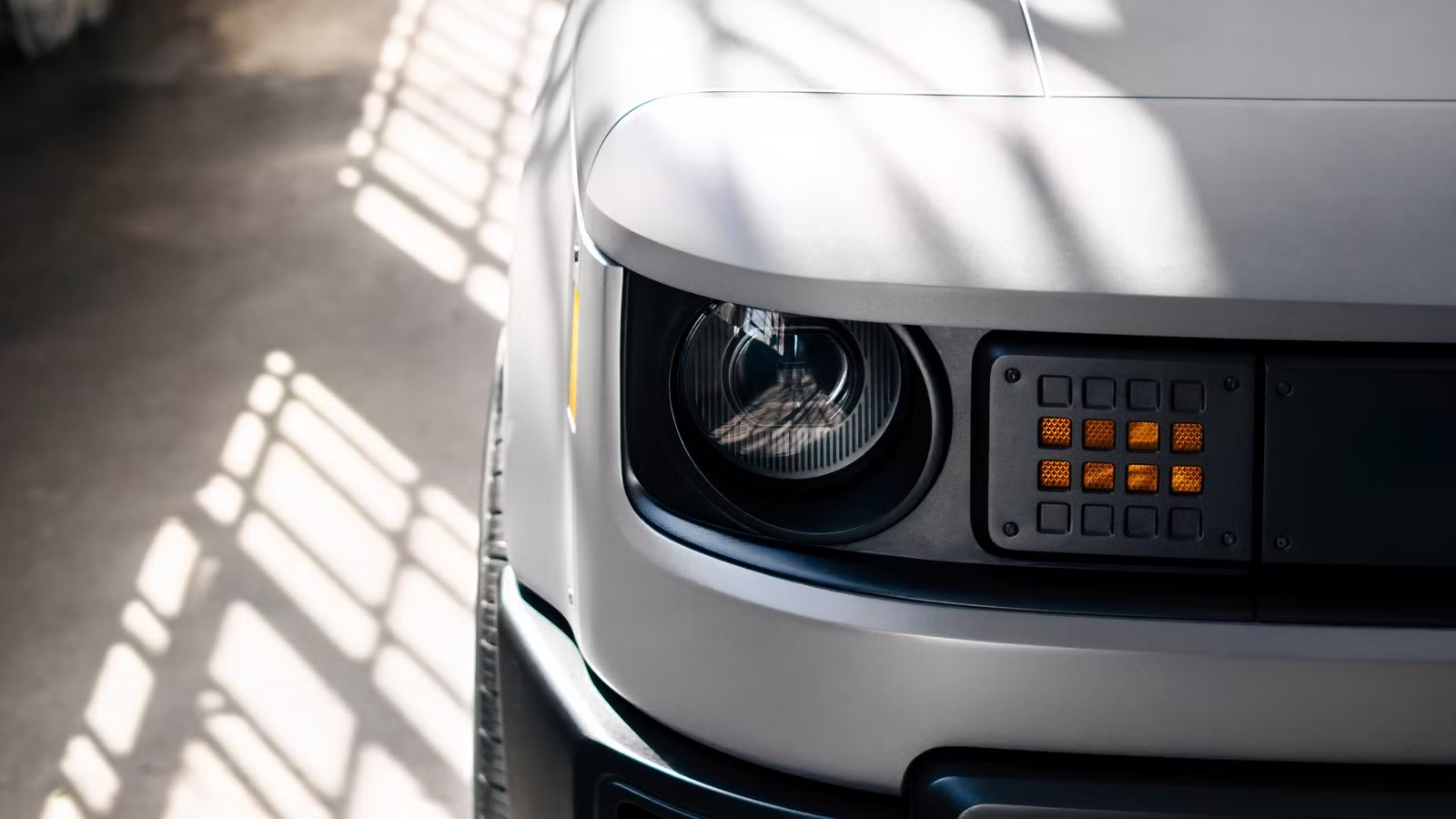
The Slate Auto Truck is nearly on sale, and one of the more significant detail has just been confirmed: the production version ships with a different battery chemistry than the prototype that generated all the early buzz. It’s not a scandal or a last-minute scramble — it’s a deliberate engineering and sourcing decision, and understanding it matters if you’re tracking what this truck actually delivers versus what was shown.
The Prototype Used NMC Chemistry — And There Was A Specific Reason For That

When Slate was developing its prototype, the federal EV tax credit was still on the table. Qualifying for that credit required batteries sourced from non-Chinese suppliers, which put LFP chemistry largely out of reach — the overwhelming majority of LFP production runs through Chinese manufacturers. To stay eligible, Slate spec’d the prototype with NMC cells sourced from South Korea.
Once the national EV tax credit was eliminated, that constraint disappeared. With no credit to chase, Slate was free to choose the chemistry that made more sense for a truck positioned on affordability and durability — and LFP won on both counts.
Why LFP Makes Sense For A Truck Built Around Value


The cost argument is straightforward. NMC batteries rely on nickel and cobalt, materials that are both expensive to extract and carry ethical sourcing complications tied to mining practices. LFP chemistry uses iron and phosphate instead — cheaper inputs, simpler supply chain, lower cell cost. For a truck whose entire identity is built around an accessible price point, that difference matters, especially without a tax credit to soften the blow at the register.
Slate’s LFP supplier is Gotion, a Chinese-owned company that has established a battery production plant in Illinois — positioned close to Slate’s own assembly facility in Indiana. That domestic manufacturing footprint helps with logistics and keeps the supply chain shorter, even if the parent company’s origins remain a talking point.
Beyond cost, LFP packs carry real-world advantages that align well with a work-truck buyer. They are significantly less prone to thermal runaway — the chain reaction that makes EV fires so difficult to extinguish — and they handle heat from daily driving more gracefully than NMC alternatives. They also hold up through thousands of charge cycles with minimal degradation, which matters for buyers planning to use this truck hard over many years.
The Trade-Off: Energy Density Closes The Door On A Longer-Range Option

LFP chemistry has one well-known weakness: energy density. A given LFP pack produces less energy per kilogram than an equivalent NMC setup, which means it has to be physically larger and heavier to hit the same capacity. That trade-off has a direct consequence for the Slate Truck. The 65-kWh LFP pack fills the entire battery space the Slate platform allocates. There is no room left for a larger, extended-range option. Buyers get one battery choice — 65 kWh, 205 miles — and that’s the ceiling. CarsDirect confirmed there will be no extended-range variant available.
For buyers who need more range, that’s a real limitation. For buyers who prioritize cost, repairability, and longevity over maximum miles, the trade-off is arguably worth it. Slate’s pitch has always been a stripped-down, configurable truck at a price that undercuts the mainstream EV market — and the LFP swap reinforces that positioning rather than undermining it.
The battery chemistry change isn’t a last-minute scramble — it’s a deliberate engineering and business decision that makes the Slate Truck more affordable, safer, and longer-lived, at the cost of range flexibility. Whether 205 miles is enough depends entirely on how you plan to use it.
Sources: Jalopnik, CarsDirect

Related posts




Latest Post


No Comments