
The Rigged 1964 Magazine Test That Built The Pontiac GTO Legend
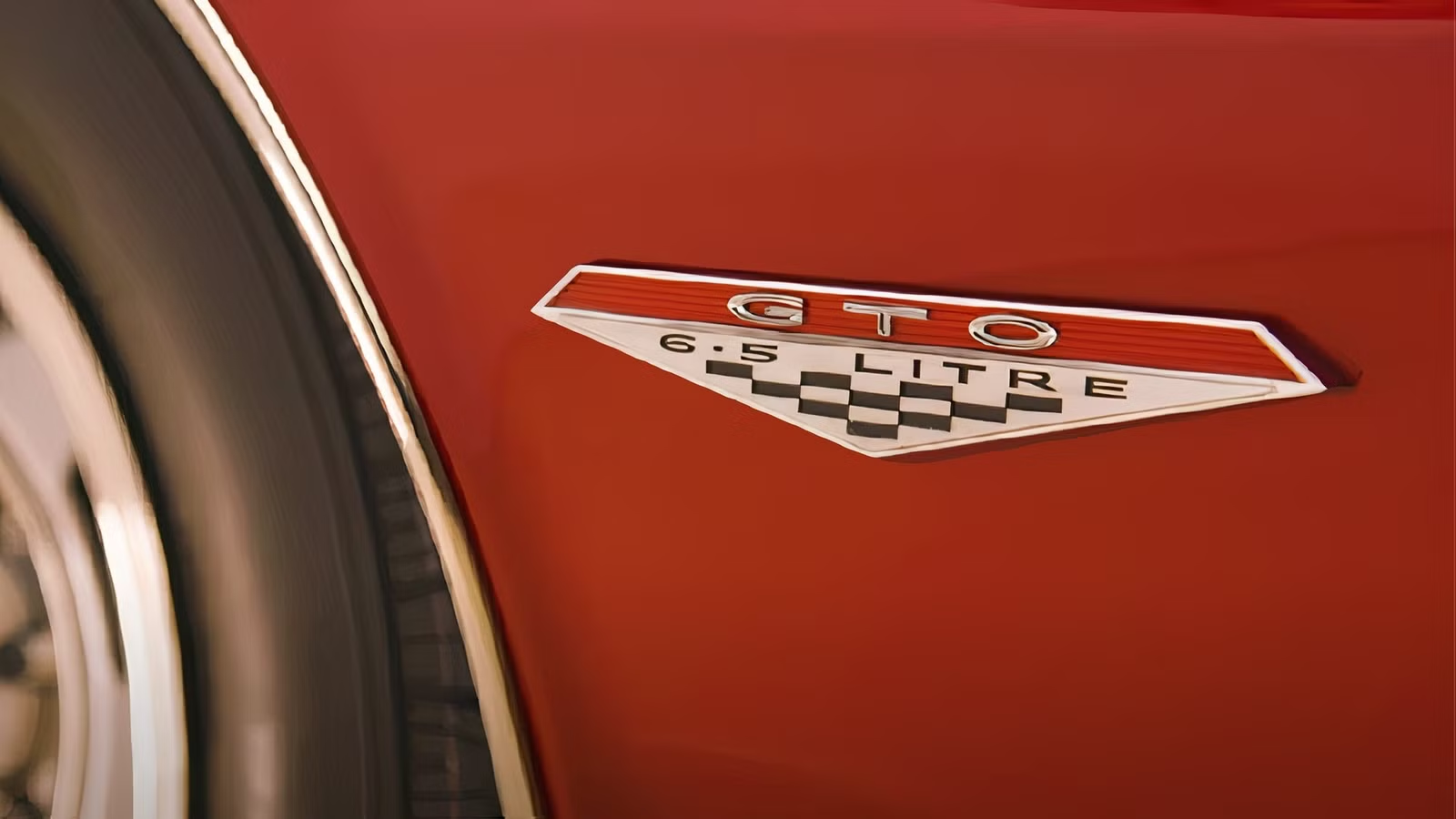
In March 1964, automotive enthusiasts all across America picked up the latest issue of Car and Driver and saw a painting of two cars ripping down a racetrack splashed across the front page. One was a sleek, low-slung, expensive European thoroughbred: the legendary Ferrari 250 GTO, and the other was straight out of America’s own backyard: a brick-nosed family coupe from Michigan, the brand-new Pontiac Tempest GTO.

The Myth of the Unbeatable Factory Muscle Car
To understand why the showdown between two such different types of automakers mattered, we have to turn the clock back to the 1960s; at that time, the American muscle car era was in its infancy and had an almost mythological feel. The popular narrative told the story of pure, unadulterated factory competition. We were led to believe that brilliant engineers at Detroit simply bolted a massive V8 into a lightweight mid-size coupe and shipped them directly to the local showrooms.

Reality was quite different, to say the least. You see, the early 1960s were a logistical nightmare for performance engineers. General Motors executives had placed a strict corporate ceiling on vehicles, limiting them to a maximum engine displacement of 400 cubic inches. Furthermore, there was an official corporate ban on factory-backed racing programs. As a result, the performance minds had to operate in the shadows.
That created a significant problem for Detroit’s marketing arms. They needed to generate enormous hype to capture the imagination of young buyers and sell them the products. But in reality, the cars rolling off standard production lines were often held back by assembly-line tolerances, conservative ignition timing, and strict emissions and noise guidelines. To bridge the gap between corporate reality and marketing fantasy, a maverick was needed to step in, steady the ship, and manually alter the established narrative.
The Michigan Dealership That Became Pontiac’s Secret Weapon

That maverick was Jim Wangers; he wasn’t an engineer, but a brilliant ad executive for Pontiac’s agency, MacManus, John & Adams. He understood better than anyone that in the 1960s, automotive enthusiast magazines were the ultimate ticket to a car’s commercial success. A glowing review in a major publication could instantly generate excitement around the product, translating into thousands of showroom orders; a mediocre track test, on the other hand, could kill a new car before it had its time in the spotlight.
To guarantee that the automotive press received cars that performed like high-powered race-bred machines, Wangers established a highly classified, de facto partnership with Royal Pontiac in Royal Oak, Michigan. Owned by Ace Wilson Jr., Royal Pontiac was far more than the standard retail dealership at the time. It was the unofficial back-alley performance arm of Pontiac.
Operating with the silent blessing of high-ranking Pontiac executives like Bunkie Knudsen and John DeLorean, Wangers worked closely with the dealership to create the legendary “Royal Bobcat” program, a name coined by combining letters from the premium Bonneville and Catalina badges. Whenever a major magazine requested a Pontiac for a performance evaluation, the vehicle didn’t arrive from the factory pool. Instead, it was secretly diverted to Royal Pontiac, where it received performance treatment before even a single journalist turned the key.
Pontiac vs. Ferrari: The Infamous 1964 Showdown

The culmination of this coordinated PR deception took place in early 1964, when Car and Driver editor David E. Davis Jr. pitched the ultimate test between the Ferrari 250 GTO and the new Pontiac GTO. Wangers saw an unprecedented marketing opportunity, but he also faced a significant performance and logistical hurdle. The standard production GTO was equipped with a 389-cubic-inch V8. While it was respectable for street driving, the factory spec simply could not compete on power compared to the headline-grabbing machines featured in Car and Driver magazine.
Wangers refused to leave such an important opportunity to chance. So, the team at Royal Pontiac pulled out the standard 389 engine from the red press car and dropped in a heavy-duty 421-cubic-inch V8, an engine designed to power full-size luxury cruisers and stock racing cars. In doing so, he completely violated GM’s corporate displacement limits for intermediate cars. To ensure the deception was absolute, the 421 block was carefully detailed and painted to look exactly like the standard production 389 engine.
What happened next was nothing short of extraordinary: when Car and Driver took the “ringer” GTO to the track, the results were stunning. The car did 0 to 60 mph in 4.6 seconds and the quarter-mile in 13.1 seconds at 115 mph. This was a shock to the automotive world. The article sparked a nationwide frenzy, resulting in the muscle car boom of the 1960s. The public devoured the story. The secret of the 421 ringer engine swap was guarded so well that an ironclad silence held for over three decades, until Jim Wangers himself finally confessed it in his 1998 memoir, Glory Days.
Under the Hood of the Royal Bobcat

For enthusiasts who wanted a taste of the ringer GTO, Royal Pontiac offered the official “Royal Bobcat” package. The kit could be ordered directly on a brand-new GTO or purchased as an aftermarket pack on existing cars. There was one small caveat: instead of wild, undrivable race parts, the Bobcat kit was built with mechanical precision.
The Bobcat recipe was simple yet devastatingly effective: the team swapped the stock gaskets for specialized, thinner ones—roughly 0.022 to 0.025 inches thinner—which instantly raised compression. The team blocked the intake heat manifold risers to keep the incoming air-fuel charge significantly cooler and denser. They progressively re-jetted the triple two-barrel carburetor setup to ensure maximum fuel delivery without bogging.
Specs Of The 428 Royal Bobcat
|
Engine |
Transmission |
Power |
Torque |
0 to 60 |
Top Speed |
|---|---|---|---|---|---|
|
7.0-Liter Naturally Aspirated V8 |
3-Speed Automatic |
425-HP @5,700 RPM |
480 LB-FT |
5.2 Seconds |
130 MPH Estimated |
The program proved to be an absolute commercial goldmine, with Royal Pontiac moving over 1,000 Bobcat conversion kits in 1966 alone. By 1968, corporate restrictions grew even tighter. After they began offering comprehensive 429-cubic-inch engine-swap programs for the intermediate GTOs, for an exchange price of just $650, a buyer could drop off a stock GTO and drive away with a performance monster that could embarrass any car on the street.
The Most Influential Muscle Car Legend Was Built On A Beautiful Lie

The 1964 Car and Driver test was a historic moment that kick-started a whole new chapter in American auto history. It also shows that the muscle car era didn’t start exclusively at factory assembly lines, but through a team of strong-willed rebels who went against the suits to make it happen.
The historical deception has not diminished the value of these legendary machines. In fact, it has done the exact opposite. Fully documented Royal Bobcat Pontiac GTOs surviving today are more coveted in the classic market than their standard factory counterparts.
Ultimately, Jim Wangers and Royal Pontiac didn’t just tune engines; they created a cultural phenomenon. They understood that a muscle car needed to be fast not just under the hood but also in the eyes of the American public. By altering the engine for the magazine test, they helped forge the most iconic era in American automotive history on the back of the Pontiac GTO.
Source: Hagerty, Mecum, Car & Driver, Old Cars Weekly.

Related posts






Latest Post


No Comments