
Chevy’s Cheapest 1966 Compact Ran Low 15s With A Corvette V8
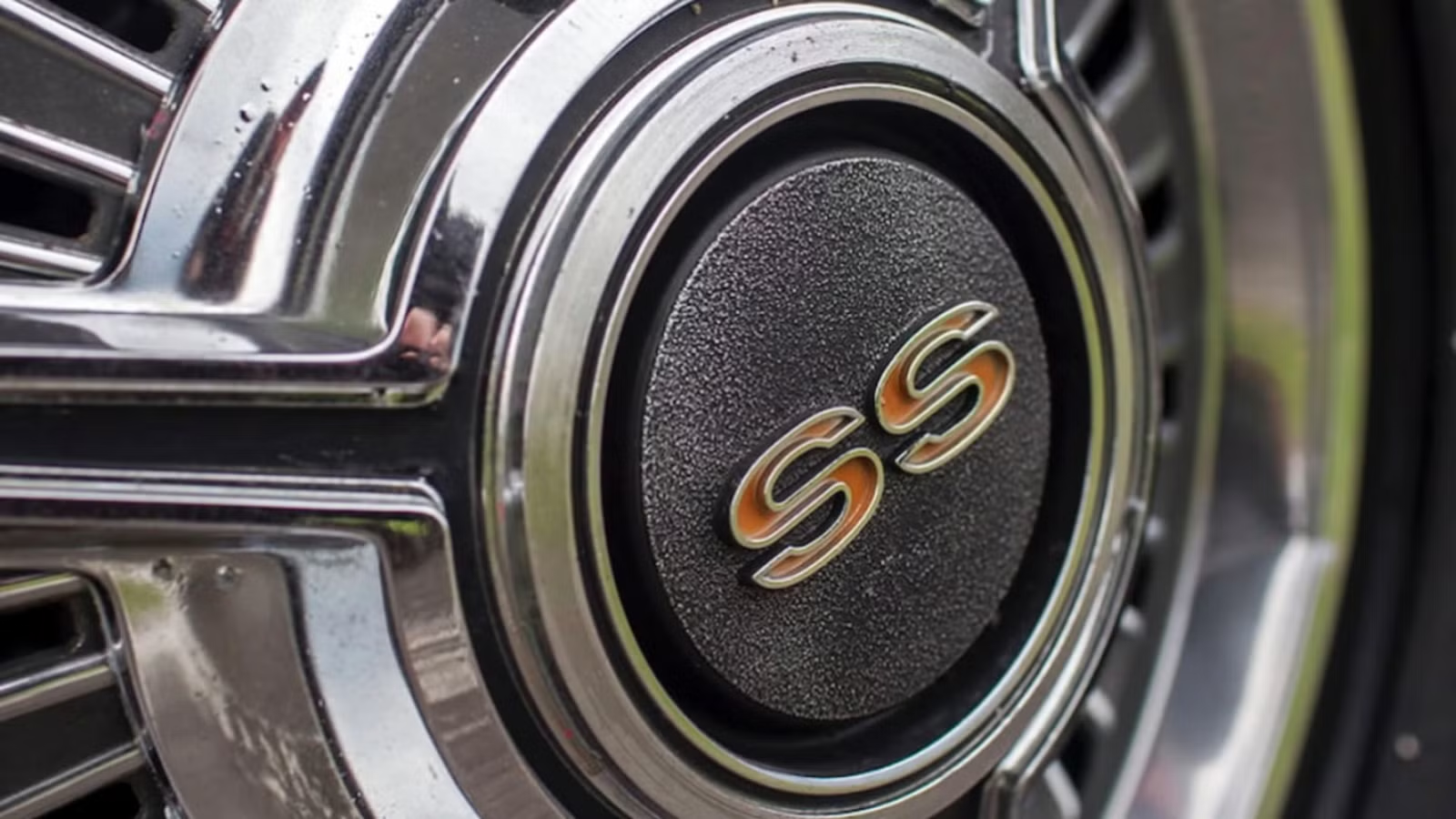
Back in the good old days, you didn’t have to spend Chevrolet Corvette money to gain Corvette power. But of course, that’s why the mid-to-late 1960s are considered the golden era of muscle cars. Seriously, there was an affordable compact Chevy car that could run a quarter-mile in the low 15s because it hid a V8 Corvette engine under the hood.

In fact, you could say this economic powerhouse started an incredible trend of dropping massive V8 power into lightweight, affordable bodies. This led to the rise of a few incredible sleeper options that punched well above their weight. Some models even defeated legendary monsters for a fraction of the cost.
Decades later, these muscle cars remain affordable compared to the most popular monikers available, like the Chevelle SS. However, these plain Jane cars can still leave these beasts in the dust. It might be a good time to jump on one of these rare, beefy models because their secret gets out and prices increase.
Chevy Wanted To Fight The Pontiac GTO

In 1966, the Pontiac GTO was all the rage with its ability to go against HEMI-powered beasts and dominate the drag strip. The available 389 cubic-inch 6.7-liter V8 engine Tri-Power configuration delivers 360 hp and 430 lb-ft of torque. This car accelerates from 0 to 60 mph in about 6.5 seconds and covers a quarter-mile in about 14.65 seconds with a top speed of 125 mph. Chevy wanted a piece of the attractive Coke-body style action, and it developed a sleeper model, but the brand decided to go in a different direction than the flashy GTO. It also didn’t want to take away from the 1966 Corvette, which had a similar price to the GTO Tri-Power. The original MSRP for the Corvette 427 was $4,295 while the GTO Tri-Power rang in at $3,600.
So, Chevy decided to put a more affordable option on the playing field, which ended up escalating the muscle car wars. It started the trend of putting potent V8 engines in lightweight bodies. It’s attributed to shifting the straight-line speed philosophy to “big blocks in little cars” to out race hefty high-performance models.
The 1966 Chevy Nova L79 Is The Ultimate Sleeper

Don’t judge the 1966 Chevy Nova L79 SS by its looks. Sure, it looks modest and a bit plain with a clean, boxy style. However, it stuffed a 327 cubic-inch (5.4-liter) L79 V8 engine with 350 hp and 360 lb-ft of torque under the hood. This car accelerates from 0 to 60 mph in about 5.7 seconds and covers a quarter mile in around 15.1 seconds. Also, it had an original MSRP of about $2,600. It’s important to note that the engine wasn’t available in the basic Chevy II 100 trim, but it was available with the Nova SS trim. The packages added “Super Sport” script on the quarter panels, “Chevy II SS” badging, wide rocker panel moldings, an aluminum deck lid, distinct wheel covers, vinyl Strato-bucket seats, and a center console.

Meanwhile, the Chevelle SS model turned the flair up to 11 to attract younger buyers and thrill seekers. It features a heavy-duty suspension, SS badging, a blacked-out grille, blacked-out hood, color-keyed lower body striping, and simulated hood scoops. The interior includes a manual floor shift, center console, a distinct SS instrument panel, and Super Sport script on the steering wheel and doors.
Even though this wasn’t a completely stripped-down model, it still had lightweight advantages. This car weighs in at 2,700 lbs, which is about 900 pounds less than the Chevelle that rings in at 3,400 lbs. Plus, the 327 engine that was designed for the Corvette has an 11.0:1 camshaft and Chevrolet’s first high-performance hydraulic camshaft.
The Nova L79 Became A Giant Killer

While the 1966 Chevy Nova SS L79 arrived from the factory ready to race in stock form, it was easy to modify. The engine has double hump cylinder heads, forged pistons, and a high-rise aluminum intake, meaning it was built to withstand high-performance stress and easily handle basic modifications. Its exceptional power-to-weight ratio could be combined with more aggressive 4.56 or 4.88 gear ratios, stiffer suspension components, a solid-lifter or roller camshaft, tube headers to bypass restrictive cast-iron manifolds, and larger carburetors to squeeze out as much power as possible. As a result, the Nova L79 could be pushed into deep 12-second quarter-mile times with basic shop components.
Racing legend Bill “Grumpy” Jenkins completed a few of these modifications to fight the 426 Street HEMI in NHRA Stock Class. He set the historic A/Stock class record of 11.66 seconds while embarrassing factory big-blocks. He figured out how to perfectly tune his small-block Nova to routinely defeat 426 HEMI-powered rivals. Bill Jenkins gained Chevrolet sponsorship in 1967 and managed to win 13 NHRA national Pro Stock events during his racing career.
|
Car |
Engine |
HP |
Torque |
0-60 MPH |
|
1969 Chevy Nova SS L79 |
327 ci (5.4-liter) L97 V8 |
350 |
360 LB-FT |
5.7 seconds |
|
1966 Dodge Charger HEMI 426 |
426 ci (7.0-liter) HEMI V8 |
425 |
490 LB-FT |
5.6 seconds |
For comparison’s sake, the most popular 426 HEMI-powered car in 1966 was the Dodge Charger. It churns out 425 hp and 490 lb-ft of torque. It weighs between 4,034 and 4,160 lbs. This car accelerates from 0 to 60 mph in about 5.6 seconds and completes a quarter mile in around 13.9 seconds with a top speed of 150 mph.
Now The Chevy Nova L79 Is Extremely Rare

Despite being a rare find with true historic value and racing heritage, the 1966 Chevy Nova L79 can be scooped up at affordable prices. It still lives on as a sleeper model with a modest style despite having the ability to crush the 426 HEMI. Automotive historians estimate that between 3,546 and 6,791 models were made, and it’s unclear how many surviving examples exist today.
Value for models in driving-quality condition can be found between $45,000 and $75,000. But models in pristine condition that have been fully restored with matching numbers fetch between $90,000 and $130,000. Meanwhile, 1966 Chevelle SS models are worth between $23,000 and over $150,000 depending on condition and quality.
On the other end of the spectrum, the 1996 Dodge Charger 426 HEMI is worth about $80,000 to over $170,000, while some pristine examples go for over $181,500. But I will take this comparison with a grain of salt, as these muscle cars are much harder to find. Also, each of these muscle cars has something in common. They were often raced hard, beyond their limits, or wrecked, which is why surviving examples are extremely rare.
Source: How Stuff Works, Automobile Catalog, Hagerty

Related posts


Latest Post


No Comments