
The 170-MPH Shelby Mustang Killed By A Price Tag Higher Than A Ferrari
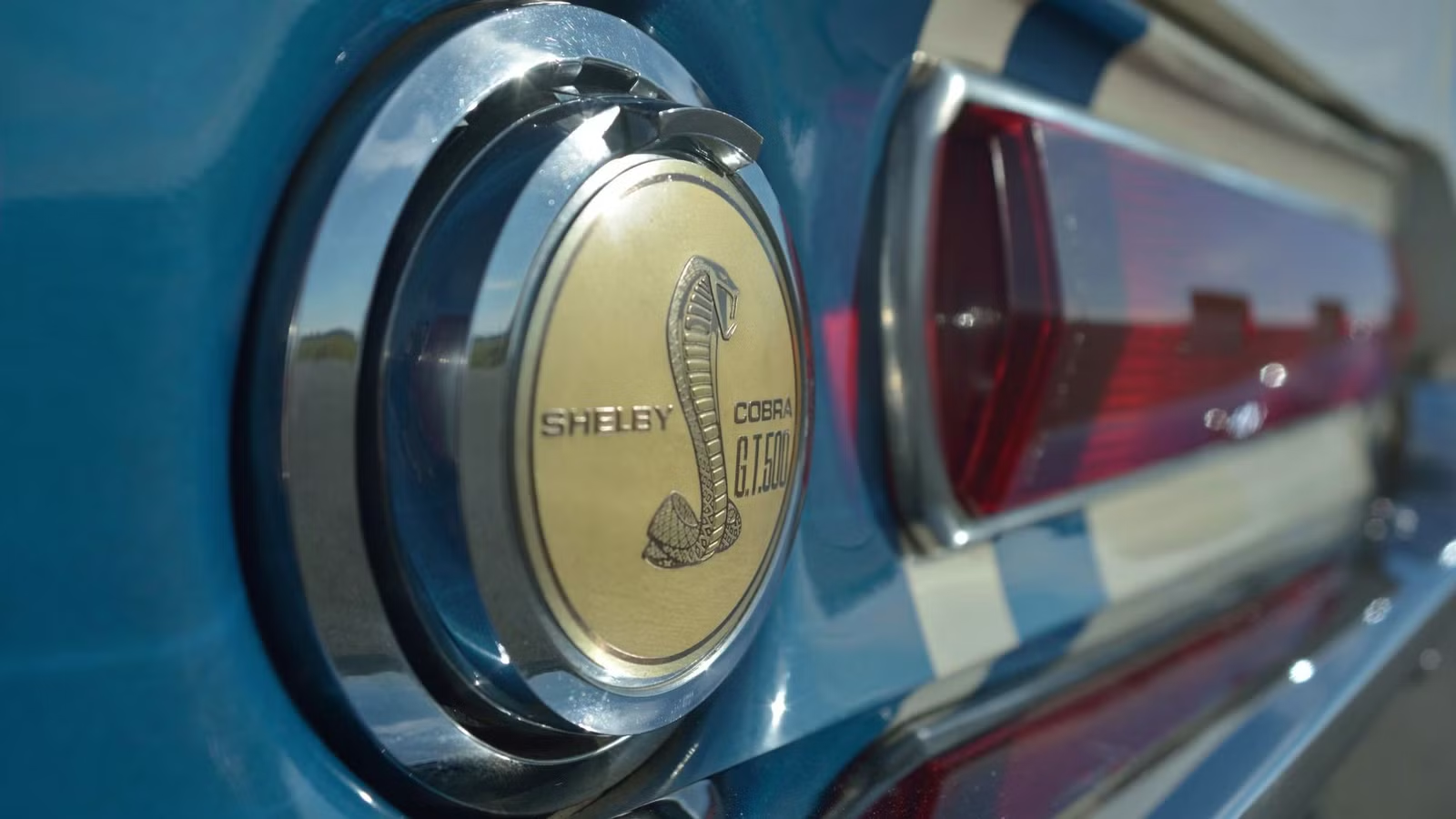
In the spring of 1967, an absolute monster rolled out of Carroll Shelby’s Los Angeles hangar. Armed with a race-bred heart that had just conquered the Mulsanne Straight, tested at sustained triple-digit speeds, and envisioned as the ultimate road-going muscle car, this lethal Ford Mustang variant had everything enthusiasts could want in a muscle car, especially during the escalating horsepower wars in Detroit at the time. The numbers proved it worked, and the people behind it believed it deserved a limited production run.

Unfortunately, the ultimate American performance machine became an immediate casualty of cold, hard math, with its projected sticker price pushing it into territory normally reserved for Ferraris. It out-engineered everything on the road, only to price itself completely out of existence before the public ever got a taste. Decades later, it remains one of the greatest what-might-have-beens of the Muscle Cars golden era.
Carroll Shelby Wanted To Bring Le Mans Engineering To America’s Streets
Carroll Shelby’s name carries almost mythical status in Ford history, but his reputation wasn’t built in Dearborn. Before partnering with Ford, Shelby had already won the 1959 24 Hours of Le Mans behind the wheel of an Aston Martin and later founded Shelby American, where his lightweight Cobra sports cars became giant killers against Europe’s best. His defining moment came in 1965 when Ford handed his team the struggling GT40 program.

Shelby and his team worked relentlessly to improve the GT40 Mk II’s suspension, airflow, brake cooling, reliability, and overall endurance, while legendary racer Ken Miles refined the car through countless test miles. The result was Ford’s historic 1-2-3 sweep over Ferrari at Le Mans in 1966, a victory that forever changed motorsport history. Having proven he could turn race cars into winners, Ford saw Shelby as the ideal person to apply those same engineering lessons to the company’s growing lineup of performance-oriented street cars.
The Mustang Gave Shelby The Ultimate Performance Canvas

Ford had watched Carroll Shelby turn the GT40 into a Le Mans champion, so the next challenge was obvious: do the same for its hottest new production car, the Mustang. Introduced in mid-1964, the Mustang had become an overnight sensation with well over 400,000 examples sold in its first year, but its popularity came with an unwanted reputation as a stylish “secretary’s car” rather than a serious performance machine. Ford Division boss Lee Iacocca was determined to shake that image, so he recruited Shelby to build a Mustang that could take the fight to the Corvette in SCCA competition.
The result was the stripped-down, track-only GT350R, along with enough road-legal GT350 models to satisfy homologation rules. Both proved hugely successful on the track and in the showroom. Then, in 1967, the redesigned Mustang finally gave Shelby room for his first big-block creation, the GT500. Powered by a 428-cubic-inch Police Interceptor V8 topped with dual four-barrel carburetors, the GT500 proved that a civilized highway cruiser could still pack enough explosive V8 punch to terrify anyone standing at the drag strip.
The Goodyear Tire Test That Accidentally Created A Muscle Car Legend

By the time the GT500 debuted in 1967, Carroll Shelby wore more than one hat. Besides building some of Ford’s fastest machines, he also served as Goodyear’s West Coast tire distributor. That relationship led Goodyear to ask Shelby to put its new Thunderbolt economy tires through a high-speed durability test, and the freshly launched GT500 seemed like the ideal platform thanks to its popularity and big-block muscle.
Shelby’s sales manager, Don McCain, had a far bolder idea. Instead of using the GT500’s stock 428 Police Interceptor V8, he proposed installing the 427 FE that had powered Ford’s GT40 Mk II to victory at Le Mans. The logic was simple. If Goodyear’s skinniest, least expensive tires could survive 500 miles at full throttle under a 520-plus-horsepower race engine, it would be the ultimate proof of their durability. What began as a tire promotion quickly evolved into the wildest Mustang Shelby had ever created.
1967 Shelby GT500 Super Snake: The 170-MPH Mustang That Priced Itself Out Of Production

That mystery muscle car was christened the 1967 Shelby GT500 Super Snake, with the “Super Snake” suffix signaling that this was anything but an ordinary GT500. Visually, it stood apart with unique triple Le Mans stripes, a redesigned grille for improved airflow, special inboard headlight surrounds, and lightweight Shelby 10-spoke wheels wrapped in the Goodyear Thunderbolt tires it was built to test.
Beneath the skin, it received numerous race-inspired upgrades, including a race-bred V8 pulled straight out of the iconic GT40, a strengthened drivetrain, improved cooling, heavy-duty brakes, and suspension tweaks that prepared it for one purpose: surviving an all-out endurance run. The Super Snake more than delivered. At Goodyear’s proving grounds in San Angelo, Texas, Carroll Shelby first pushed the car to 170 mph before handing it to chief engineer Fred Goodell, who averaged an astonishing 142 mph over a continuous 500-mile test, proving both the car and Goodyear’s new Thunderbolt tires beyond doubt.
Its Heart Came Straight From Ford’s Le Mans Program

|
Engine |
Output |
Induction |
Transmission |
Drivetrain |
Top Speed |
|
GT40 Mk II-derived 427-cu-in (7.0L) FE Side-Oiler V8 |
Approximately 520–650 hp (varies by source) |
Dual four-barrel Holley carburetors |
Heavy-duty Ford Toploader 4-speed manual |
RWD |
170 mph |
The GT500 Super Snake’s main party trick sat beneath its fiberglass hood. Instead of the GT500’s 428 Police Interceptor V8, Shelby installed a 427 cubic-inch FE Side-Oiler sourced from Ford’s GT40 Mk II program. Widely regarded as the ultimate evolution of Ford’s legendary FE engine family, the Side-Oiler earned its name from an oil gallery that prioritized lubrication to the crankshaft and main bearings before feeding the valvetrain. The design ensured a steady oil supply during sustained high-rpm driving, making it ideal for endurance racing. Combined with aluminum heads, a forged steel crankshaft, Le Mans-spec connecting rods, and lightweight accessories, it was engineered to spend hours at roughly 6,000 rpm. Output is generally estimated at 520 to 650 horsepower, which was an extraordinary figure for a street-based Mustang in 1967.
The engine wasn’t the only upgrade. Shelby paired it with a heavy-duty Toploader four-speed transmission, a stronger rear axle with a Detroit Locker differential, an external oil cooler, and revised suspension featuring stiffer passenger-side springs and shocks. These upgrades ensured the Super Snake could harness its race-bred engine while surviving Goodyear’s grueling 500-mile endurance test at sustained high speed.
The Super Snake Proved That Engineering Doesn’t Always Beat Economics

By 1967 standards, the Super Snake bordered on the unbelievable. While Detroit’s hottest muscle cars were fighting for quarter-mile bragging rights, Shelby had built a Mustang capable of 170 mph, making it one of the fastest production-based cars on the planet. For context, the fastest production car in the world at the time was the newly released Lamborghini Miura P400, whose 171-mph top speed was so fast that it’s widely regarded as the world’s first supercar. Following the successful San Angelo tire test, Shelby and sales manager Don McCain proposed building 50 customer cars to give enthusiasts the chance to buy what was essentially a Le Mans-inspired Mustang.
Reality, however, proved less forgiving than the proving grounds. The GT40-derived 427 FE carried an upcharge of roughly $1,825 on its own, and once the specialized hardware was factored in, the Super Snake’s projected MSRP ballooned to $7,995. That was roughly twice the cost of a standard GT500, more than a 427 Cobra, and even exceeded the asking price of a Ferrari 275 GTS/4 NART Spyder. For a car still wearing a Mustang badge, the numbers simply didn’t add up. Shelby quietly shelved the project before a single production example could be built.
The Lone Prototype Lived A Far More Interesting Life Than Shelby Ever Expected

The Super Snake may have missed production, but it never disappeared. After the proposed customer program collapsed, the one-off Mustang was sold for $5,000 to two Braniff International Airways pilots in Dallas, who modified it with shorter 4.10 gears and enjoyed it as the brutally quick machine Shelby intended. Over the next three decades, it changed hands several times before Mustang collector Richard Ellis acquired it and oversaw a careful restoration that returned the car to its original Goodyear test configuration, even sourcing a rare set of Thunderbolt tires.
As collectors began to appreciate its unique place in Shelby history, its value skyrocketed. The one-of-one Mustang brought $1.3 million at Mecum’s Indianapolis auction in 2013, then eclipsed that figure with a $2.2 million sale at Kissimmee in 2019, making it one of the most expensive muscle cars ever to cross an auction block. After the auction, it spent time on display at the Shelby Heritage Center in Las Vegas, but there have been no confirmed public sales, auction appearances, or ownership changes since then.
Decades Later, Shelby American Revived A Lost Legend

For half a century, the Super Snake remained one of Carroll Shelby’s greatest “what ifs.” That changed in 2018 when Shelby American launched a 10-car continuation series, completing the production run that never happened in 1967. While Shelby American has been building modern Mustang-based Super Snakes since the mid-2000s, this was something entirely different. Rather than modifying a contemporary Mustang, the continuation cars were designed to replicate what a production 1967 Super Snake would have looked and felt like.
Instead of using new Mustangs, Shelby sourced original 1967 fastbacks, preserving their factory VINs and titles while rebuilding them into faithful interpretations of the proposed production Super Snake. Under the hood sat a period-correct, carbureted 427-cubic-inch (7.0-liter) big-block V8 producing more than 550 horsepower, paired with a four-speed manual and finished with details faithful to the one-off original. Built exclusively for serious collectors, prices started at an eye-watering $249,995 before the donor car. While some might have scoffed at such a sticker price, their desirability was underscored in May 2022, when continuation car #3 sold for a whopping $662,000 at the Northwest Collector Car Auction in Pasco, Washington.
Sources: Hemmings, Agora Models, Mecum Auctions, Old Cars Weekly, Motor Trend, Trucks & Auto Auctions

Related posts





Latest Post


No Comments