
America’s V8 Era Is Down To Just These Automakers
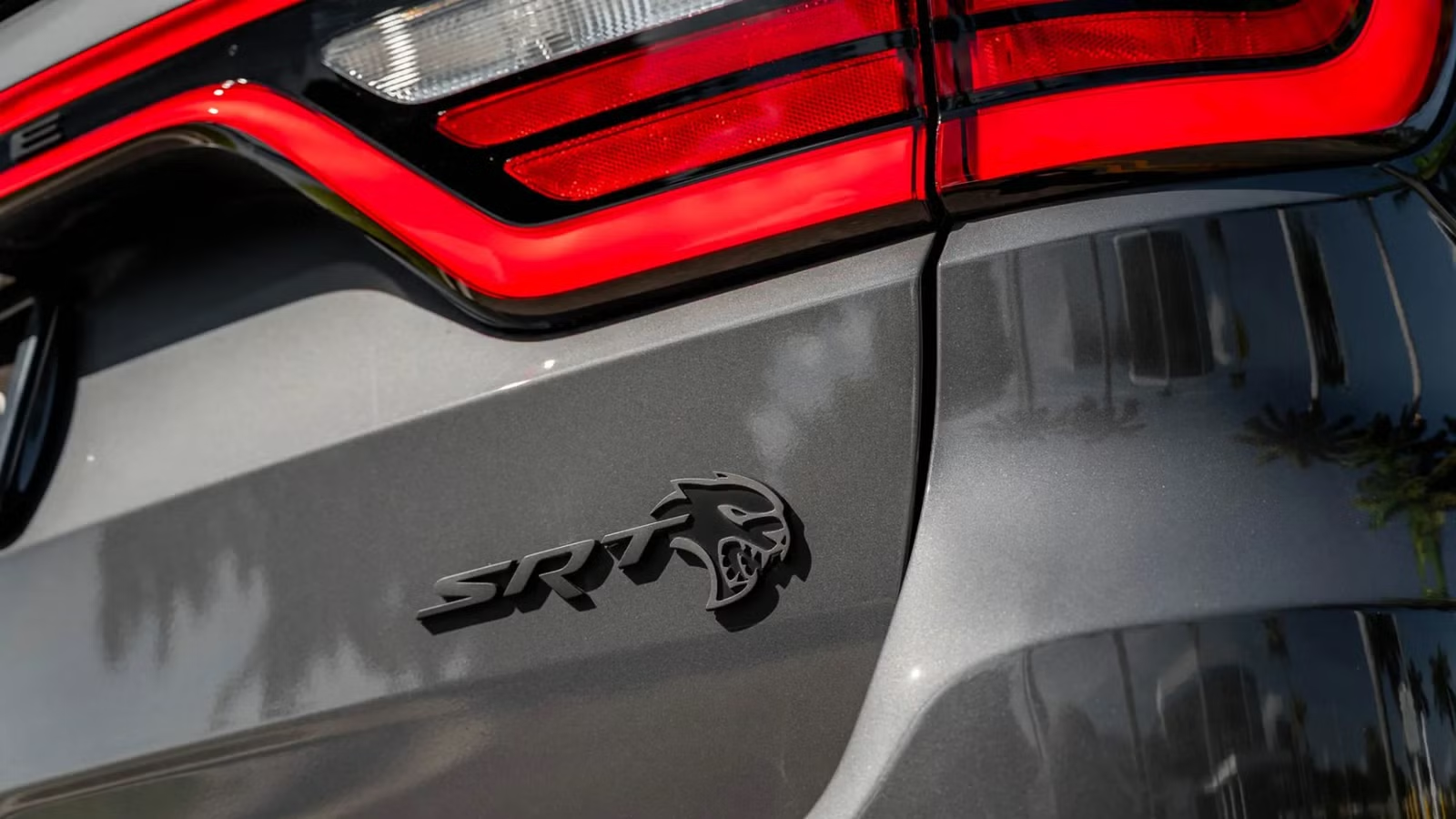
The year is 2026, and the V8 market looks smaller than ever. The legendary engine faded model by model, year by year, trim by trim. A pony car left the stage, two old-school muscle icons went quiet, and a big rear-drive sedan bowed out – and that’s just the most recent history. Even some full-size trucks and SUVs have started trading eight cylinders for turbos, hybrids, and quieter ways to make power.

That makes the survivors today feel more important. The V8 is no longer the default American answer to speed, towing, or swagger – it has become a choice with a smaller guest list. Some automakers still protect it in trucks, SUVs, sports cars, and luxury machines. Others have already moved on. So, who is still keeping America’s V8 flame alive?
The V8 Went From Default Choice To Endangered Option
For decades, a V8 did not feel exotic in America. It felt normal, powering family sedans, coupes, luxury barges, police cars, tow rigs, farm trucks, work vans, SUVs, and muscle cars that made every tunnel feel like a public-service announcement. The V8 sat at the center of a simple promise – more cylinders, more torque, more attitude. As simple as that.

That promise shaped the way enthusiasts judged vehicles. A V8 gave the vehicle a pulse, made each cold start feel like an event, and turned a plain commute into a little theater. Even when the car itself looked as exciting as a rental-office chair, the engine could still make it feel special.
Then the market changed. Automakers started replacing V8s with turbocharged four-cylinders, turbocharged six-cylinders, hybrids, plug-in hybrids, and EVs. The new stuff can be quick, sure – sometimes it humiliates old V8s before the V8 even clears its throat. A modern turbo six can tow hard, launch fast, and save fuel while doing it. But the issue is not weakness – the issue is character. The classic American formula had noise, displacement, and a little mechanical drama — the new formula has torque curves, battery assist, and fewer excuses to visit the gas station. The new formula has torque curves, battery assist, and fewer excuses to visit the gas station.
The Disappearances Made The Survivors More Important

In recent years, many of the best V8-powered models simply disappeared. The old Dodge Charger and Challenger era ended after 2023 production, taking with it one of the loudest chapters in modern muscle. Those cars yelled across the parking lot while wearing bright colors and acting innocent.
The Chevrolet Camaro also left a hole. The sixth-generation car ended after the 2024 model year, and for track-day people, that one stung. The Camaro had become a sharper weapon than casual observers gave it credit for. It was not just a cars-and-coffee prop, because it could dance. Then the Chrysler 300C bowed out, too, giving one last 6.4-liter HEMI salute before the big sedan left production.
The loss did not stop with muscle cars. The Nissan Titan’s production, for example, ended after the 2024 model year, removing another V8-powered full-size truck from the U.S. market. That narrowed the field again. Now the survivors carry more weight – some are pickups, some are SUVs, some are sports cars, and some cost enough to make a bank app ask, “Are you sure?” The V8 still exists, but the list has become smaller, louder, and far more interesting.
Ford, GM, And Stellantis Still Carry America’s V8 Core

The answer in 2026 starts with Ford. The 2026 Mustang GT still offers the 5.0-liter Coyote V8, and that matters more than a horsepower number on a brochure. The Mustang has become the last traditional American pony car with a V8 and a direct line to the old world. Ford also keeps the 5.0-liter V8 alive in the 2026 F-150, where it makes 400 horsepower and 410 lb-ft of torque in the official lineup. That gives Ford a rare two-front V8 presence — one foot in Friday-night pony-car culture, the other in full-size pickup country.
General Motors has the widest V8 footprint, though. Chevrolet still lists V8 power in the Silverado, including 5.3-liter and 6.2-liter EcoTec3 choices. GMC keeps V8 power in the Sierra, with the 5.3-liter V8 standard on some upper trims and the 6.2-liter V8 still part of the broader lineup. These trucks sell in numbers that sports cars can only dream about.

GM also keeps V8 energy alive at the emotional end of the showroom. The Corvette remains a V8 machine, from naturally aspirated screamers to twin-turbo madness. Cadillac still sells the CT5-V Blackwing with a 6.2-liter supercharged V8 and a six-speed manual, which feels almost suspiciously generous in 2026. The Escalade still uses a 6.2-liter V8, and the Escalade-V turns that idea into a supercharged family-room missile with 682 horsepower. GM can cover a work site, a country club, a racetrack, and a valet stand without leaving the V8 family.
Then comes Stellantis, and its V8 story has more plot twists than a cheap detective novel. Dodge muscle cars moved away from the old Hemi formula, with the new gas Charger using the twin-turbo 3.0-liter SIXPACK straight-six instead of a V8, though an eight-cylinder variant is expected to return soon. Yet the V8 did not vanish from the company’s American brands — Ram brought back the 5.7-liter Hemi V8 for the 2026 Ram 1500, while Dodge offers several Hemi V8 versions in the 2026 Durango, including 5.7-liter, 6.4-liter, and supercharged 6.2-liter forms. Jeep also keeps the flame lit with V8-powered Wrangler 392 editions. The Hemi left some places, then kicked down the side door in others.
The V8 Isn’t Dead, But It Has Moved Upmarket

Detroit still carries the mainstream American V8 core, but the wider market tells a different story. The V8 now lives where price, emotion, and brand image can pay the bills. It has moved away from “normal engine choice” and toward “special engine choice.” That shift changes the meaning of the badge – a V8 no longer says a buyer simply checked the stronger box, it says the buyer meant it.
Lexus proves the point with the LC 500. Its naturally aspirated 5.0-liter V8 feels almost rebellious now, even though 2026 will be its final year on the market. No turbos, no fake drama, just revs, sound, and that odd joy that happens when engineers leave a little soul in the machine. BMW also keeps V8s in high-end M and M Performance models, including the X7 M60i and the M5 family. Mercedes-Benz still sells V8-powered luxury SUVs like the GLS 580, which uses a 4.0-liter biturbo V8 with mild-hybrid help. Land Rover offers strong V8 Defender variants, including the Defender 90 V8 and the 626-hp Defender OCTA. These are obviously not bargain engines.

The ultra-premium side makes the shift even clearer. Porsche still uses V8s in Cayenne performance models. Audi keeps the 4.0-liter twin-turbo V8 alive in the RS 6 Avant Performance, a wagon that tells minivans to go stretch before practice. Bentley moved the Continental GT into a V8 hybrid era. Lamborghini’s Temerario uses a twin-turbo V8 with three electric motors. Ferrari still uses V8 hybrid power in select performance models. Aston Martin builds the Vantage around a 4.0-liter twin-turbo V8. McLaren still sells the 750S with a 4.0-liter twin-turbo V8 and no hybrid system at all.
That lineup shows the V8 still has a job. It just changed offices. The engine now works mostly in halo products, luxury SUVs, supercars, and expensive performance trims. Automakers can still justify the cost there because customers pay for feel, sound, brand history, and bragging rights. In cheaper vehicles, the math gets tougher. A turbo six or hybrid can hit the numbers with less fuel and easier emissions work. In a six-figure machine, though, emotion still gets a line item. Funny how that works. The accountant may hate it, but the right foot understands.
The V8 Era Isn’t Over, But It Is No Longer Ordinary

We can safely say the V8 did not vanish from America. It lost its old job. For years, it served as the standard answer for more power in almost anything with a hood and a payment plan. Now it has become a choice that automakers protect, package, and charge for. It no longer sits in the middle of the market. It sits near the top, where passion can cover the extra cost.
That brings the story back to the slow fade. The sound that used to spill out of family sedans, police cars, coupes, pickups, and big SUVs now comes from fewer showrooms and fewer types of vehicles. A new V8 buyer in America now mostly shops Detroit trucks, Detroit performance models, expensive luxury SUVs, or exotic sports cars. That makes each remaining V8 model feel less like another option and more like a vote.

Ford, GM, and Stellantis still keep the flame alive, so that regular enthusiasts can still recognize it. Luxury and exotic brands matter because they show the engine still has global pull. The age of casual V8 ownership has mostly passed, but the engine’s appeal has not. America’s V8 era is not dead, but it has changed from a mass-market engine culture into a smaller, louder, more deliberate one — and the automakers still in that club matter more than ever.
Source: Ford, General Motors, Stellantis

Related posts

Latest Post



No Comments