
The Luxury SUV That Regularly Crosses 300,000 Miles No Matter What You Throw At It
In today’s age, modern luxury SUVs are engineered with a specific life cycle in mind, typically sufficient for a 36-month lease and bundled with a factory warranty. These vehicles are later discarded on the used market as the warranty runs out, with the complex electronics, air-suspension bladders, and dual-clutch transmissions beginning to give up. Buying a used modern high-end SUV today is nothing less than a high-stakes gamble against depreciation and component failures that might send you straight into financial ruin.

That being said, there was one exception to the problem of the modern SUV: tucked away in the premium shadow of the auto market lies a heavy-set steel machine built to old-school industrial-engineering principles, an automotive paradox: a six-figure machine wrapped in plush leather that was engineered to survive 300,000 miles. An SUV that could face the harshest, most adverse terrain on the planet Earth. A vehicle not built for the lease-return lane but for the absolute, uncompromising finality of ownership.
The Hidden Expiration Date of Premium SUVs
The modern luxury SUV market has been surviving on over-the-top optics. Manufacturers lure buyers into showrooms with flashy spec sheets, complex turbo-hybrid powertrains, and air suspension systems designed to seemingly glide over any asphalt. But only if you look closer and peek beneath the soft-touch plastic trim and the massive plastic engine cover would you see the reality: cars engineered for pure shock value, not for longevity.

To meet the increasingly stringent emissions laws, chasing horsepower has become a complicated affair. The industrial shift from simple, low-stressed mechanical engines to highly stressed, small-displacement engines with tightly packed turbochargers operating at extreme thermal cycles and complex direct-injection systems that choke intake valves with carbon buildup is one of the many reasons the longevity of today’s powertrains has declined. Modern luxury engines are built with razor-thin tolerances and require heavy cooling components, which, no surprise, are made out of plastic. Those components become brittle and eventually warp under continuous high heat cycles.
That’s not all; the chassis components, such as the rubber air-suspension bladders used in high-end premium SUVs to control ride height, are incredibly fragile. After just a few years of use, the heat, cold, and road grit slowly rot them, cause them to leak, and cause them to collapse. And when these complex systems fail at the 100,000-mile mark, be ready for the repair bills, as they might cross even the total residual value of your now five-year-old luxury SUV. This phenomenon has made the modern SUV more of a disposable item as the clock runs down on these machines.
The Uncompromising 25-Year Engineering Directive

To answer this disposable reality we live in today, we have to look back decades ago, when a select group of Japanese engineers developed an internal development directive that completely stood at odds with the rest of the automobile world: a strict structural requirement known as the “25-year” service mandate life, developed to high commercial-grade standards away from the typical luxury manufacturing philosophy.
The mantra wasn’t an advertising slogan; it was a belief in an uncompromising blueprint made for survival. The vehicles built under this code were designed to take on the harshest conditions on the planet: the Australian Outback, the deep African jungle, and the brutal heat of the Arabian desert. In such places, a catastrophic mechanical failure was not an option. In places like these, the real luxury was the vehicle’s reliability.
To meet the mandate, prototypes were subjected to relentless testing. Frames were built from massively oversized, fully boxed high-tensile steel to withstand decades of continuous frame-twisting loads. Axles, transfer cases, and wheel bearings were engineered with safety margins more typical of heavy agricultural machinery than of a typical luxury SUV. The engineering team in Japan took this heavy-duty foundation and did something entirely unexpected: they insulated it, wrapped it in premium leather, and added the best technology modern luxury had to offer at the time to deliver a world-class cabin experience.
The Lexus LX 570: The Ultra-Reliable Luxury SUV Built For 300,000 Miles

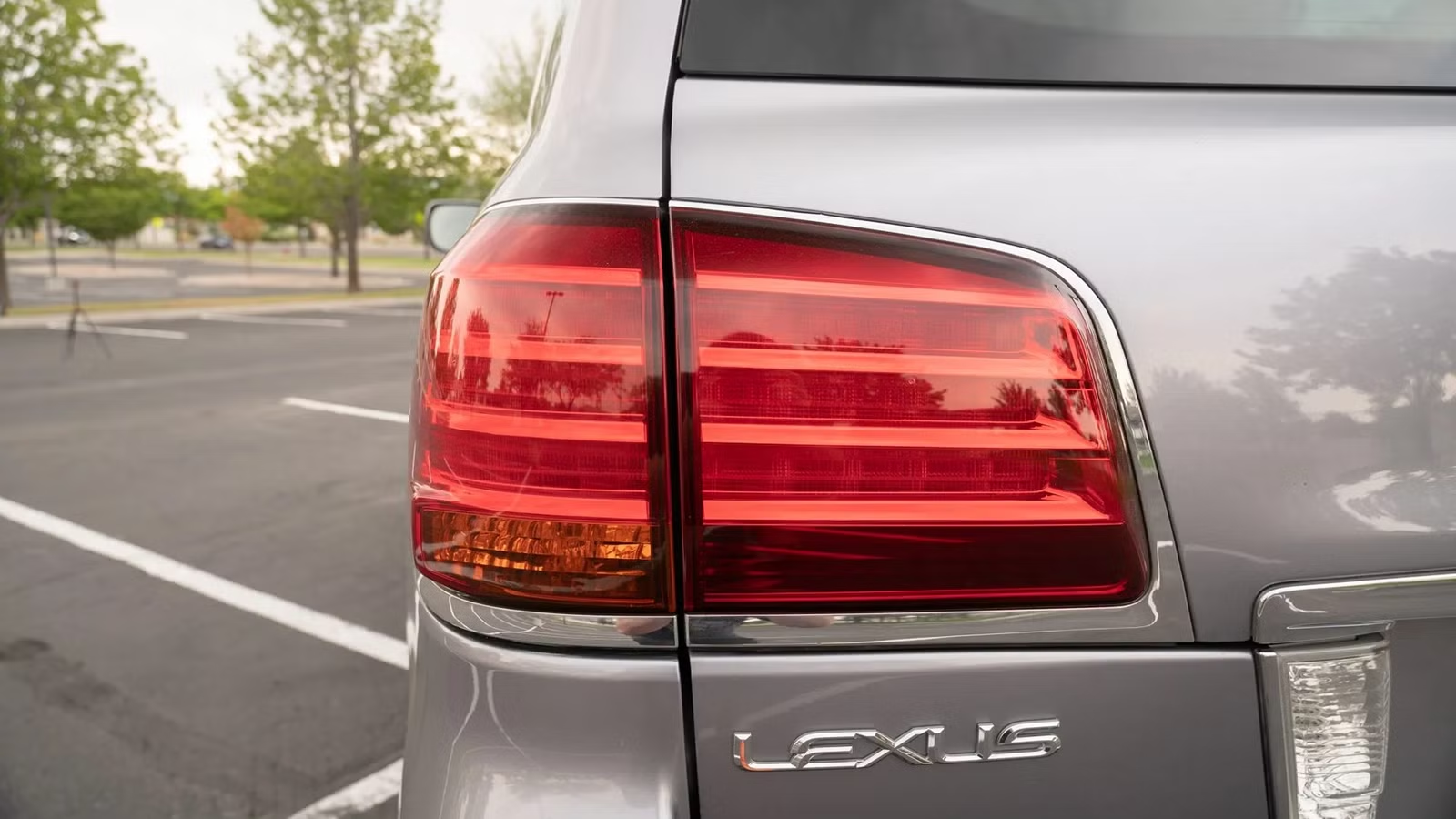
The SUV in question was the third-generation Lexus LX 570 (URJ200), produced from 2008 to 2021; to the average observer, it appears to be just another big, flashy, chromed-out SUV meant for wealthy suburban families to visit the mall on weekends. That was just at the surface. Underneath the semi-aniline leather seats, the 19-speaker Mark Levinson sound system, and a large infotainment screen was the secret. The indestructible bones of the 200-Series Toyota Land Cruiser.
Built at Toyota’s Yoshiwara plant in Japan, the LX 570 represents the ultimate “Land Cruiser in a tuxedo.” It is a heavy-duty, body-on-frame beast masquerading as a country club cruiser. While its contemporaries rely on fragile unibody platforms, the LX 570 has the indestructible strength of a body-on-frame chassis.
What truly sets this machine apart is how it blends commercial durability with absolute opulence. The car is something of an acoustic vault, insulated by thick glass that isolates passengers from road and wind noise and engine vibrations, leaving the interior as quiet as possible even at highway speeds. Lexus utilized Shimamoku wood, an intricate, multi-layer wood-carving process that requires Takumi craftsmen to complete 67 separate steps over 38 days to manufacture. The result? A smooth tactile feel where every switch, button, and leather stitch feels bespoke yet robust.
Why Lexus’s 5.7 Naturally Aspirated V8 Outlasts The Competition

|
Displacement |
Horsepower |
Torque |
|
5.7 Liters |
383 HP |
403 LB-FT |
At the heart of the matter is the mechanical masterpiece responsible for the legendary invincibility: the 3UR-FE engine, a naturally aspirated, all-aluminum 5.7-liter V8 producing a healthy 383 horsepower and a strong 403 lb-ft of torque. In the era dominated by high-strung V6 turbos, the 3UR was a masterclass of low-stress engineering. It used a massive, heavy-duty dual-timing chain system rather than a rubber belt, which ensured the valvetrain worked effortlessly without skipping a beat over years of use.
Because of the massive displacement, the engine made its power effortlessly, without the thermal stress associated with turbochargers. Furthermore, it featured a massive 7.9-quart oil sump and an oversized cooling system designed to maintain stable operating conditions under extreme loads. By using a traditional port-injection system, the intake valve remained free of the carbon buildup that plagued direct-injected rivals.
Instead of using complex and fragile air suspension, the Lexus LX 570 used a closed Hydraulic Active Height Control (AHC) system. The system pumped specialized fluid through heavy-duty steel lines to nitrogen-filled gas cylinders. As hydraulic fluid acts as both a pressure medium and a continuous internal lubricant, the system was completely sealed from external elements, allowing it to function flawlessly at miles that would destroy traditional air-suspension bladders.
Why The LX 570 Stays In Your Garage For Life

In this era of downsizing, the traditional large-displacement naturally aspirated V8 engine has been systematically phased out by automakers. When Lexus redesigned and updated its flagship, replacing the LX 570 with the new LX 600, it retired the proven engine and replaced the 5.7-liter V8 with a twin-turbocharged V6. While on paper a modern twin-turbo V6 delivers excellent power and fuel economy figures, achieving this required high-pressure direct injection systems, dual intercoolers, and much more, which will inevitably hamper long-term reliability.
This exact shift is why the third-generation Lexus LX 570 has transitioned from a depreciating luxury vehicle to a permanent spot in the enthusiast’s garage. It stood for an era that delivered the absolute pinnacle of massive engineering tolerances and mechanical over-building. An SUV that rewarded enthusiasts who prioritized true mechanical capability and honesty over gimmicks and luxury trends.
True luxury isn’t defined by the size of a car’s touchscreen, which becomes glitchy and obsolete within five years. True luxury is defined by absolute mechanical and component durability over the years. The Lexus LX 570 is not just an old truck with a third row slapped onto it. It is a luxury machine built at the absolute peak of reliable engineering. A luxury SUV that will outlast every modern SUV and keep you in comfort even well after 300,000 miles.
Source: Lexus, Bring a Trailer.

Related posts



Latest Post


No Comments