
The Motorcycle That Quietly Ended British Dominance
There was a time when British motorcycles used to be your go-to option if you sought a performance-focused ride, even if it meant making some sacrifices in terms of reliability. Companies like BSA and Norton were riding the wave of success in the fifties and sixties, when it seemed like the good times would last forever. But, of course, that’s not how things played out, and storm clouds had long been gathering on the horizon for the British motorcycling industry as a whole. Then it all came crashing down quicker than anyone could comprehend, with brands that were once industry leaders finding themselves face to face with bankruptcy.

Where The Cracks Really Started To Form

It wouldn’t be accurate to think of this downfall as something strictly caused by external factors, because Britain’s motorcycling giants revealed many internal ailments when you looked closer. Sure, popular models such as the Triumph Bonneville or Norton Commando might’ve been fast, but owners had to contend with leaky engines, excessive vibration, and those dreaded Lucas electronics on a regular basis. Management complacency led to outdated manufacturing techniques and a lack of innovation, which made companies vulnerable to the changing times. But the final nail in the coffin came from abroad, and the already-weakened British industry was simply unable to withstand the pressure. That collapse became imminent by the early seventies.
Japanese Manufacturers Were Slowly Gaining Ground In The 1960s

While Britain’s top dogs were resting on their proverbial laurels, though, companies like Honda were surgically working toward something revolutionary. Yet the Japanese weren’t known for making big bikes that could hang with those from England back then, and Honda’s flagship performance model was its comparably smaller CB450 Black Bomber from 1965. Said machine was by no means bad, mind you, but something bigger was needed to really captivate Western buyers with a thirst for going fast. And as the sixties drew to a close, a new era in motorcycling was about to be spearheaded by Honda, with Kawasaki, Yamaha and Suzuki following close behind. Let’s zoom in on the model that kicked everything off in 1969.
Honda Changed The Game Forever With The CB750

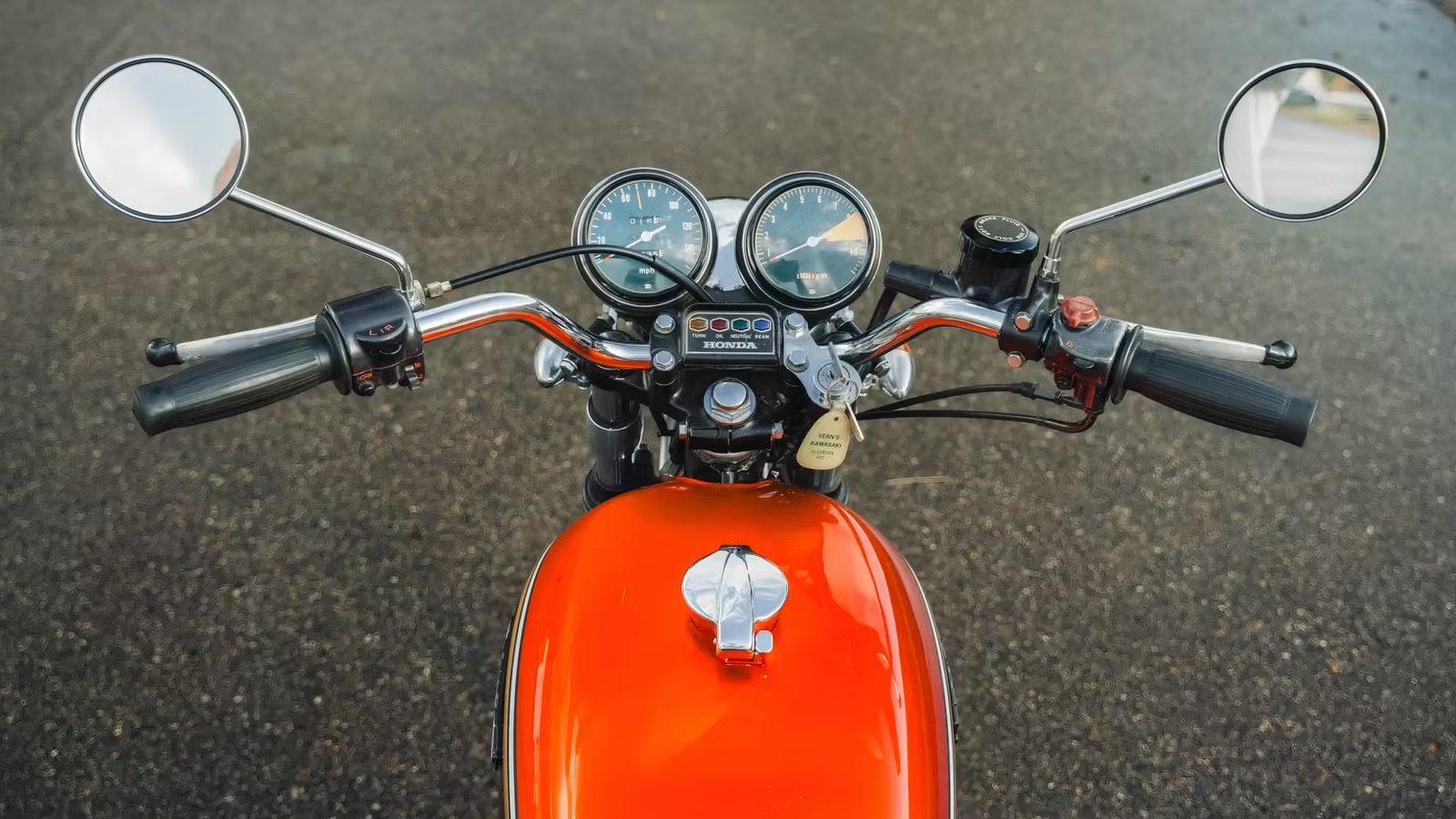
When the CB750 landed at the tail end of the sixties, nothing like it had been seen on public roads before. Development was led by Yoshiro Harada, and big boss Soichiro Honda had some very ambitious plans for the company’s new flagship. Harada-san faced the monumental task of translating that vision into reality, starting with the democratization of the inline-four engine layout. Said configuration was a rarity on road-going motorcycles at the time, demanding a pretty hefty premium for the privilege. The CB750 sought to make it accessible to the masses, though, and this became its first major selling point over Britain’s twins. Honda made use of a transverse 736cc four-banger, pairing it with a five-speed transmission.
The SOHC mill came with 67 hp and 44 lb-ft of torque at its disposal, all while feeling incredibly smooth compared to the parallel twins used by British marques. Not only that, but it was also far more reliable and equipped with an electric starter to make riders’ lives a lot easier. Top speed was rated at 124 mph, making the CB750 the fastest production motorcycle out there at the time of its release. It could finish the quarter-mile run in just under 13 seconds, and Honda also sought to innovate in the chassis department. So whereas every production bike before the CB750 came with traditional drum brakes front and rear, Honda’s four-cylinder beast was the first to use a disc mechanism up front. Albeit simple compared to what became available later on, the setup did offer a nice bit of extra stopping power over a drum.
Technical Specifications
|
Engine |
Air-Cooled Transverse Inline-Four |
|
Displacement |
736cc |
|
Transmission |
5-Speed |
|
Horsepower |
67 HP |
|
Torque |
44 LB-FT |
|
Top Speed |
124 MPH |
|
Suspension |
Front: Telescopic Forks Rear: Twin Shock Absorbers |
|
Brakes |
Front: Single Disc Rear: Drum |
And it certainly came in handy given the engine’s capabilities, while also paving the way for the technology to become an industry standard not long after. The build quality was superior to that of British motorcycles pretty much across the board, so things like oil leaks and electrical failures were mostly in the past. Given all the great innovations it brought to the table, the CB750 went on to be known as the world’s first superbike, as well as the one that marked the beginning of the Universal Japanese Motorcycle (UJM) craze from the seventies. But it was only the model that opened the floodgates, followed by so many other great UJMs that raised the bar even further. This proved catastrophic for British companies, whose best offerings suddenly felt ancient compared to what was coming out of Japan.
The End Came Swiftly For Britain’s Motorcycle Makers

Things were looking pretty grim by the seventies, and even direct government intervention wasn’t enough to save Norton or BSA (which also owned Triumph at the time). The companies were merged under Norton Villiers Triumph (NVT) in 1973 but to no avail, as it was too little too late to undo all those previous years of stagnation. NVT met its end in 1978, with Japanese brands firmly established as reputable names in the performance segment by then. So the impact generated by the first-gen Honda CB750 can hardly be overstated, having shaken an entire industry to its core and laid out the superbike blueprint for everyone else to adopt further down the road.
A Legacy That Still Shines Brightly Today

Even though Honda produced a large number of CB750s during the model’s first generation, clean examples will still command a pretty penny when heading to the auction block. This is thanks in no small part to its historical significance and far-reaching influence, as well as the fact that it’s getting harder and harder to find a pristine stock specimen as time goes by. A lot of them became donors for custom cafe racer projects back when prices were lower, but that trend has died down considerably in recent years. In general, one can expect a tidy first-gen CB750 to sell for about 15 grand, though prices tend to vary quite a lot based on things like mileage, ownership history, and the availability of service records.
At the upper end of the spectrum, you’ve got the early production variants with sand-cast engine cases, simply referred to as Sandcast models. They can easily rake in more than $30,000 when offered in good condition, but one particular example previously owned by Steve McQueen’s movie studio Solar Productions fetched an eye-watering $155,000 in 2022. So, in short, you probably shouldn’t expect to find a clean CB750 for cheap in most cases, though there have been occasions when some decent-looking bikes changed hands at what seemed like quite a bargain for the buyer. Just don’t assume that’s going to be the norm.
Sources: Honda, Motorcyclist, Cycle World, Carole Nash, RevZilla, Hemmings, Bring a Trailer

Related posts
Latest Post


No Comments