
The Legendary Oldsmobile That Out-Muscled GM’s Favorites
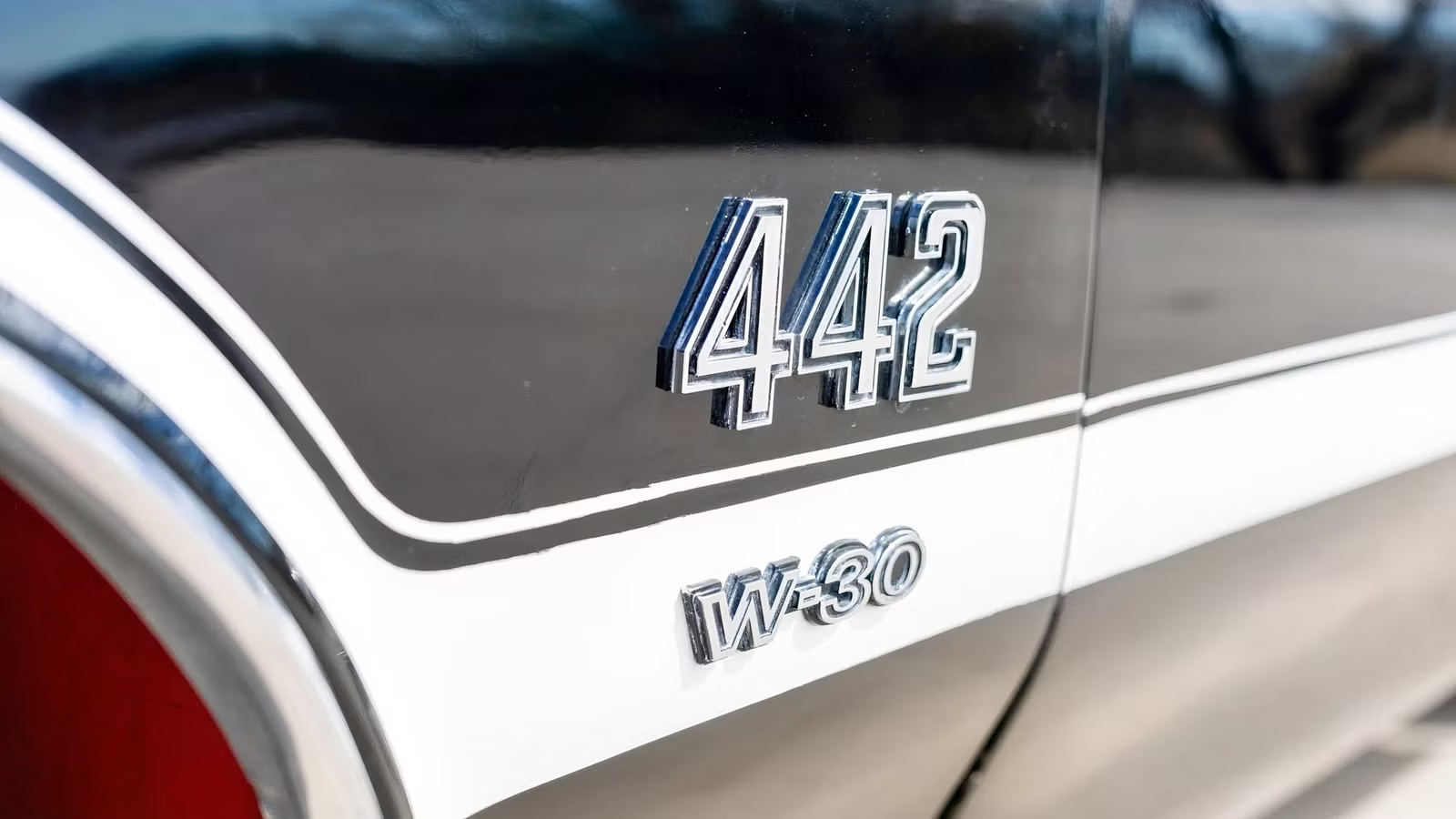
When it comes to General Motors’ greatest muscle cars, the conversation usually turns to things like the Chevrolet Chevelle SS 454, or the Camaro ZL1, or the Pontiac GTO. And while these are all legendary muscle cars in their own right, there’s another car that is often unfairly overlooked. Released in 1970, it had the power and ability to outpace even more celebrated rivals, with a big-block V8 under its fiberglass hood that would help it become one of the most formidable muscle cars of its time.
The Muscle Car Horsepower War Wasn’t Just About The Biggest Number

Horsepower has always been an easy number to point to in marketing. In very broad strokes, it’s a way for companies to succinctly plant the idea that its car is faster because its number is higher than a competitor’s. By the late 1960s, horsepower figures became the basis of an all-out arms race between companies vying to put the biggest number into their brochures. But while it’s a quick and easy fact to put in an ad, it doesn’t tell consumers the full story, particularly in the muscle car market.
For a start, there’s torque. Explosive launches are a key trait of the muscle car genre, and while horsepower might hint at a car’s power, torque is what gets it off the line. In a world of big-block V8 engines and quarter-mile drags, torque is what ultimately defines how fast these cars feel off the line. Of course, other things come into play here, like grip, weight, gearing, and a multitude of other factors, but those are harder to convey in an ad. And as the ‘60s drew to a close, this was one area where GM’s internal policies were beginning to hold it back.
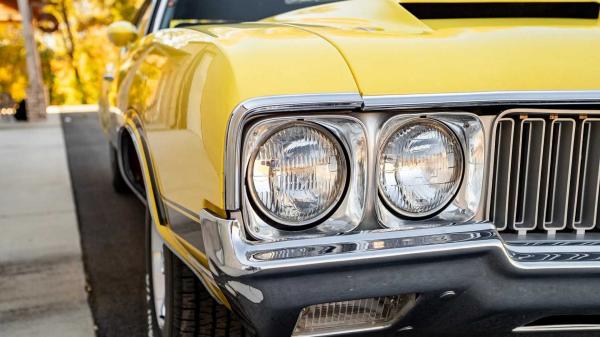

The Oldsmobile Muscle Car Smart Collectors Snap Up Quietly
Pounce on this rare Oldsmobile muscle car before word gets out and its value finally explodes.
A Rule Change Quietly Reshaped GM’s Performance Hierarchy

General Motors had a self-imposed policy between 1964 and 1969 that prohibited intermediate-size cars from using engines larger than 400 cubic inches, to prevent its cars from competing with the flagship C2 Corvette. This limited GM’s intermediate cars to engines of 400 cubic inches or less. Each division developed its own V8s to fit within the rule, leaving cars like the Oldsmobile 442, Pontiac GTO, and Buick GS 400 unable to match larger-displacement engines increasingly offered by competitors. But as the 1970s drew closer, GM knew it needed to change.
Chrysler introduced its now-legendary 426 Hemi engine to its street cars for the 1966 model year, making it available in cars like the Dodge Coronet and Plymouth Belvedere, while Ford introduced the Mustang Mach 1, which packed the 428 Cobra Jet engine, in 1969. It made little sense to continue to curtail cars within the company given that neither the Mach 1 nor the Coronet were really competitors to the Corvette, so GM quietly lifted the restriction and set about upgrading some existing models, one of which would become one of the defining muscle cars of its era.
The 1970 Oldsmobile 442 W-30 Was GM’s Most Complete Big-Block Muscle Car

|
Engine |
Power |
Torque |
Top Speed |
0-60 MPH |
1/4 Mile |
|
7.5-Liter 455-cubic-inch Rocket V8 |
370 HP |
500 LB-FT |
~135 MPH |
~5.5 Seconds |
13.7 Seconds |
The Oldsmobile 442 was first introduced in 1964 as an answer to the emerging muscle car market. Initially an optional performance and handling add-on package for the Oldsmobile F-85 and Cutlass, the 442 name came not from its power (that was 310 gross hp), nor its displacement (it had a 330 cubic-inch, 5.4-liter V8), but from its 4-barrel carburetor, 4-speed manual transmission, and dual (2) exhausts.
It wasn’t an immediate hit. Just 2,999 models were sold in its debut year, though 1965 saw the addition of a 400 cubic-inch V8 that made 345 hp, and sales picked up to nearly 22,000. It wasn’t until 1968 that the car became a fully-fledged standalone model, though GM’s internal politics meant it didn’t receive a more powerful engine until 1970, with the release of the W-30.
The W-30 was the most powerful 442 of the time thanks to its 455 cubic inch Rocket V8 engine. Producing a factory-rated 370 hp and 500 lb-ft of torque, it comprehensively outpaced the previous iterations. And while the much bigger engine was certainly one part of the W-30’s upgrades, it was far from the only one. To start, the engine’s intake manifold was made from aluminum rather than cast iron. This reduced the weight, lowered the center of gravity, and improved the airflow to help the engine achieve the higher power it was known for.

The modifications at the front of the car didn’t stop there. The W-30 featured a fiberglass hood (replacing the traditional steel) with functional scoops that gave the car an undeniably racier silhouette and further reduced weight. Valves were also made larger, while springs were stiffened to prevent valve float, and camshafts were specific to either manual or automatic. It all made for a much more powerful, much more exciting prospect than had ever been available, though unfortunately not one that would prove incredibly popular.
The W-30 was an optional extra on top of the base 442 which, in 1970, produced 365 hp. Adding another bill on top pushed the W-30 into even more expensive territory, limiting its appeal compared to competitors (of which there were many). At the same time, emissions regulations were tightening, and insurance costs were rising. Only around 3,100 1970 442 W-30s were made, most of which were Holiday Coupes (though there were roughly 260 Sports Coupes, and another roughly 260 Convertibles).
Why The W-30 Could Embarrass More Powerful Rivals

The W-30 earned a reputation for producing more power than it was advertised as having. Many enthusiasts and owners believed that its stated 370 HP was on the more conservative side, and, indeed, it could more than hold its own against competitors that were less modest with their figures.
Comparing the W-30 to the LS6-powered 1970 Chevrolet Chevelle 454, for example, shows that Oldsmobile may have come in low. The Chevelle, which made a reported 450 hp, set a 1/4 mile time of 13.81 seconds per Car and Driver, while the supposedly 370 hp W-30 set a 14.2-second time per Motor Trend (though the magazine noted that Oldsmobile engineers had recorded a 13.7-second time earlier).
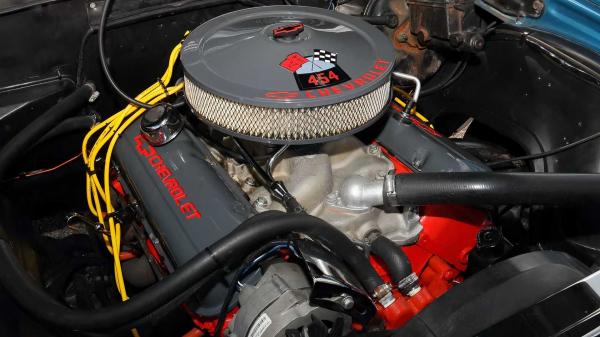
How The Chevy 454 V8 Compares To Pontiac’s 455 V8
Here’s how the two biggest-displacement V8 engines from Pontiac and Chevrolet ever stack up.
The W-30 Became One Of Oldsmobile’s Greatest Engineering Achievements

The W-30 wasn’t just the base car with a bigger engine; it was a carefully designed performance model with real engineering behind it. The scoops on the hood weren’t just for show, they helped provide a ram-air effect to cool the engine. The big-block engine’s parts were fettled to create a massive, usable torque range. It was an entirely considered car that didn’t simply take the lifting of the 400 cubic-inch rule as an opportunity to throw in a big engine and call it a day, but instead applied a measured, specific approach and created one of the most outstanding machines in its entire catalog.
Today, the W-30 version of the 442 is a highly coveted, incredibly rare car. The 1970 version of the car sells for a median price of $85,800, though one did sell through Barrett-Jackson for $189,200 in April 2026. It’s unsurprising, given how rare the car is and what it represents: the peak of Oldsmobile’s muscle car performance.
Sources: Barrett-Jackson, Hemmings,

Related posts




Latest Post


No Comments