
2027 Suzuki SV-7GX Review: The SV650, Gone Sport-Touring
Few motorcycles have lived as many lives as the Suzuki SV650. It debuted as a stark naked, smartly priced, balanced middleweight with a steel-trellis frame and torquey V-twin thump that you felt in your chest. It has donned full- and half-fairings with the SV650SF and SV650S, respectively. While never launched as an official factory race replica, track-prepped SV650s were the undeniable twins class kings on grids throughout the early and mid-2000s. Suzuki even mated its legendary V-twin to the comparatively long-travel-suspended V-Strom 650 range, sending its heart on off-road adventures.

It has seen and done it all. Now, more than 25 years after the SV helped launch countless riding careers and with more than 500,000 645cc V-twin engines brought into the world, the SV is taking on a new sport-touring role in the 2027 Suzuki SV-7GX.
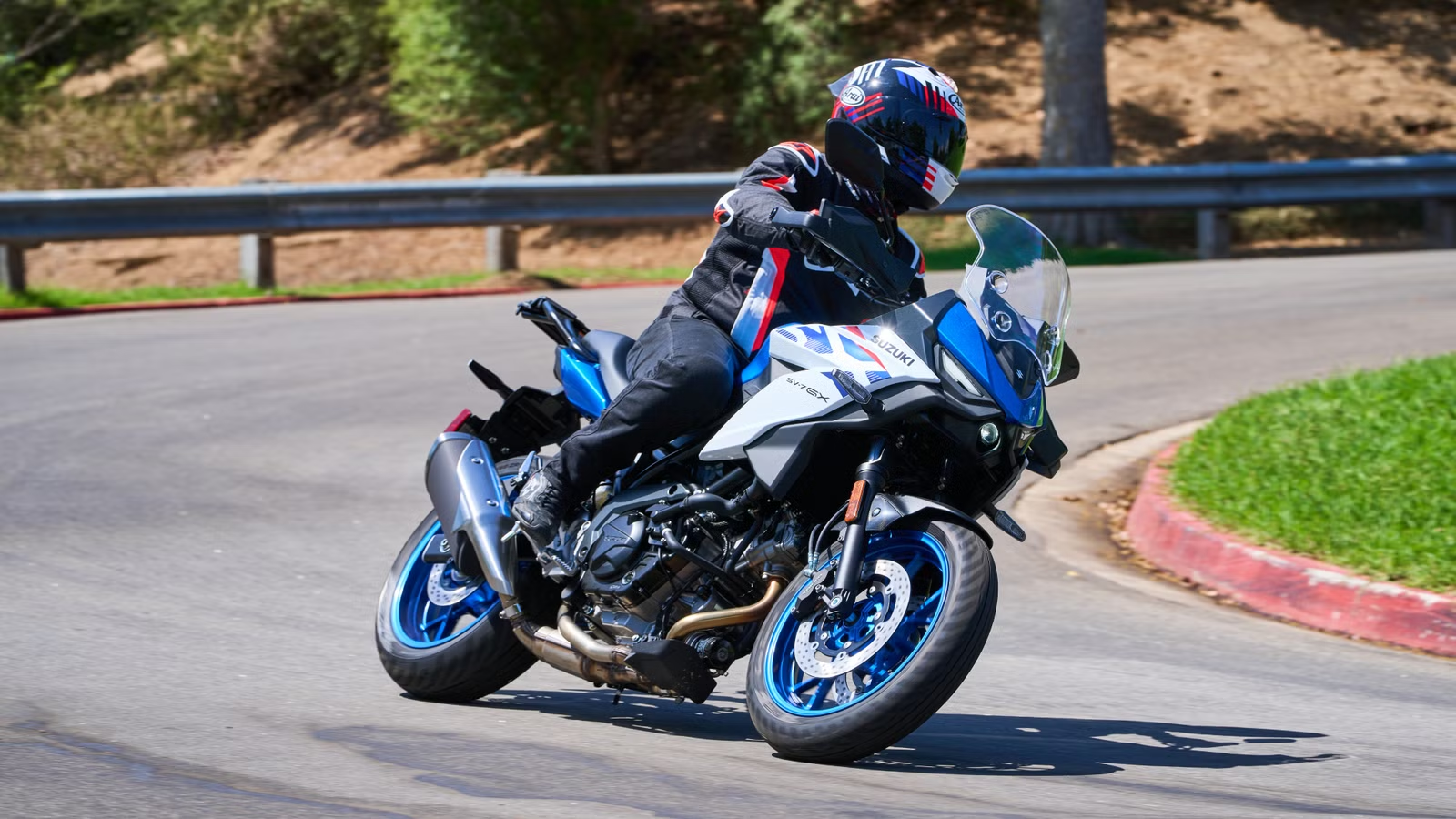
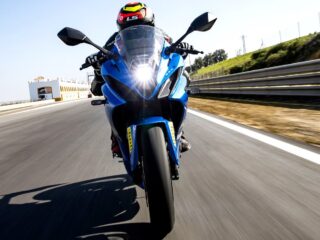
Suzuki calls it a crossover, a word that conjures images of soccer-field-destined minivans and sugary Capri Sun in this motorcycle scribe’s mind, but boiling it down to a traditional 17-inch wheeled sport-tourer suffices. In practice, the SV-7GX doesn’t stray from the design path of the SV650 too far at all. The SV-7GX builds on the same proven steel-trellis frame and beam-style swingarm, retunes the suspension settings, while adding the main ST elements: a wind-sheltering half-fairing with a multi-position windscreen and handguards. The riding position is a skosh more relaxed than the standard naked sportbike, though not as upright as the V-Strom 650.
And that’s the SV-7GX in a nutshell. Two versions reach U.S. showrooms: the SV-7GX at $8,599, available in Pearl Brilliant White/Metallic Triton Blue or Pearl Matte Greige (yes, you did read “Greige”). For those less discerning about flashy graphics, there’s the graphics-free SV-7GXV, available exclusively in Pearl Brilliant White with black wheels for $8,399, a $200 savings.


After a short excursion in San Diego with the Suzuki Motor USA staff, we headed north and sampled the Hamamatsu-based brand’s sport-tourer on some of our favorite local haunts.
The Heartiest of Middleweight Hearts: Suzuki’s 645cc V-twin Engine

Suzuki’s venerable 90-degree DOHC V-twin almost seems like a throwback in today’s marketplace. What with most manufacturers, Suzuki included, having embraced parallel-twin engines in middleweight lineups for some time. Said p-twin engines often imitate V-twin character with a 270-degree firing order, though never quite duplicate it, despite having a few clear advantages.
Those modernized inline-twin mills often rev out a little smoother, have a little more top-end, and with respect to Suzuki’s 776cc engine powering the GSX-8 range, eke out peak performance wins. There are even some packaging benefits since a parallel-twin engine doesn’t have a cylinder head jutting forward like a 90-degree V-twin, allowing engineers to shorten the length of the bike and draw the front-end closer.

Well, it sounds like we’re selling the SV’s traditional V-twin down the river, folks. Rest assured, that isn’t the case because the claimed 72.4 horsepower at 8,500 rpm and 47.2 pound-feet of torque at 6,800 rpm cited by our friends at Suzuki GB has something the “refined” competition doesn’t: bullish V-twin charm. It all starts with a torquey mule kick on the bottom end, flowing perfectly into midrange performance that makes scooting around town a breeze or connecting canyon corners with little more than a simple throttle squirt. Getting into lockstep with the lopey rhythm is part of this twin engine’s joy, and touches on its chameleon-like adaptability.
Admittedly, things do get a little buzzy up high, but it’s quite livable when cruising at the extra-legal speeds most Californians abide by. It’s a peach of a powerplant, and the refreshingly lumpy, stick-to-your-ribs hit it delivers resonates as well as the burly exhaust note. There’s a tangible difference at play, which might explain why Suzuki is still churning SV-based bikes out today.

When we say the SV has seen and done it all, we mean it quite literally, because the 645cc mill is one of the few engines that has lived through all forms of fueling. We met it wearing primitive carburetors, it adopted electronic fuel injection (EFI), gained dual spark plugs for efficiency, and evolved yet again, now sporting a wholly modern ride-by-wire throttle manipulating the self-synchronizing 39mm throttle bodies. The engine gulps in oxygen via a new and more direct downdraft air intake. From there, it spits everything out of the 2-into-1 exhaust, which uses a larger catalyzer and a heated oxygen sensor, per EPA, CARB and Euro 5+ regs.
There’s also an upgraded 400-watt charging system, needed to power the SV-7GX’s newfangled electric gizmos, including a 4.2-inch full-color TFT display, and still has enough juice for accessories. That dash pairs with Suzuki’s Ride Connect+ smartphone app, piping turn-by-turn navigation, incoming notifications and weather alerts onto the screen.

On the electronics front, Suzuki got it right, as the default A mode is calibrated so sweetly, you’d never feel the need to explore the slightly softer B, or the C with its 60 hp cap. That said, newer riders, or anyone caught out in a downpour, will appreciate B’s gentler manners and C’s softened, confidence-building delivery. Traction control offers three levels plus off, set independently of the power mode and adjustable on the fly. Of course, Suzuki still employs the nifty one-touch Easy Start button and Low RPM Assist to help riders get off the line. The only thing missing is cruise control, which is a whiff given the ride-by-wire throttle.
The twin is mostly as we know it on the top end. However, the six-speed gearbox did receive some attention with newly machined cogs of the same ratio, mainly to accommodate a bidirectional quickshifter. Also assisting in those goals are a new gear position switch, starter clutch and clutch release mechanism. Grabbing gears on the upstroke is clean as can be, though if there are any shortcomings here, it’s with the downshift. Twins generally have comparatively high engine braking, which is nice when helping slow the bike. Yet all that back-torque can sometimes make those transitions feel clunky, especially stacked against what’s found on the brand’s inline four-cylinder motorcycles that can manage things better because we’re dealing with less inertia and more firing intervals. Put simply, twins can sometimes struggle there.
Handling and Suspension: Cutting a Rug on a Budget

Odes are penned to the SV’s engine, though the happy-go-lucky steel-trellis chassis deserves its flowers. The lower center of gravity, along with the middle-of-the-road geometry numbers and 465-pound curb weight, cut an impressive rug once you’re rolling.
Turn-in takes little effort, and the 7GX holds a steady line without drama, whether you’re filtering through gridlocked Los Angeles traffic or trailing into a mountain curve. Meanwhile, Suzuki ponied up Pirelli Angel GT II rubber that does quite well to balance performance-minded grip with sport-touring-focused mileage desires.
Where penny-pinching can be seen when compared to the class at large, though not necessarily felt, is with the nonadjustable traditional 41mm fork featuring 4.9 inches of travel. The link-type shock and its 5.1 inches of travel offers seven-step spring preload adjustment via a cam-style adjuster. Together, the budget suspenders manage all the rough stuff, taking hits on the chin in stride, while keeping the SV-7GX pointed in the right direction, thanks to their model-specific tuning. If there are gripes, it’s that aggressive moves can expose some dive with the old-school damping-rod-equipped fork, and the shock isn’t a fan of Southern California’s famed washboard-cement freeways.
Still, the Suzuki rewards riders who don’t bully it into submission. When you flow, the SV follows, quite handily through a choice piece of twisty tarmac confidently.

The axial-mount, four-piston Tokico calipers and 290mm floating rotors up front are as we remember them: basic as can be. No radial mounts, no cornering ABS, no Brembo logos, and you won’t miss them much. They work, ’nuff said. Bite is gentle and progressive, though the standard ABS can be a bit overzealous. The single-piston Nissin caliper and 240mm rear disc do come in handy when doing low-speed maneuvers.
Upright Ergonomics: Svelte, Not Cramped or Compact

The defining feature of the SV-7GX is its sport-touring functionality. Compared to the SV650, it shakes out like this: the handlebar sits over a half-inch higher, nearly a full inch closer, and the footpegs are nudged nearly a half inch downward. The SV-7GX may have the appearance of a “tall-rounder,” though the accessible 31.3-inch saddle goes against that grain, along with a typical Japanese “in the bike” sensation once behind its comfy bars.
Suzuki graced the seat with an additional ration of foam to improve comfort, which certainly helps. After a few hours in the saddle, one might start to feel some soreness creeping in, and scooting back into the wider zone will offer a touch of backside relief. Should you have the inseam length to spare, the Comfort High Seat doesn’t seem like an unwise addition.

Meanwhile, the windscreen offers a decent bubble of protection and can be mounted in three positions, spanning a rough 2-inch range, and the handguards aid while at pace, too. Convenience does come at a cost, and as much as we’d like a one-touch adjustment solution, it would hit the bottom line. Suzuki supplies a toolkit (awesome) without the right hex key for the job (less awesome). That said, fellow crossover the GSX-S1000GX+ has a multi-position bolt-on windscreen, which is a bit cheeky at $18,949.
A practical thread continues with a standard rear carrier, ready to accept the brand’s 45- or 27-liter top cases. We’ve also got a 15-watt USB-C charging port and LED lighting said to be designed to mimic cornering headlights. Perhaps the most compelling pragmatic line is the larger 4.6-gallon fuel tank with a claimed 56 mpg on tap; you can rack up well over 200 miles with a conservative wrist.
SV-7GX Verdict: Call It What You Want, We’ll Call It Solid

The SV-7GX isn’t the most powerful or high-tech middleweight sport-tourer, and Suzuki never intended it to be at $8,599. What it does do is answer questions from a variety of different riders by delivering a characterful V-twin, friendly handling, and useful touring features while undercutting its rivals.
Kawasaki’s longstanding Versys 650 LT runs $10,399, though that includes locking hard bags. Triumph’s Tiger Sport 660 costs nearly $2,000 more than the SV and justifies its price tag with more advanced features, chief among them: cruise control. Yamaha’s Tracer 7, a natural foe overseas, has yet to make its way stateside, and we have to wonder if it ever will. Honda’s NC750X DCT also costs about a grand more and is the only machine in the class with an automated-manual Dual-Clutch Transmission (DCT). Big Red’s contender is undeniably utilitarian thanks to DCT and its 23-liter frunk, though it champions practicality to a beige-tinted fault.

The catch-all nature of an all-rounder means the SV-7GX speaks to those stepping up through the displacement ranks, commuters wanting an affable daily rider, or veterans who value balance over bragging rights. The SV650 earned its legend by being more than the sum of its parts, some of which look old enough to vote or gamble from the class’s perspective. Suzuki’s SV-7GX honors that tradition in true SV fashion: a few subtle tweaks, and the platform goes somewhere entirely new.
Gear Check:

Helmet: Arai Corsair-X
Gloves: Alpinestars SP X 7
Jacket: Alpinestars T-GP Air
Pants: Alpinestars Cooper V3
Boots: Alpinestars Superfaster
2027 Suzuki SV-7GX Review Photo Gallery:
2027 Suzuki SV-7GX Specifications:
Engine:
|
Type |
Liquid-cooled four-stroke 90-degree V-twin, DOHC |
|
Displacement |
645cc |
|
Bore x stroke |
81.0mm x 62.6mm |
|
Maximum horsepower |
72.4 horsepower (54 kW; 73 PS) @ 8,500 rpm, claimed (UK/Europe) |
|
Maximum torque |
47.2 lb-ft (64 Nm) @ 6,800 rpm, claimed (UK/Europe) |
|
Compression ratio |
11.2:1 |
|
Valvetrain |
DOHC; 4 valves per cylinder |
|
Fueling |
Ride-by-wire electronic fuel injection w/ new dual 39mm self-synchronizing electronic throttle bodies fed by a downdraft intake; dual iridium spark plugs per cylinder; 87 AKI regular unleaded (91 RON or higher) |
|
Exhaust |
2-into-1; larger-capacity catalyzer in the collector pipe ahead of the silencer, w/ heated oxygen sensor |
|
Cooling |
Liquid |
|
Transmission |
6-speed close-ratio w/ bi-directional Quick Shift System; gears 2 through 6 newly machined for 2027. Ratios: 2.461, 1.777, 1.380, 1.125, 0.961, 0.851 |
|
Clutch |
Plate type, assist or slipper function and actuation Not Provided By Manufacturer; clutch release mechanism updated for 2027 |
|
Final drive |
Chain. |
Chassis:
|
Frame |
Tubular steel trellis, perimeter-style; beam-style swingarm |
|
Front suspension; travel |
Conventional 41mm hydraulic telescopic fork, coil spring, oil damped; 4.9 inches (125mm). |
|
Rear suspension; travel |
Link-type monoshock, coil spring, oil damped, 7-step cam-style spring-preload adjuster; 5.1 inches (129mm) wheel travel. |
|
Wheels |
Cast aluminum, 10-spoke; blue or red painted (SV-7GX), black painted (SV-7GXV) |
|
Front wheel |
17-inch diameter |
|
Rear wheel |
17-inch diameter |
|
Tires |
Pirelli Angel GT II (Angel GT II A front), radial sport-touring |
|
Front tire |
120/70ZR17M/C (58W); 33 psi recommended |
|
Rear tire |
160/60ZR17M/C (69W); 36 psi recommended |
|
Front brake |
Dual 290mm floating discs w/ Tokico 4-piston calipers |
|
Rear brake |
240mm disc w/ Nissin 1-piston caliper |
|
ABS |
Standard, front and rear. |
|
Electronic rider aids |
Suzuki Intelligent Ride System (S.I.R.S.): Suzuki Drive Mode Selector w/ A (Active), B (Basic) and C (Comfort) modes, C limiting output to approx. 60 horsepower (45 kW); Suzuki Traction Control System, 3 modes plus off; Bi-directional Quick Shift System (on/off; upshifts above 2,000 rpm, downshifts above 1,700 rpm); ride-by-wire electronic throttle; Suzuki Easy Start System; Low RPM Assist System. TPMS Not Provided By Manufacturer |
Dimensions & Capacities:
|
Wheelbase |
56.9 inches |
|
Rake |
25.0 degrees |
|
Trail |
4.2 inches (106mm) |
|
Seat height |
31.3 inches (795mm). |
|
Fuel capacity |
4.6 gallons (17.4 liters) |
|
Estimated fuel consumption |
56.0 mpg (23.8 km/L), claimed |
|
Curb weight |
465 pounds (211 kg) |
Pricing & Warranty:
|
Website |
suzukicycles.com |
|
Price |
$8,599 Base MSRP (SV-7GX); $8,399 Base MSRP (SV-7GXV). |
|
Warranty |
Not Provided By Manufacturer |
|
Service interval |
Oil: 4,000 miles; valve service: 15,000 miles |
|
Color |
Pearl Brilliant White/Metallic Triton Blue (BQJ), Pearl Matte Greige (Q2A) (SV-7GX); Pearl Brilliant White (YUH) (SV-7GXV) |

Related posts


Latest Post


No Comments